
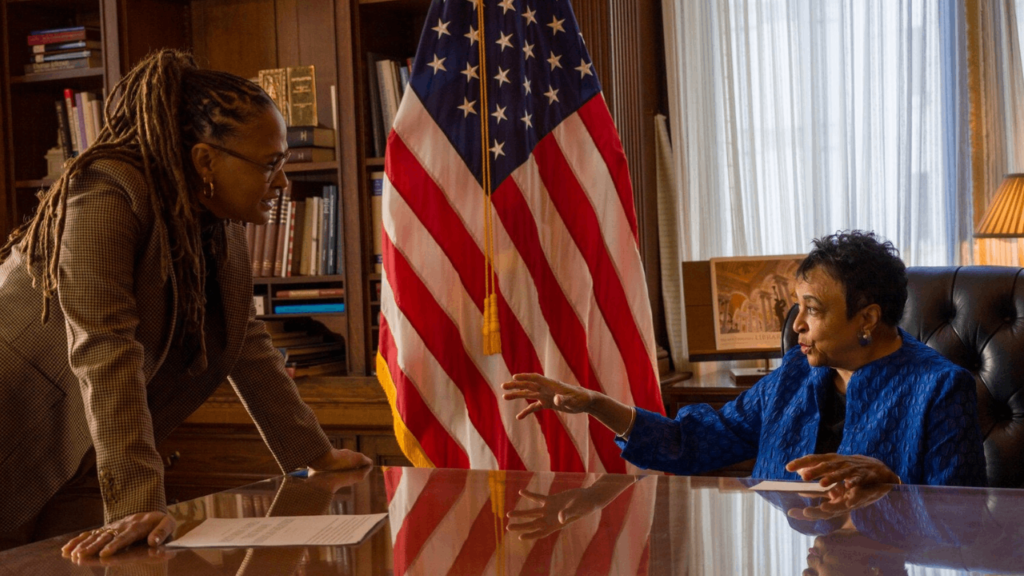
14th, Ava DuVernay’s new Netflix documentary, premiered on October 9 as the closing-night film of the 64th New York Film Festival. It follows her Oscar-nominated documentary 13th, released a decade ago. Netflix will give the film a brief theatrical run beginning November 27 before making it available to stream on December 4. Early reviews are largely positive, with critics describing the documentary as urgent, accessible and timely. IndieWire offers the most notable dissenting assessment, arguing that the film tries to cover too much.
The documentary turns its attention to the 14th Amendment to the US Constitution, ratified in 1868. It examines birthright citizenship, due process, equal protection and the amendment’s insurrection clause, exploring the protections these provisions were intended to provide and how they have been challenged over time.
As Deadline describes it, DuVernay frames the 13th, 14th and 15th Amendments as a constitutional reset following the Civil War before tracing how their protections have been eroded. The film opens with a sequence of presidents taking the oath to preserve, protect and defend the Constitution. It also features contributions from Stacey Abrams, Eric Foner, Sherrilyn Ifill, Jeff Flake, Steve Schmidt, Hasan Piker, Alexandria Ocasio-Cortez, Jelani Cobb, Lonnie Bunch and David Blight.
Variety called 14th a powerful sequel that carries the same historical and topical force as 13th. The review praised DuVernay’s ability to make the nuances of history come alive, noting that the documentary is “not a dry lecture.” It also highlighted her examination of the Confederate flag as a cultural symbol, tracing its presence from rock stars such as Tom Petty and ZZ Top to its appearance on the roof of the General Lee in The Dukes of Hazzard. These examples help illustrate the fragility of the constitutional promises at the centre of the film.
The Hollywood Reporter described the documentary as an essential and compelling deep dive. Its review called the film “never visually dull” and jokingly suggested that DuVernay should continue working through the constitutional amendments one by one, even reaching the amendment concerning congressional pay raises.
Screen Daily called 14th a damning exploration of the contemporary attack on the rights of Black Americans and described it as “an urgent rallying cry.” The review praised Ifill as the heart of the film’s argument and noted that DuVernay keeps the material from becoming too sombre. It also highlighted the documentary’s conclusion, which ends with two calls to action.
Deadline, meanwhile, described the film as an impassioned defence of the Constitution. The publication noted that the documentary takes aim at Donald Trump and what it characterises as an attempted rescission of rights, placing the film’s constitutional concerns within the current political climate.
Two other reviews published around the New York Film Festival were similarly enthusiastic. The Playlist called 14th “the best possible civics lesson.” Although it described the documentary as unabashedly polemical, the review argued that its anger is earned through the accumulation of historical evidence. It praised DuVernay’s examination of the amendment’s erosion through Jim Crow, voter suppression, Confederate memorials and Charlottesville.
Awards Radar also described the documentary as an urgent message and warning. Its review praised DuVernay’s narrative skills for keeping the film moving and suggested that its eventual availability on Netflix could help it reach audiences across the political spectrum.
IndieWire’s Beandrea July offered the most mixed assessment. July described 14th as an ambitious follow-up to 13th but argued that “its urgency sometimes overwhelms its argument.” The review singled out an animated five-pointed star that loses one point as each section of the amendment is eroded, describing the device as effective. July also acknowledged that the documentary performs a genuine public service.
However, July felt DuVernay could have relied more heavily on Ifill, a Howard University law professor and former head of the NAACP Legal Defense Fund, describing her as the closest thing the film has to a narrator. Despite these reservations, the review characterised the documentary as energetic, accessible and frequently entertaining. That assessment aligns with DuVernay’s stated desire to ensure the film does not feel like medicine for its audience.
The timing is central to the discussion surrounding 14th. The documentary arrives ten years after 13th, during the second Trump administration. In an interview with Variety, DuVernay said the intervening decade had brought an increase in attacks on democracy, particularly in debates over who qualifies as an American. Variety also noted that the film arrives as the midterm elections approach.
Taken together, the reviews suggest that 14th derives much of its power from its urgency, clarity and accessible presentation of constitutional history. While most critics have praised DuVernay’s ability to connect historical developments with contemporary political debates, IndieWire’s review raises questions about whether the documentary attempts to cover too much. Whether regarded as an essential civics lesson or a somewhat overloaded companion to 13th, 14th closes the New York Film Festival with a timely examination of constitutional rights and their place in American public life.
Film Details: 14th (Documantary)
- Director: Ava DuVernay
- Featuring: Stacey Abrams, Eric Foner, Sherrilyn Ifill, Jeff Flake, Steve Schmidt, Hasan Piker, Alexandria Ocasio-Cortez, Jelani Cobb, Lonnie Bunch and David Blight
- Genre: Documentary
- Producers: Ava DuVernay, Spencer Averick, Tammy Garnes and Paul Garnes
- Editor: Spencer Averick
- Cinematographers: Michael Cambio Fernandez and Clifford Charles
- Composer: Jason Moran
- Production Company: Array Filmworks, in association with Array Alliance
- Distributor: Netflix
- Runtime: 1 hour 48 minutes
- Festival: New York Film Festival 2026 (Closing Night)
- Release Date: November 27, 2026 (theatrical); December 4, 2026 (Netflix)