
Kevin Hart has never been a performer accused of not trying hard enough. In 72 Hours, the new Netflix comedy directed by Tim Story, Hart reunites with the filmmaker for their fourth collaboration. Hart throws himself into the material with the same relentless physical commitment that has defined his entire career. The question critics are asking is whether the material deserves that effort. The answer, across most major publications, is a fairly emphatic no, though several reviewers find enough charm in Hart’s performance, and in one unexpectedly smart undercurrent running through the film, to make it watchable.
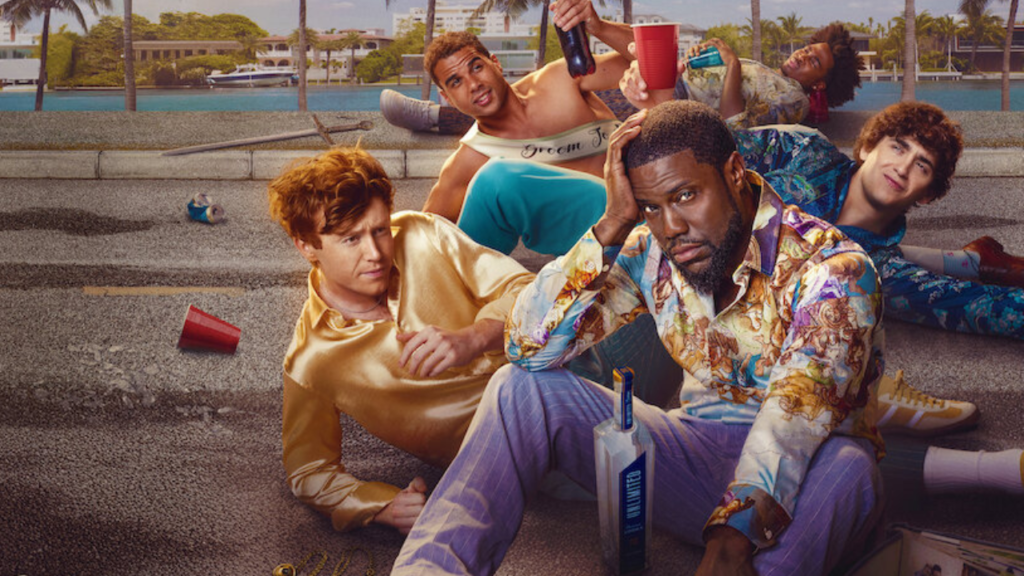
The film follows Joe Nixon, a 40-year-old marketing executive who is accidentally added to a Gen Z bachelor party group chat. Desperate to understand what young people actually want because his career depends on it, Joe joins the trip to Miami without telling the group he could be their father. What follows is a weekend of escalating chaos involving a gangster’s mansion, a cocaine dealer played by Michael Mando, mistaken identities, and a very ill-advised Al Pacino impression. The supporting cast includes Marcello Hernández, Mason Gooding, Kam Patterson and Ben Marshall, three of them recruited from Saturday Night Live, along with Teyana Taylor as Joe’s long-suffering girlfriend and Andy Garcia in a scene-stealing cameo.
Almost every review opens with some version of the same observation: the premise had real potential, and the film wastes most of it. Frank Scheck of The Hollywood Reporter sums it up cleanly, saying there is an amusing and insightful movie to be made about the culture clash between a 40-year-old Millennial and a group of Gen Z twenty-somethings, but that this is not that movie. Instead of leaning into the generational satire the setup promises, the film pivots into a wildly farcical action-comedy full of slapstick set pieces and raunchy gags that most critics found more exhausting than funny.
The New York Times describes the film as a comedy that mistakes loudness for wit, noting that the screenplay, credited to four writers including the duo behind the American Pie franchise, runs out of ideas long before its 105-minute runtime does. The A.V. Club makes a similar observation, calling the film overlong and arguing that it struggles to justify its length once the comedic ideas run dry well before the final act.
When it comes to Kevin Hart’s performance, critics are considerably more forgiving. Frank Scheck acknowledges that Hart tries hard, as he always does, and that his ability to wrest a few laughs from the material is a genuine testament to his comic chops and professionalism. Robert Daniels of RogerEbert.com, who awarded the film two-and-a-half stars, offers one of the more insightful readings of the critical conversation, arguing that 72 Hours functions as an unexpectedly meta portrait of Hart himself.
Daniels writes that Hart’s character mirrors the star’s own anxieties as a performer who has transitioned from being a bankable box office name to a streaming personality asked to recycle his familiar jokes about his height and immaturity. In that reading, 72 Hours becomes less a straightforward comedy than a surprisingly existential work about a performer wrestling with his own cultural relevance. It is the most interesting argument any critic makes about the film, and it saves Daniels’ review from becoming a simple dismissal.
The Guardian is less generous, suggesting that Hart’s comedic instincts, while reliably energetic, are trapped inside a film that has no idea what it actually wants to say about generational difference and settles instead for spectacle.
The younger cast—Marcello Hernández, Mason Gooding, Kam Patterson and Ben Marshall—receive mixed notices. Critics broadly agree that all four have proven themselves funny elsewhere, but that the material here does not give them enough to work with. Scheck notes that none of them can elevate the pedestrian material. Daniels also makes a pointed observation: the Gen Z characters occasionally make references more suited to Millennials, undercutting the film’s own premise about the generational divide between them and Hart’s character.
Two supporting performances cut through more clearly. Andy Garcia is singled out across multiple reviews as the film’s comic highlight. Scheck calls him hilarious, arguing that serious actors can sometimes be the funniest people in the room when given the right material, and Garcia proves it here. Katt Williams, who appears in a cameo, also draws specific notice from Daniels, who uses him to illustrate the film’s confused identity. Williams makes a dated Will Smith joke, leading Daniels to question which kind of comedy the film is actually trying to be.
Teyana Taylor, however, draws the sharpest criticism of all the supporting cast—not for her performance, but for what she is given to do. Scheck specifically calls out how uncomfortable it is to see Taylor, fresh off her Oscar-nominated dramatic turn in One Battle After Another, reduced to playing a disapproving girlfriend with nothing interesting to do. He describes it as less a departure than a regression, a sentiment shared by several reviewers.
The scene in which Joe accidentally ingests cocaine and transforms into a character called Riccardo Montana, complete with a thick Al Pacino Scarface impression, has emerged as the moment where most critics lost patience entirely. Scheck calls it the film’s unfunny nadir. The gag is repeated later, suggesting the filmmakers believe the bit is stronger than it actually is. Most critics disagreed.
Not every review is a complete dismissal. Daniels argues that the film’s meta-textual thread—the idea that Joe’s dated references and failed attempts at connecting with youth culture mirror Hart’s own position as a star—is genuinely clever whenever the screenplay commits to it. The problem, he argues, is that this more interesting film keeps getting buried beneath bloated action set pieces and gross-out gags that have little to do with its strongest ideas.
Gazettely and IMDb offer a more generous assessment overall, acknowledging that 72 Hours delivers consistent entertainment as a disposable streaming comedy. Several reviewers concede that, as background entertainment, the film passes the time. As a comedy with something meaningful to say, however, it falls short.
72 Hours is the kind of film that gets made when a reliable star and a familiar director prioritise velocity over vision. Tim Story and Kevin Hart have now made four films together, and each has found an audience. This one probably will too. Netflix has built an enormous platform for exactly this kind of undemanding comfort food. But critics largely agree that somewhere inside 72 Hours is a sharper, funnier and more honest film about what it feels like to age out of relevance in a culture obsessed with youth. That film keeps almost breaking through—until another slapstick set piece arrives and the moment passes.

Film Details: 72 Hours
Director: Tim Story
Writers: Jon Hurwitz, Hayden Schlossberg, Kevin Burrows, Matt Mider
Cast: Kevin Hart, Marcello Hernández, Mason Gooding, Kam Patterson
Genre: Comedy
Cinematography: Larry Blanford
Editor: Peter S. Elliot
Music: Christopher Lennertz
Release Dates: 20 July 2026 (Paris Theater); 24 July 2026 (United States)
Running Time: 105 minutes
Streaming on: Netflix
Read More Review Roundups on POF