
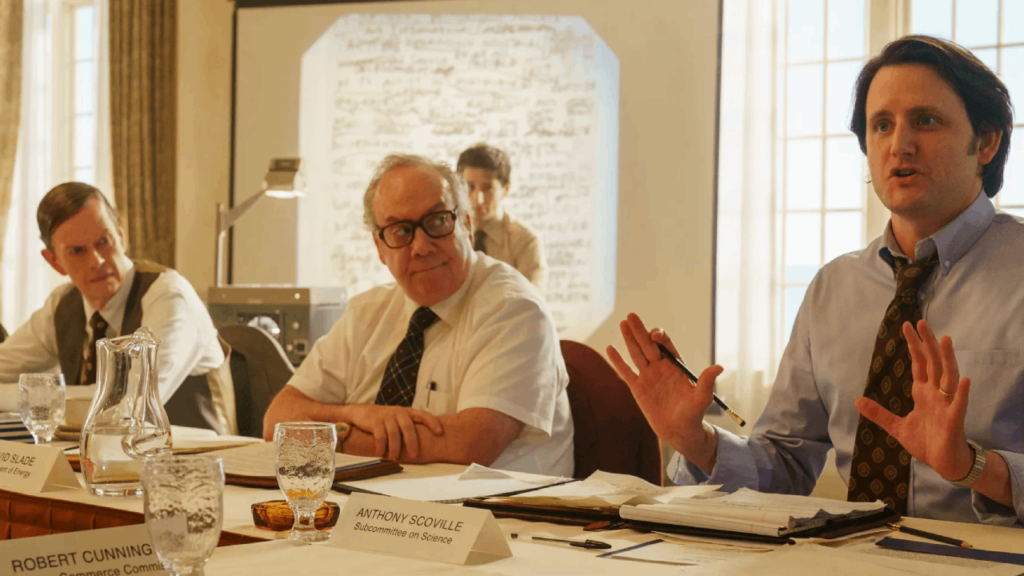
Tom McCarthy’s A Statement puts 20 experts in one Florida hotel room, gives them a rapidly escalating climate crisis to confront and asks them to agree on what should be told to Congress. The result, now making its world premiere at the 64th New York Film Festival, has left critics with plenty to discuss. Paul Rudd and Paul Giamatti anchor a large ensemble, while McCarthy turns a real 1980 conference into a film that can be funny, frustrating and unexpectedly revealing. The reviews, however, are far from unanimous.
Set in October 1980, the film revisits a gathering at the Don CeSar Hotel in St. Petersburg, Florida, where environmental activists, scientists and policymakers met to consider the dangers of rising carbon dioxide emissions. Their assignment sounded straightforward: work out recommendations for Congress and agree on a statement. In practice, reaching agreement proved considerably harder. The meeting took place just before the presidential election that would bring Ronald Reagan to the White House, adding another layer to a story about how quickly scientific warnings can become tangled in politics and institutional caution.
What makes A Statement unusual is how closely it stays to the event that inspired it. McCarthy, Thomas Bidegain and Noé Debré built the screenplay from the conference’s surviving transcripts, with much of the dialogue drawn directly from what was actually said. McCarthy also filmed at the same hotel where the real meeting took place. Rather than inventing a conventional thriller around the climate crisis, the filmmaker lets arguments, personalities and small moments of friction carry the drama.
That choice places the ensemble at the center of the film. Paul Rudd plays Tom Jorling, the moderator attempting to keep a room full of strong personalities moving toward common ground. Paul Giamatti plays Department of Energy representative David Slade, whose practical skepticism becomes one of the meeting’s recurring obstacles. Around them are John Turturro, Evan Peters, Tatiana Maslany, Amy Ryan, Jason Clarke, Zach Woods and Nina Arianda, among others, creating the kind of crowded, personality-driven cast that gives a conference table cinematic life.
The performances are one of the clearest strengths identified across the early response. The Guardian likewise praises the cast, with Paul Rudd, Paul Giamatti and Tatiana Maslany singled out as part of an excellent ensemble. Giamatti, in particular, has emerged as a standout in several reactions, finding comic edges in a character who is often pushing back against the room. His performance gives the film one of its recurring sources of tension, while Rudd’s role as moderator places him at the center of the increasingly difficult effort to find common ground.
The film’s biggest point of agreement may actually be its ambition. TheWrap calls A Statement an engaging period piece that “slyly meets our moment,” arguing that McCarthy turns bureaucratic transcripts into something surprisingly watchable. The Guardian sees a more human side to the material, emphasising the personalities, disagreements and attempts at compromise behind the historical record. The film is not interested in turning its subjects into heroes or villains; it is interested in watching intelligent people struggle to do something difficult together.
That approach also shapes the film’s tone. Because the story is built around a conference rather than a conventional dramatic crisis, the tension comes from conversation, disagreement and the gradual difficulty of reaching a conclusion. The stakes are enormous, but the setting is deliberately contained. The climate crisis exists beyond the hotel room, while the people inside it are left trying to translate scientific warnings and political concerns into language that can become a collective statement.
But that same approach is where the critical divide begins. The movie is talky and flat as well as grabby and meandering, raising questions about whether its unusually cerebral construction will find much of an audience. Another response similarly points toward a talk-heavy climate seriocomedy whose lightness may prevent it from digging as deeply into its subject as some viewers might expect.
The criticism is therefore tied closely to the film’s central creative decision. By keeping the drama inside the conference room and allowing conversations to carry much of the narrative, McCarthy creates a film that depends on audiences remaining engaged with debate, personalities and competing arguments. For some critics, that makes the material compelling because the tension emerges naturally from the difficulty of achieving consensus. For others, the same restraint makes the film feel too contained and limits its dramatic momentum.
That disagreement is ultimately what makes the roundup interesting. For some critics, the conference-room setting is the movie’s great strength. The tension comes from watching people argue over language while the scale of the crisis outside the room grows ever larger. For others, the same structure leaves the film feeling too contained. The question is not whether A Statement has something to say, but whether conversation itself can sustain a feature film.
The historical setting adds another layer to that question. The film takes place in 1980, when the participants were already confronting the implications of rising carbon dioxide emissions. Their challenge was not simply to understand the threat but to agree on how that understanding should be communicated to Congress. The difficulty of reaching that agreement becomes the dramatic engine of the film.
There is an almost haunting irony in that premise. The people in A Statement understood the climate threat in 1980, yet struggled to turn that understanding into collective action. More than four decades later, McCarthy has taken that stalled conversation and placed it back on a movie screen. Critics may disagree about how effectively the film works, but the historical contradiction at its center is difficult to ignore.
The film’s decision to draw heavily from the surviving conference transcripts reinforces that contradiction. Instead of reshaping the event into a more conventional piece of historical drama, McCarthy and his collaborators allow the original arguments and personalities to provide the foundation. The result is a film in which the details of discussion become part of the dramatic texture.
The same strategy explains why the ensemble is so important. With 20 experts gathered around the same table, the film depends on individual personalities to distinguish one argument from another. Rudd’s moderator attempts to maintain direction, Giamatti’s David Slade provides practical skepticism, and the wider ensemble contributes to the sense of a room filled with competing perspectives. The film’s drama therefore comes less from physical action than from the pressure created when those perspectives collide.
And perhaps that is where A Statement finds its strongest cinematic pull. It is a film about people sitting around a table, talking about a crisis far larger than the room — and discovering that knowing what is coming is much easier than deciding what to do about it. Critics may remain divided over whether that idea is enough to sustain the film, but the premise gives McCarthy’s latest work a clear tension between historical knowledge and collective action.
At its core, A Statement turns a conference about climate change into a study of disagreement, compromise and institutional caution. Its supporters see an intelligent and unexpectedly watchable period piece that finds human drama in bureaucratic discussion, while its detractors question whether the talk-heavy structure becomes too restrained. What remains consistent across the responses is the recognition that McCarthy has chosen an unusual way to approach a subject whose scale could easily have encouraged a more conventional dramatic treatment.
The result is a film in which the biggest conflict exists between the urgency of the problem and the difficulty of reaching agreement. The people in the room know that the crisis is growing, yet the process of deciding what to say and what action to recommend proves remarkably complicated. That tension between knowledge and action gives A Statement its central dramatic idea and explains why the film has generated such divided reactions following its New York Film Festival premiere.
Read More Review Roundups on POF
Film Details: A Statement
Director: Tom McCarthy
Writers: Tom McCarthy, Thomas Bidegain, Noé Debré
Cast: Paul Rudd, Paul Giamatti, Evan Peters, John Turturro, Tatiana Maslany, Amy Ryan, Jason Clarke, Zach Woods, Nina Arianda, Mary Catherine Garrison
Genre: Comedy, Drama
Runtime: 111 minutes
Language: English
Country: United States
Production Companies: Anonymous Content, Sony Pictures Classics
Distributor: Sony Pictures Classics
Festival: New York Film Festival 2026 — Spotlight
World Premiere: October 2026