
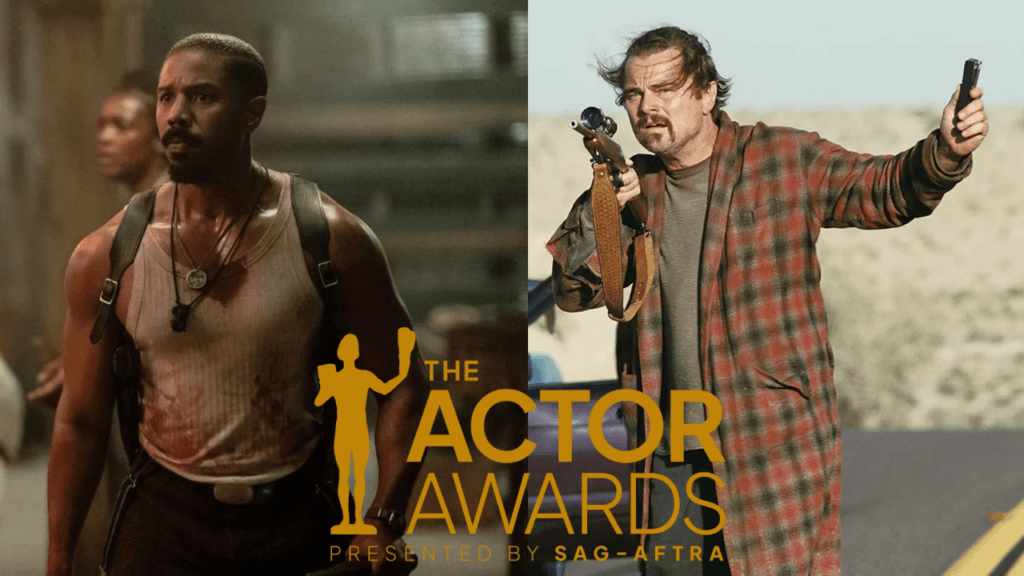
The nominations for the Actor Awards 2026 — formerly known as the SAG Awards — were announced Wednesday morning, and while the list confirmed a few dominant forces in this year’s awards season, it also delivered a series of omissions that may ultimately matter more than the inclusions. Unveiled by Abbott Elementary star Janelle James and breakout actor Connor Storrie, the nominations offered a familiar reminder of SAG-AFTRA’s strengths as an Oscar bellwether, while simultaneously exposing its long-standing limitations — particularly when it comes to international cinema and unconventional performances.
Leading the nominations was One Battle After Another, Paul Thomas Anderson’s large-scale action epic, which made history by earning a record-breaking seven nominations — the most ever for a single film at the ceremony. The Warner Bros. release scored nods for cast ensemble, stunt ensemble, and five individual acting nominations for Leonardo DiCaprio, Benicio Del Toro, Sean Penn, Teyana Taylor, and Chase Infiniti. The showing underscores how decisively the film has connected with actors, particularly in how it blends physical spectacle with performance-driven storytelling — a combination SAG voters historically reward.
Warner Bros. emerged as the dominant studio overall with 12 nominations across four titles, comfortably ahead of Focus Features, A24 and Netflix. That studio-wide performance signals more than just campaign muscle; it reflects SAG’s continued preference for theatrically scaled, ensemble-heavy films that foreground actors working off one another, rather than more minimalist or director-forward projects.
Close behind Anderson’s film was Sinners, Ryan Coogler’s muscular drama, which earned five nominations — tying it for the second-highest tally in Actor Awards history. In addition to a cast ensemble nod, the film surprised observers by landing a stunt ensemble nomination, leapfrogging more effects-driven contenders. Individual nominations for Michael B. Jordan, breakout Miles Caton, and Wunmi Mosaku further cemented Sinners as a full-spectrum acting contender rather than a one-category player.
The ensemble race now pits One Battle After Another and Sinners against the casts of Frankenstein, Hamnet, and Marty Supreme — a lineup that clearly reflects SAG’s taste for emotionally legible, actor-to-actor interaction over formal experimentation. Historically, the ensemble category has proven to be one of the most reliable Oscar indicators: since the Academy expanded Best Picture to up to 10 nominees in 2009, 76% of SAG ensemble nominees have gone on to secure Oscar Best Picture nominations.
Yet as much clarity as the nominations provided, the snubs sent shockwaves through the race. Among the most notable omissions was Cynthia Erivo for Wicked: For Good, marking her second high-profile miss following a Critics Choice omission. The absence suggests that despite the film’s commercial power and cultural footprint, Erivo’s stylized, transformation-heavy performance may be facing resistance within peer-based voting bodies that traditionally favor more naturalistic acting.
Even more striking was the complete shutout of international performances. Wagner Moura, widely considered a top-tier Oscar contender for The Secret Agent, failed to secure a nomination despite winning Best Actor at Cannes and earning support from the Golden Globes, Critics Choice Awards, and the New York Film Critics Circle. The omission underscores a persistent divide between SAG-AFTRA’s largely domestic voting base and the increasingly international composition of the Academy’s actors branch. Historically, SAG has lagged behind the Oscars in recognizing foreign-language performances — a pattern that suggests Moura’s prospects may remain strong despite this setback.
Domestic stars were not immune either. Adam Sandler suffered his first major miss of the season for Jay Kelly, after landing precursor nominations elsewhere. The snub was compounded by the absence of his co-star George Clooney, as well as the film’s failure to land a cast ensemble nomination. When SAG overlooks both individual performances and the ensemble, it often signals a broader lack of connection with the film as a whole — a troubling sign for a project hoping to maintain awards momentum.
Another film that felt the sting of collective rejection was Sentimental Value, whose entire cast — including Renate Reinsve, Stellan Skarsgård, Elle Fanning and Inga Ibsdotter Lilleaas — was shut out across all categories. Such across-the-board omissions typically suggest that while a film may be admired critically, it failed to resonate on a visceral, performer-to-performer level with SAG voters.
Statistically, the Actor Awards remain a powerful predictor in acting races. Since 2009, SAG’s film acting nominees have overlapped with Oscar nominations at an average rate of 80%, peaking at 19 out of 20 matches in the year of The Hurt Locker and dipping to 12 in the CODA year. But those numbers also reveal the limits of the data: SAG is strongest when forecasting studio-backed, English-language performances and weakest when evaluating international or stylistically unconventional work.
In that sense, the 2026 Actor Awards nominations did not narrow the Oscar race so much as polarize it. They elevated films firmly rooted in American performance traditions while sidelining global contenders and subtler acting styles. For awards watchers, the message is clear — SAG still defines momentum, but it does not define the entire picture.