

The inevitability of ageing adds a certain beauty to it. And I would say that there should be pride in it too.
And yet, we find ourselves often doing everything we can to avoid ageing. This is more so common for women than for men. Women are expected to look pretty, remain desirable and somehow hold on to their youth for as long as they possibly can. And the same thinking is reflected in what we watch on screen.
The shelf life of male actors is often considered much longer in Hindi cinema. You will notice that many of the male hero faces we have been seeing on our screens have remained the same for decades, regardless of the fact that they have obviously aged through those decades as much as the women have. But the roles they play have not necessarily aged with them.
The same hero is still romancing, saving the day and performing tough, larger-than-life action sequences that ask us to believe that age does not really matter. The woman opposite him, however, is often much younger. And this is not something that has happened only once or twice. It has become so familiar that we hardly question it anymore.
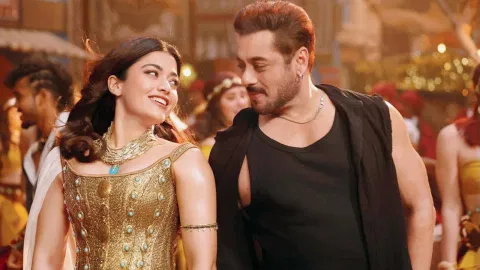
Take Salman Khan and Rashmika Mandanna in the film Sikandar (2025) for instance. Khan was 59 and Mandanna was 28 when the film was released, making their age difference 31 years. The casting became a talking point, but what was interesting was not just the difference in their ages. It was how familiar the situation itself felt. An older male superstar being paired with a much younger actress is hardly new in Hindi cinema.
Shah Rukh Khan was 42 when he appeared opposite a 21-year-old Deepika Padukone in Om Shanti Om (2007). Salman Khan has been paired with actresses considerably younger than him across several films. And while there is nothing inherently wrong with an age-gap pairing, the question is why this gap so often moves in only one direction.
Why is an older man still so easily accepted as the romantic hero, while an older woman is often made to feel as though she has already crossed the age at which she can be one?
There are obviously a number of factors that contribute to this.
One of them is the way women are perceived in society. Women are often judged more heavily on how they look and how young they appear. The expectation to remain attractive does not seem to disappear even as they grow older. If anything, it becomes more dire. Men, meanwhile, are allowed to age into something else. Their grey hair becomes a sign of experience or even style. Their age gives them authority. Their ageing even becomes part of their appeal.
For women, ageing has historically been treated more like something that needs to be hidden or prevented. And Hindi cinema has not existed separately from that thinking.
There is also the commercial argument. Male stars have traditionally been seen as the bigger drivers of theatrical business, which has meant that their age becomes less of a concern when a film is being put together. If a male superstar can continue bringing audiences into theatres, there is little commercial reason for the industry to stop placing him at the centre of a film or change his image to that of an older brother or have him play a father on screen.
But this creates its own cycle.

The same male stars continue to headline films. They continue to play heroes. They continue to be paired with younger actresses. And because the women opposite them are expected to look young, actresses begin to have a much shorter shelf life as romantic leads. The strange, or one might argue the natural, thing is that the men have aged too. Shah Rukh Khan, Salman Khan, Aamir Khan, Ajay Devgn, Akshay Kumar, everyone has aged. But their characters have often been given much more freedom to remain the heroes they were when they were younger.
Why should a man in his 50s or 60s not play someone his own age and have a story that belongs to that age? Why does he still have to be the young-at-heart romantic hero, while the woman beside him has to be young enough to maintain the illusion?
And this is where it begins to affect more than just casting. When actors are allowed to age, cinema can also allow the stories around them to age. A man in his 40s can have a marriage that has lasted twenty years. He can fall in love again after losing someone. He can be dealing with children who have grown up, a career that is changing, a relationship that has become complicated or the questions that come with getting older. The same should be true for women. A woman in her 40s can fall in love. A woman in her 50s can be desirable. A woman in her 60s can be the central character of a film without the story having to be about her age, with the narrative instead shifting towards newer subjects.
Yet, Hindi cinema has often struggled to give women that same freedom. Instead, once an actress reaches a certain age, the roles around her begin changing. She is more likely to be cast as the mother, the wife or the older relative than the woman whose own story is unfolding. And there’s nothing wrong with being cast in such a role, because that’s essentially the job: to act and become someone else. But the issue lies in the difference in that treatment, which becomes even stranger when you consider how much experience these actresses have accumulated by then, almost equal to that of their male counterparts over the years, if not more. Kajol, Rani Mukerji, Madhuri Dixit, Sushmita Sen and many others have already spent decades acting. They have reached an age where they can bring a completely different understanding to characters, relationships, and emotions.
This has been changing to some extent. Women are increasingly being cast in lead roles that feel more suited to their age and where they are in life, rather than being moved into supporting roles because they have grown older. But the difference is still there. The fact that these roles stand out at all perhaps says something about how long it took for them to become more common.
But age should not be the reason they are pushed away from the centre of the story.
The film Sky Is Pink (2019) offered a good example of what can happen when actors are allowed to inhabit characters who actually grow older. Priyanka Chopra and Farhan Akhtar played a married couple whose story spans 25 years. The characters were not frozen at the age at which the actors first appeared on screen. Their relationship, their family, and their lives changed with time.
And that is something we should see more of. Because ageing does not mean that life becomes less interesting. If anything, it gives us more depth to cover.
There is a strange irony in how Hindi cinema treats its young actors too. We continue to have a relatively small group of male stars who remain at the centre of mainstream cinema for years, while young actresses are constantly being introduced as the next new face. An actor in his 30s can still comfortably be presented as young. An actress in her 30s can already find herself being discussed in terms of how long she has left as a leading lady.
That difference says more than a lot.
It also means that when younger actresses enter the industry, they are often being asked to play opposite men considerably older than them rather than actors from their own generation. And because the older male stars continue occupying those roles, there is less urgency to create space for new male leads. The result is a cycle where the same men remain heroes, younger women keep being brought in opposite them, and actresses are eventually expected to step aside when they reach an age that the men beside them have been allowed to cross without consequence.
It is not that actors should stop playing young roles altogether, especially if the story demands it and the character suits them even as they grow older. It is that actresses should not have to stop playing them simply because they have gotten older. The problem is not ageing itself. It is that we have decided whose ageing is acceptable. We are all going to age. The actors will, the actresses will, and so will the audiences watching them.
So why should cinema keep pretending that only one half of its stars are allowed to grow older?
There is a certain essence to watching people change with time. The face changes, the experiences change, and the characters we can tell stories about change too. Age should give an actor more stories, not fewer.
And if Hindi cinema can allow its heroes to remain heroes for most of their careers, there is no reason its heroines should have to disappear from leading roles because they have grown older.