
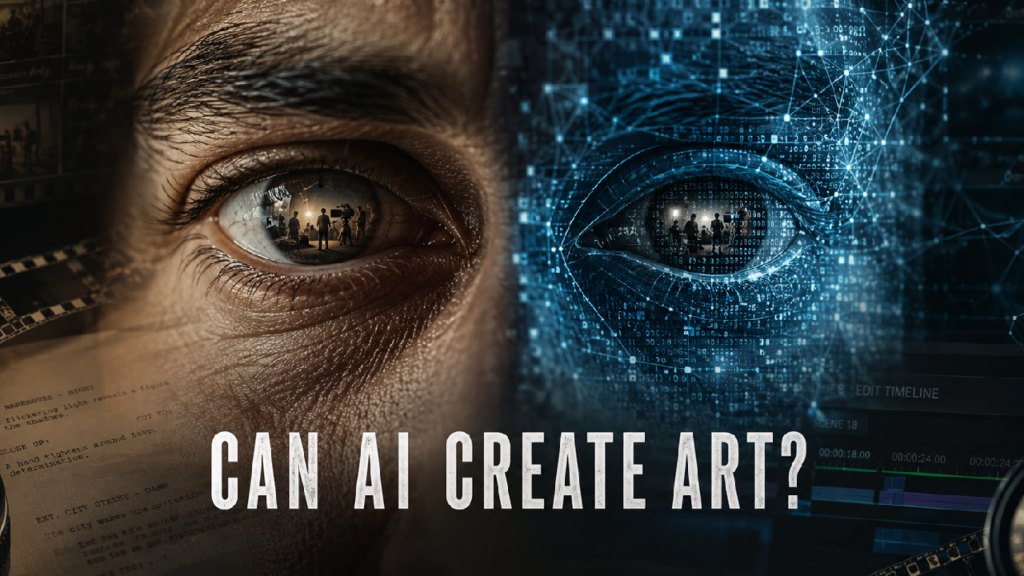
Artificial intelligence is no longer a theoretical discussion within the film industry. From AI-assisted storyboarding and previsualization tools reportedly being explored on projects associated with Martin Scorsese to filmmaker Darren Aronofsky’s collaboration with Google DeepMind, the technology is increasingly becoming part of modern filmmaking workflows.
The conversation has also reached the industry’s highest institutions. Earlier this year, the Academy clarified that films created with AI-assisted tools would remain eligible for Oscar consideration, while emphasizing that human creative contribution would continue to be the primary factor in evaluating artistic achievement. As AI becomes more deeply integrated into production pipelines, one question continues to divide filmmakers, artists, and technologists alike: can artificial intelligence become a creative partner, or does it risk diminishing the human voice that has always defined cinema?
Artificial intelligence is no longer a concept that filmmakers imagined in the future of filmmaking. It is already being used across various stages of production, from script analysis and visual development to image enhancement and previsualization.
As technology becomes increasingly integrated into creative workflows, one of the film industry’s most important debates has moved from theory to reality: can AI become a creative partner, or does it risk diminishing the human voice that has always defined cinema?
The conversation has intensified in recent years as some of the world’s most respected filmmakers have begun exploring the technology in different ways.
Reports of AI-assisted tools being used for storyboarding and previsualization on projects associated with Martin Scorsese sparked discussion across the industry, not because filmmakers were replacing artists, but because it raised a more complicated question about creative authorship.
At the same time, directors such as James Cameron have argued that AI could help make filmmaking more efficient, while filmmaker Darren Aronofsky has embraced experimentation through projects developed with Google DeepMind. The Academy has also acknowledged the growing presence of the technology, clarifying that films created with AI-assisted tools remain eligible for Oscar consideration while emphasizing that human creative contribution remains the primary factor in judging artistic achievement.
Yet not everyone is convinced that technological advancement and artistic creation are the same thing. Guillermo del Toro, one of contemporary cinema’s most celebrated storytellers, has been among the strongest critics of generative AI’s creative potential. He has argued that art comes from intention, experience, and emotion rather than computation.
His skepticism reflects a broader concern shared by many filmmakers and performers: while AI may be capable of generating images, dialogue, and visual styles, can it truly understand the human experiences that give stories meaning? That question sits at the centre of an increasingly urgent debate, one that now extends from Hollywood studios and awards bodies to independent filmmakers, technologists, and creators around the world.
John Waters also took a firm stance on the issue. “Not to help me write. I would use AI to cure cancer,” he told Billboard when asked about the technology. “But not to write, no. I saw something that was written supposedly for me by AI, and it was just like a really bad first draft — but yes, it was a first draft.”
Artificial intelligence has become cinema’s most provocative new collaborator. It can generate images in seconds, write scripts on command, create digital performers, and even mimic visual styles once considered uniquely human. As filmmakers and technologists continue to embrace AI’s possibilities, one question remains unresolved: can generative technology truly create art, or can it only imitate it?
The debate is no longer confined to Hollywood. Similar conversations are taking place across the global film industry, including India, where filmmakers, technologists, and legal experts have begun examining questions surrounding authorship, artistic control, copyright, and the role of human experience in storytelling.
That distinction lies at the heart of the debate. Cinema has always evolved alongside technology. Sound transformed silent films. Colour altered visual storytelling. Digital effects redefined spectacle. AI is simply the latest innovation in a long line of technological revolutions. However, unlike previous tools, AI enters territory traditionally associated with human creativity itself.
The industry’s challenge, therefore, is not deciding whether AI belongs in cinema. It already does. The real question is determining where the technology’s role should begin and end. For many filmmakers, the issue is not merely capability but control. Nina Zheng, Deputy General Manager of ASUS China, highlighted a growing frustration among creators: AI often struggles to execute highly specific artistic intentions.
“One point is that the AI creators need is actually not just a more powerful AI, but a more obedient AI,” Zheng said. “A director has a very complete cinematic vision in mind, but the AI often presents something unexpected.”
Her observation exposes a fundamental limitation of generative tools. While AI can generate endless possibilities, cinema is often built on precision. Directors spend years refining a particular emotion, visual tone, or narrative rhythm. AI may be able to produce content quickly, but translating subtle human intuition into algorithms remains an imperfect process.
Others see AI as something far more revolutionary: a democratising force. One speaker at a recent industry forum argued that cinema has historically been inaccessible to most people because filmmaking required significant financial resources.
“99% of people couldn’t participate in cinema because it required money. The right for everyone to participate in this art was stripped away,” the speaker said. “This is why so many young people love AI now. It is an equalizer.”
The argument is difficult to dismiss. AI-generated visuals and editing tools dramatically reduce production costs, potentially allowing independent creators to compete in spaces once dominated by large studios. For aspiring filmmakers with limited resources, AI represents opportunity rather than threat.
The growing interest in AI is also driven by economics. Tools capable of generating concept art, storyboards, visual references, and previsualization sequences can significantly reduce development costs and shorten production timelines. For independent filmmakers and creators working with limited resources, AI offers access to capabilities that were once available only to larger studios with substantial budgets.
Yet accessibility alone does not settle the artistic debate. Emotion remains one of cinema’s most important creative foundations.
Tom Holland recently shared his thoughts on the growing role of artificial intelligence, explaining why he believes creativity remains uniquely human. “Creativity is safe from AI because creativity has to do with the human experience,” Holland said while appearing on Spain’s El Hormiguero alongside Zendaya. “It’s about emotions, it’s about understanding one another.” “AI can sift through data, but it can’t understand people’s emotions. It doesn’t understand the difference between being happy and being sad,” Holland continued. “The way artists paint, it’s not about what they’re copying, it’s about expressing themselves. So I feel protected.”
The debate has also shaped wider industry conversations in recent years. During the Hollywood strikes of 2023, concerns over AI became a major issue for both writers and performers. The Writers Guild of America and SAG-AFTRA pushed for protections against AI-generated scripts, digital replicas of performers, and the use of artificial intelligence without consent or compensation. The resulting agreements reflected a growing consensus that technological innovation must be balanced with protections for creative labour.
The global film industry remains divided. James Cameron, one of cinema’s most technologically ambitious directors, has spoken about AI’s potential to improve efficiency in filmmaking while reducing costs.
Meanwhile, filmmaker Darren Aronofsky has taken a more exploratory approach. His production company, Primordial Soup, partnered with Google DeepMind to create Ancestra, a project designed specifically to examine AI’s role in filmmaking.
These contrasting approaches reflect the broader uncertainty surrounding the technology. Some filmmakers view AI as a powerful creative tool. Others fear it could dilute the human element that gives cinema its emotional impact. Perhaps the debate itself is framed incorrectly. The future of cinema may not be a battle between AI and artists, but a negotiation between them.
After all, audiences rarely connect with films because of technical perfection. They connect because a story reflects something recognisably human: grief, love, fear, hope, regret. AI can replicate patterns, styles, and structures, but whether it can genuinely understand those emotions remains an open question.
Advocacy groups such as the Creators Coalition on AI have emerged to promote responsible, human-centred integration of the technology, while the Academy’s evolving stance suggests that the industry recognises the complexity of the issue rather than viewing it in black-and-white terms.
For now, AI’s place in cinema remains unresolved. It can generate images, accelerate workflows, and democratise production. What it cannot yet do is replace the deeply personal experiences from which great stories emerge.
Cinema was born from technology, but it has always been sustained by humanity. As AI becomes increasingly woven into the filmmaking process, the industry’s greatest challenge may not be preserving jobs or protecting intellectual property. It may be ensuring that, amid all the innovation, the human voice remains most important and at the centre of the frame.
Read More: