
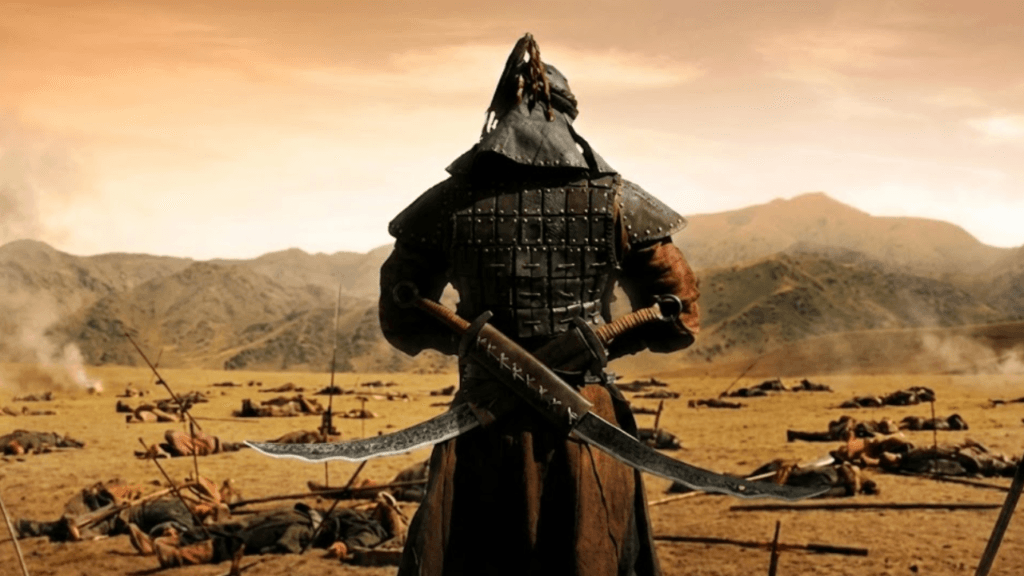
Alik Sakharov, the Emmy-winning filmmaker behind some of the most visually ambitious and emotionally charged episodes of Game of Thrones, House of Cards, Ozark, and Marco Polo, is set to direct Unbroken Sword, a Saudi-backed historical epic that aims to bring one of the most decisive military stories in world history to the global screen. The film chronicles the life of legendary 7th-century Arab military commander Khalid ibn al-Walid, culminating in the Battle of Yarmouk, a confrontation that reshaped the balance of power across the Middle East and beyond.
Positioned as the largest film ever produced in the Arab world and the region’s most ambitious English-language feature to date, Unbroken Sword is backed by Saudi Arabia’s General Entertainment Authority and Riyadh Season, and produced by Sela. Far from a symbolic cultural gesture, the project represents a strategic shift in Saudi Arabia’s filmmaking ambitions—from facilitating international productions to mounting original, globally positioned cinematic works rooted in regional history but crafted for worldwide audiences.
The scale and seriousness of that ambition were recently underscored when Turki Alalshikh, Chairman of the General Entertainment Authority, toured Al-Hosn Big Time Studios and Qiddiya Studios in western Riyadh to personally assess progress on the film. The project is currently deep in pre-production at Qiddiya, Saudi Arabia’s next-generation entertainment city, with extensive groundwork already in place across departments.
السيف الذي لم يكسر (خالد بن الوليد) ❤️ pic.twitter.com/z70wmP5sBT
— TURKI ALALSHIKH (@Turki_alalshikh) December 1, 2025
Conceived as a sweeping historical epic, Unbroken Sword blends large-scale war strategy with personal transformation and spiritual reckoning. Rather than treating its subject as a one-dimensional battlefield legend, the film traces Khalid ibn al-Walid’s evolution from a feared warrior into one of history’s most formidable military leaders.
Production is taking shape across Saudi Arabia’s newly built filmmaking infrastructure, with Qiddiya Studios and Al-Hosn Big Time Studios serving as key bases. These purpose-built facilities reflect an emphasis on physical scale and authenticity, with large practical sets prioritised over virtual environments. Vast outdoor locations have been constructed to recreate battlefields and historical settlements, reinforcing the film’s commitment to immersive world-building. According to Alalshikh, more than 1,000 swords are being handcrafted specifically for the production, while over 3,000 trees are being planted to shape landscapes suited to the film’s period setting—details that point to a tactile, hands-on approach rarely attempted at this scale in the region.
For Sakharov, Unbroken Sword represents a significant artistic transition. Known primarily for premium television, his move into a feature-length historical epic rooted in real-world history marks a new phase in his career. Alalshikh has revealed that Sakharov initially arrived with limited knowledge of Khalid ibn al-Walid’s story, but became deeply committed after extensive research, ultimately relocating from New York and spending the past six months living on-site to oversee the project closely. His immersion signals a determination to approach the material with seriousness rather than surface-level spectacle.
Joining Sakharov is veteran Hollywood producer Richard Sharkey, whose credits include House of the Dragon, The Lord of the Rings franchise, Marco Polo, and The Fifth Estate. Sharkey briefed Alalshikh during the studio tour on the project’s international crew and clear global release ambitions, reinforcing that Unbroken Sword is being positioned as a worldwide theatrical event rather than a regionally confined historical drama.
Unbroken Sword is scheduled for release in 2027, giving the production a defined horizon and positioning it as a flagship title within the Kingdom’s long-term cultural strategy. The project aligns closely with Saudi Arabia’s Vision 2030 framework, where cinema is envisioned not only as entertainment, but as a driver of cultural influence, economic diversification, and global soft power.