
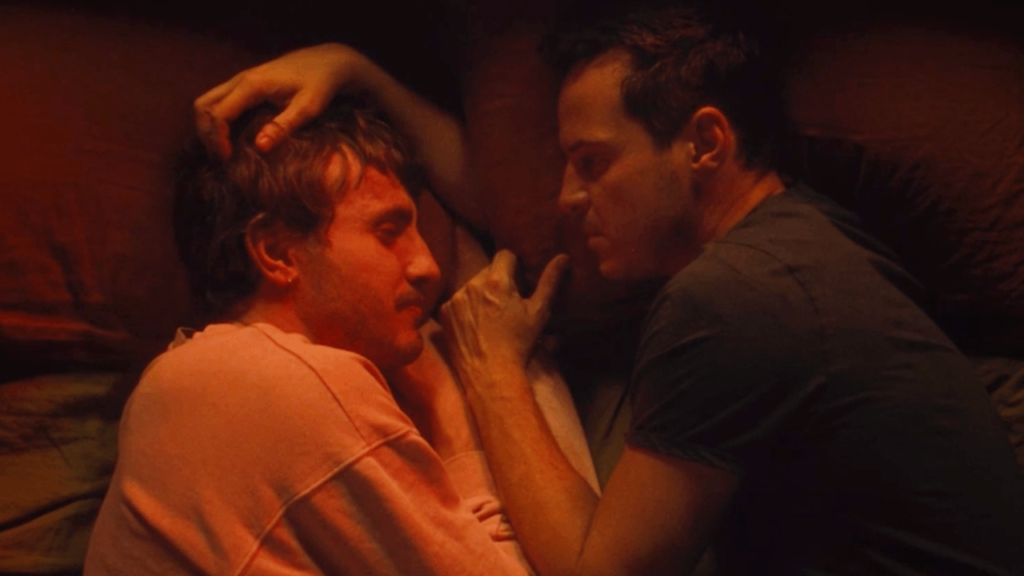
Loneliness is not necessarily an isolated experience. Sometimes, it can exist even within the presence of a constant crowd.
However, All of Us Strangers (2023), written and directed by Andrew Haigh and adapted from the novel Strangers by Japanese writer Taichi Yamada, tackles loneliness in a different way.
Andrew Haigh’s film begins with something that sounds almost simple: Adam, a gay screenwriter living alone in a nearly empty London apartment building, starts seeing his parents, who died in a car accident before he turned twelve. They appear exactly as they were when he last knew them, as if thirty years have somehow folded back on themselves.
At the same time, Adam becomes close to Harry, a younger gay man living in the same building. What begins as an encounter between two lonely strangers slowly becomes something more intimate. But the further Adam moves into these relationships, the less the film seems interested in telling us what is real and what is not.
Instead, it asks a more difficult question: what if something does not have to be real to be emotionally true?
Now because Adam is a writer, there is another way of looking at everything that happens in All of Us Strangers. The film itself begins to resemble the mind of someone writing. Thoughts become scenes. Memories become people. Regrets become conversations that never happened. The past does not remain in the past because Adam has never really finished living with it.
In that sense, the film reminded me of Federico Fellini’s film 8½ (1963), which is about a filmmaker struggling to make a film, keeps moving into dreams, memories, fantasies and imagined encounters, making the inner world of its protagonist feel like the film itself. All of Us Strangers does something similar in a very different way. Its protagonist is not making a film, but he is a writer trying to write about his parents, and his own unresolved life begins to enter the world he creates.
But there is something especially poignant about the loneliness Adam is carrying. Adam was barely twelve when his parents died. A child becoming an orphan is, on the surface, a simple idea. But the intricacies of losing your parents that early are much harder to measure. They do not simply take away two people. They take away the years in which a person is still discovering who they are through those people.
For Adam, that loss carries another weight.
He was growing up queer at a time when there was far less acceptance, far less language for what he might have been feeling and far more fear around what being gay could mean. His parents were not only the people he lost; they were the people who were supposed to have helped him navigate the world he was entering. He never got to find out how they would have reacted when he eventually understood himself. He never got to experience the awkwardness, fear, acceptance, or even difficulty of telling them.
He never got to come out to them. And that absence becomes one of the deepest wounds in the film.
There is something especially moving about the fact that Adam has already accepted himself by the time we meet him. He is not discovering that he is gay. He is not struggling to accept his sexuality in the present. Yet the wound is still there because acceptance does not erase everything that happened before it.
You can bury a demon without killing it.
Adam knows that his parents are gone. He knows that times have changed. He knows that being gay is not what it was when he was growing up. But somewhere inside him remains the child who never got to find out whether his parents would have accepted him. And that child still needs an answer.
So when his parents appear again, Adam is given something that real life never allowed him to have: time. Time to tell them who he is. Time to ask what they would have thought. Time to hear their response. Time to sit beside them as an adult and look at the people they were before death froze them in his memory. And that is what makes these scenes so affecting. Adam is not simply imagining his parents as they might have been. He is imagining the parents he needed while becoming the person he had to become without them.
The film’s queerness is therefore not separate from its loneliness. The two are inseparable.
Adam’s sexuality shapes what he lost, what he feared, what he never got to say and the kind of loneliness he grew into. It also shapes the relationship he eventually forms with Harry. Andrew Haigh, himself a gay filmmaker, approaches this loneliness without making it feel like a neat historical problem that disappeared once society became more accepting. The film understands that a generation can move forward while the people who lived through an earlier one still carry what it left behind.
For much of the film, we assume Harry is real. He is the person Adam meets, the person he begins to love, the person who seems to offer him the possibility of finally stepping outside the walls he has built around himself. But when Adam discovers Harry’s dead body, the film reveals that Harry had died that very night when he first came to Adam’s door. Everything that followed has existed in the strange space between memory, imagination, grief, and desire.
That changes Harry completely.
He is no longer just the man Adam falls in love with. He becomes the manifestation of something Adam has been missing for years: intimacy without fear, another gay man who understands a part of his loneliness without needing it explained, someone with whom he can exist without having to translate himself.
Their loneliness finds each other.
The building they live in becomes an extension of this feeling. It is enormous, but empty. Even when Adam is surrounded by people, there is a sense that he is sealed away from them. The same feeling follows him into the train, the club, and the crowds. He can be surrounded by movement and still look completely alone. And there is something particularly striking about seeing a queer man experience this kind of isolation in spaces where he should, theoretically, be able to belong. The club should mean community. The train should mean movement. Yet Adam remains secluded within himself.
The film repeatedly uses reflections and glass to reinforce this. A mirror tells the truth because it gives us back what is actually standing in front of it. Adam is constantly looking at himself, but what he sees is not simply his present self. There is the child inside him too. The child who lost his parents. The child who was frightened. The child who was growing up gay without knowing what that life would look like.
There is something haunting about the way Adam looks at himself and screams, as though the adult man is finally hearing the voice of the child he has spent decades carrying.
This is also why the film never really feels like it belongs entirely to the past or the present. The two exist together. Adam does not travel back in time in the conventional sense. He travels into the parts of himself that never moved forward. He is not only searching for his parents. He is searching for the version of himself that existed before their deaths, before he had to learn how to become an adult and a gay man without them.
Death is the one thing that does not leave you a choice.
And even then, All of Us Strangers suggests, we do not really give up. We carry people forward in strange ways. We recreate their voices. We remember their faces. We imagine conversations. We see them in places they no longer exist.
That is what Adam has been doing all along. He has been carrying forward the people he lost, the people he needed.
The final moments with Harry make this especially heartbreaking and beautiful. Adam enters the room where Harry’s body lies, and outside that room is the Harry that Adam has created through his own mind and imagination. Yet even knowing that none of it can change what happened, Adam stays with him. He comforts him. He listens to him. He holds him.
There is something deeply pure in that. Adam cannot save Harry. He cannot rewrite the night Harry came to his door. But he can finally be there.
To be there for someone even when you cannot fix what has happened. To take away some of their fear even if it means carrying some of it yourself. To leave everything else behind when someone is vulnerable and simply stay. Even if that loved one is a ghost who exists only in the fragile space between memory and imagination.
Adam’s imagination does not simply create another world. It creates the people he needs in order to survive his own.
And maybe the most beautiful thing the film understands is that sometimes we do not imagine because we want to escape reality. We imagine because reality left something unfinished.