
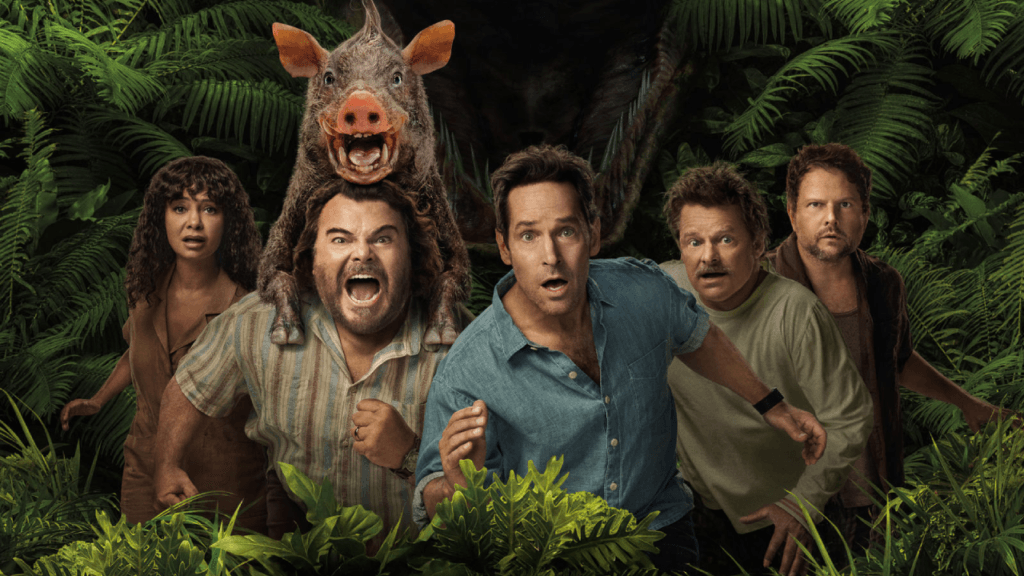
Released in the crowded Christmas corridor, Anaconda (2025) arrives with a curious promise. It is neither a straight remake of the 1997 jungle thriller nor a full-blown parody, but a knowingly self-aware reimagining that filters creature-feature spectacle through middle-aged regret, nostalgia, and Hollywood self-reflexivity. Directed by Tom Gormican, the film pairs Paul Rudd and Jack Black as lifelong friends attempting to reclaim a sense of creative purpose by remaking their favourite B-movie — Anaconda itself — only to encounter the very monster they are trying to fictionalize.
Critics, however, are sharply divided on whether this clever premise translates into a satisfying whole. While many praise the chemistry between its leads and the film’s willingness to poke fun at reboot culture, others argue that Anaconda loses confidence in its own satire, retreating into familiar action beats just when it should be sharpening its bite. The result, according to most reviews, is an entertaining but uneven hybrid — one that sparks conversation precisely because it never fully decides what kind of movie it wants to be.
Why Anaconda Returns Now — and What This Version Is Trying to Say
Directed and co-written by Tom Gormican, Anaconda (2025) stars Jack Black and Paul Rudd alongside Thandiwe Newton, Steve Zahn, Daniela Melchior, and Selton Mello. Backed by Sony Pictures, the film runs just under 100 minutes and positions itself as a holiday crowd-pleaser with ironic ambitions.
Unlike the earnest pulp tone of the original 1997 film, this version is openly meta. It comments on nostalgia, intellectual property recycling, and the romanticized idea of “making movies like we used to.” In doing so, it aligns itself with a recent wave of self-aware studio comedies that both exploit and critique the very system financing them. That tension — between commentary and complicity — becomes a recurring point in critical responses.
When Nostalgia Turns Dangerous Inside the Amazon
Anaconda (2025) follows Doug and Griff, two middle-aged friends whose lives have drifted far from their youthful creative dreams. Bound by decades of friendship and a shared love for schlock cinema, they travel deep into the Amazon rainforest with a half-serious plan: remake their favorite low-budget monster movie as a way to rediscover meaning, relevance, and artistic agency.
What begins as a comic exercise in nostalgia soon turns perilous when the crew realizes the jungle harbors a real, massive anaconda — far more dangerous than anything they imagined staging. As fiction collapses into reality, the film shifts from self-referential comedy into survival adventure, forcing its characters to confront not just physical danger but the emotional weight of deferred ambitions and compromised lives.
Importantly, the plot avoids traditional slasher escalation. Death counts and shock value take a back seat to tone management, with the film oscillating between satire, buddy comedy, and glossy creature spectacle. This tonal fluidity becomes central to how critics evaluate the film’s success — or lack thereof.
A Clever Premise That Leaves Critics Sharply Divided
Critical reaction to Anaconda is broadly mixed, but rarely indifferent. Across major publications, reviewers tend to agree on two things: the film’s premise is clever, and its execution is inconsistent.
Several critics highlight the effortless rapport between Jack Black and Paul Rudd as the film’s emotional anchor. Their banter, shaped by years of shared comedic language, gives the first half of the film a loose, playful energy. RogerEbert.com notes that their chemistry keeps the movie buoyant even when the narrative loses focus, while The Guardian praises their “natural, engaging rhythm” as the film’s most reliable asset.
However, as the film transitions into action territory, enthusiasm wanes. The Hollywood Reporter points out that while the film doesn’t skimp on movement or scale, its action sequences feel oddly weightless — more theme-park ride than cinematic tension. Variety echoes this sentiment, suggesting that the film relies too heavily on the inherent joke of its concept without pushing that joke far enough.
The Wrap offers one of the sharper critiques, arguing that Anaconda spends so much time commenting on the absurdity of remaking a creature movie that it forgets to actually deliver a compelling creature movie. Vulture similarly notes that the film gestures toward deeper themes of disappointment and aging but pulls back just as those ideas demand exploration.
Still, not all responses are cautious. The San Francisco Chronicle offers a more enthusiastic take, applauding the film for delivering genuine moments of suspense within its comedic framework and suggesting it may ultimately age better than expected. The Seattle Times also leans positive, emphasizing the film’s relaxed confidence and willingness to embrace silliness without embarrassment.
Where critics converge most clearly is on performance and tone — at least initially. Jack Black and Paul Rudd’s dynamic is widely seen as the film’s strongest element, grounding the meta conceit in recognizable human frustration. Their characters’ fear of obsolescence, masked by humor, resonates with reviewers who see the film as a reflection of Hollywood’s broader anxiety about relevance.
Several critics also commend the film’s early restraint. Rather than rushing into spectacle, Anaconda allows its characters and premise to breathe, building a comic rhythm that feels conversational rather than forced. There is appreciation, too, for the film’s refusal to treat its jungle setting purely as a CGI playground; moments of tactile tension and practical staging are noted, even if inconsistently applied.
The most divisive element of Anaconda is its tonal shift. Roughly midway through, the film pivots from introspective comedy to conventional action-adventure, and critics split on whether this is a feature or a flaw.
For some, the shift feels like a betrayal of the film’s initial promise. Variety and Vulture argue that the movie grows cautious just when it should be bold, smoothing out its rough edges in favor of broad accessibility. Others, like The Guardian, are more forgiving, viewing the tonal swing as part of the film’s identity crisis — thematically appropriate even if uneven.
Another recurring criticism concerns underdeveloped supporting characters. Despite a strong ensemble on paper, reviewers note that characters played by Thandiwe Newton and Daniela Melchior are sidelined once the plot accelerates, reducing their narrative function to reaction rather than agency.
Hollywood Nostalgia, Creative Regret, and the Limits of Self-Awareness
Beneath its genre trappings, Anaconda gestures toward a critique of IP culture and creative stagnation. Critics read the film as a commentary on how nostalgia can both inspire and imprison artists, particularly in an industry obsessed with recycling proven brands.
However, many feel the film stops short of fully interrogating these ideas. The satire remains gentle, rarely biting, and ultimately unwilling to challenge the system it lightly mocks. RogerEbert.com observes that while the themes are present, they are treated more as background texture than driving force.
Between Pulp Past and Meta Present, Anaconda Struggles to Choose
Compared to the 1997 Anaconda, this version is almost unrecognizable in tone. Gone is the straight-faced pulp seriousness, replaced by irony and self-awareness. Critics often compare the film instead to meta-comedies like Tropic Thunder or The Unbearable Weight of Massive Talent, though most agree it lacks the anarchic commitment of those films.
Within Tom Gormican’s emerging filmography, Anaconda is seen as a logical if imperfect extension of his interest in performance, identity, and spectacle — albeit filtered through a studio franchise lens.
In the end, Anaconda (2025) is widely seen as an affable, intermittently inspired film that never quite becomes the sharp satire or gripping creature feature it hints at being. Critics appreciate its humor, performances, and premise, but remain divided on its execution.
For audiences, the takeaway is clear: those drawn to star chemistry, meta humor, and light holiday entertainment may find plenty to enjoy. Viewers seeking sustained tension or a fearless genre reinvention may leave wanting more. The debate surrounding the film, much like the movie itself, reflects a broader industry uncertainty — about nostalgia, originality, and how much irony a blockbuster can sustain before it loses its teeth.
Anaconda (2025): Credits & Release Info
Director: Tom Gormican
Cast: Jack Black, Paul Rudd, Thandiwe Newton, Steve Zahn, Daniela Melchior, Selton Mello
Runtime: ~99 minutes
Release: Theatrical, December 25, 2025
Read more POF Review Roundups