
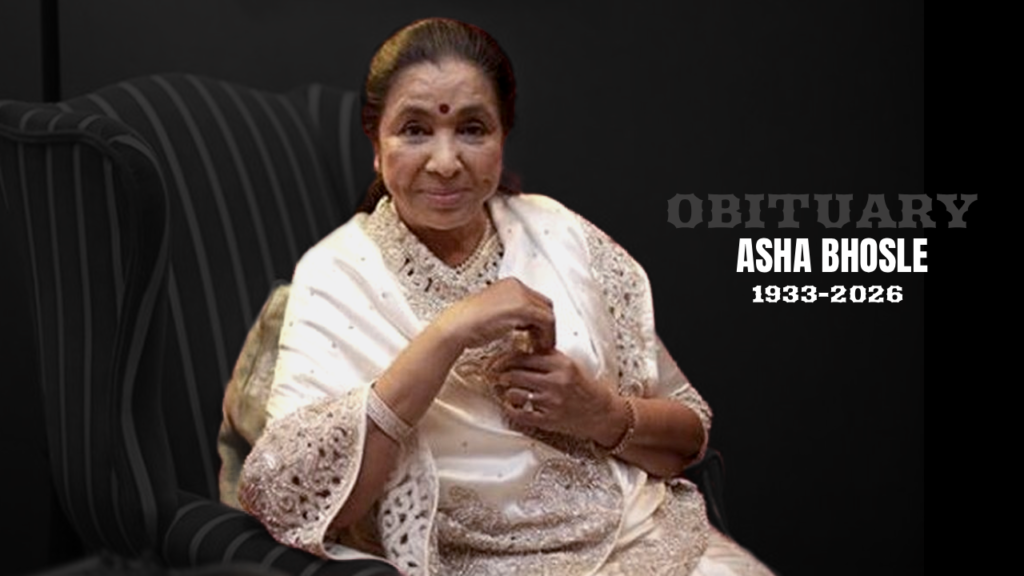
There was a time in Hindi cinema when desire did not belong to the heroine. It lived in shadows, in smoke-filled rooms, in sequins and velvet, in the gaze of the woman who stood just outside respectability. The vamp. The one who danced, teased, tempted, and disappeared before the story restored its moral balance. Faces like Helen, Bindu, or Aruna Irani gave that presence a body. But the voice that gave it life — its mischief, its ache, its dangerous elegance belonged to Asha Bhosle.
And yet, to remember Asha Bhosle only as the voice of the vamp would be to miss the scale of what she truly achieved. Because what she did, quietly and consistently over decades, was expand the emotional and sonic possibilities of the female playback voice in Indian cinema.
Born into a household where music was not ambition but atmosphere, Asha grew up absorbing rhythm, discipline, and performance as a way of life. But her journey into cinema was far from smooth. Entering an industry already beginning to be defined by the soaring purity of her elder sister Lata Mangeshkar, Asha found herself searching not just for work, but for identity. And that search led to one of the most defining artistic decisions in Indian music history.
“I realised I’d have to change my singing style because Didi is already there… I didn’t want to be pitted against her,” she once said in an interview with Indian Express. Instead of imitation, she chose divergence. Drawing inspiration from Western music she listened to closely, she began reshaping her voice, its phrasing, its breath, its tonal play. “I wanted to be able to sing all kinds of songs. So I trained myself accordingly.”
That instinct to adapt, to experiment, to refuse containment became the foundation of her legacy. By the late 1950s and 1960s, Asha Bhosle had begun carving out a space that no one else occupied. While Lata’s voice came to define emotional stillness, devotion, and melodic purity, Asha’s voice moved differently. It laughed. It lingered. It flirted. It suggested more than it stated. It could be playful and wounded in the same breath, controlled yet unpredictable.
This difference found its most electric expression in her collaborations with R. D. Burman. Together, they didn’t just create songs they created a new grammar for film music. From Teesri Manzil to Caravan, from jazz-inflected arrangements to rhythm-heavy compositions, their work brought a modern, urban, almost global sensibility into Hindi cinema.
And it was within this musical shift that the vamp found her voice.
Listen to Piya Tu Ab To Aaja, and you understand immediately. The breathy prelude. The teasing pauses. The rise and fall of tone that feels almost like choreography in sound. Paired with Helen’s magnetic screen presence, the song did something Hindi cinema had rarely allowed before, it centred desire without apology.
Asha Bhosle did not just sing for the vamp. She humanised her. She gave her wit, intelligence, agency. In songs like O Haseena Zulfonwali, Yeh Mera Dil, Hungama Ho Gaya, or Aaiye Meherbaan, the woman on screen was no longer just spectacle. She was presence. She was power. And crucially, Asha never allowed sensuality to slip into vulgarity. There was always control — a musical intelligence that kept even her boldest songs rooted in craft. She made flirtation sound effortless, but it was built on precision. She made glamour sound easy, but it carried sophistication.
Yet even this iconic association the voice of the vamp is only one fragment of her vast artistic identity. Because just as easily as she could inhabit a smoky cabaret, Asha Bhosle could move into the delicate world of ghazals, the emotional depth of romantic ballads, the structure of classical compositions, or the energy of pop and folk. Over a career spanning more than eight decades, she recorded over 12,000 songs across more than 20 languages, a staggering body of work that places her among the most prolific recording artists in the world.
Her voice travelled generations. She sang for Madhubala and later for Urmila Matondkar. She moved from Dum Maro Dum to Rangeela Re without losing authenticity. She remained relevant not by resisting change, but by moving with it. “Young people like a different style… I’ve been moving along with the generations,” she once said this, a line that in hindsight reads less like observation and more like artistic philosophy.
Recognition followed, but it never seemed to define her. She was honoured with the Dadasaheb Phalke Award and the Padma Vibhushan, alongside multiple National Film Awards and an extraordinary run at the Filmfare Awards. At the peak of that success, she stepped away from competitive awards, choosing instead to make space for younger singers, a gesture that spoke to her understanding of legacy not as accumulation, but as continuity.
And then there was the narrative that followed her for decades, the supposed rivalry with Lata Mangeshkar. It persisted because it was easy. Two sisters. Two icons. A comparison waiting to be made. But the truth, as Asha herself often said, was far simpler. “People did carry tales… but blood is thicker than water.”
They were not competitors in the way the world imagined. They were contrasts. If Lata’s voice felt like a calm river, Asha’s felt like shifting wind. One anchored the emotional core of Indian cinema. The other expanded its edges. Together, they defined its sound.
On April 12, 2026, in Mumbai, that voice — restless, playful, endlessly adaptive — fell silent.
And just like that, timelines turned into tribute boards. Voices softened. Old songs returned to the surface. Not as memories, but as lived experiences — fragments of lives, of films, of moments that never quite left. Because Asha Bhosle was never just a singer. She was a mood. A shift. A possibility.
She made room for the bold woman, the playful woman, the experimental artist. She allowed a female voice to carry not just melody, but personality. Not just emotion, but attitude. Not just tradition, but rebellion. And long after the era of the vamp faded, long after cabaret gave way to item numbers and then to something else entirely, her imprint remained — in phrasing, in breath, in the way a line could tease before it resolved.
Her voice does not belong to the past. It lingers — in playlists, in memories, in the DNA of Indian film music itself.
Not as nostalgia. But as something still alive. Because Indian cinema did not just need a voice of purity.
It needed a voice that could smile, challenge, seduce, experiment, and evolve. And Asha Bhosle gave it that voice.
Read More: