
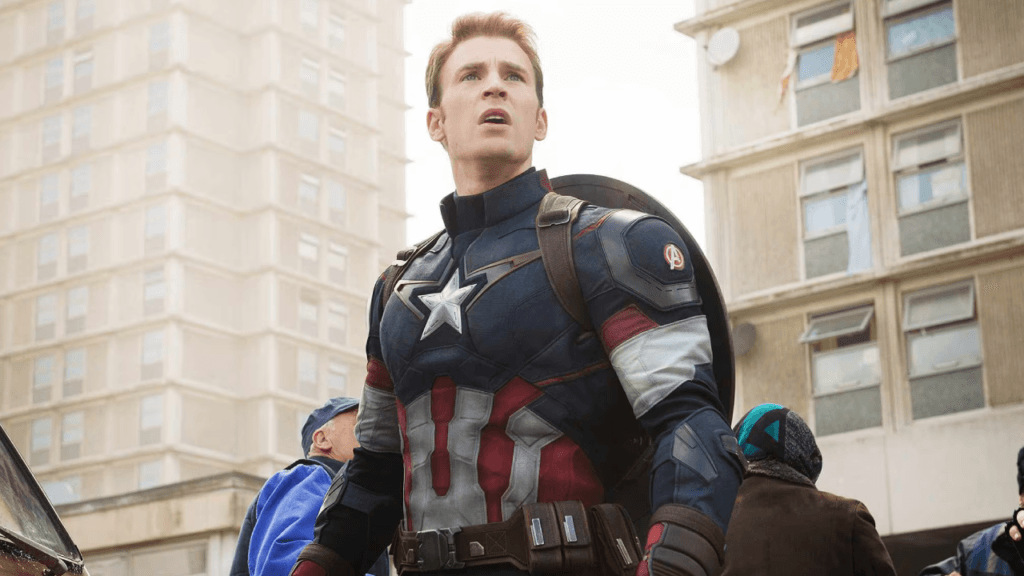
Marvel Studios has officially confirmed the return of one of its most defining characters. The first teaser trailer for Avengers: Doomsday reveals that Steve Rogers, portrayed once again by Chris Evans, will appear in the upcoming Marvel team-up film, set for theatrical release on December 18, 2026. The teaser arrives with a striking narrative turn: the former Captain America is now shown as the father to a newborn child.
Rather than functioning as a traditional spectacle-driven preview, the teaser is deliberately intimate and restrained. Focused almost entirely on Steve Rogers, it avoids large-scale action or ensemble imagery, choosing instead to reintroduce the character through a moment of quiet transformation. It is a reveal that immediately reframes Rogers not as a soldier or symbol, but as a man defined by legacy, responsibility, and personal continuity.
Marvel has attached the teaser exclusively to theatrical screenings of Avatar: Fire and Ash, signaling its intent to position Doomsday as a true event film while beginning its marketing campaign exactly one year ahead of release. According to reports, this Cap-centered teaser is only the first in a planned series, with additional character-focused previews expected to roll out in the coming weeks.
The decision to bring Steve Rogers back carries significant weight within the Marvel Cinematic Universe. His arc in Avengers: Endgame was framed as a definitive conclusion — a rare example of closure in a franchise built on perpetual continuation. By allowing Rogers to live out a full life beyond the battlefield, Marvel elevated his ending from mere retirement to thematic resolution. Reintroducing him now, especially without immediate explanation, suggests that Doomsday is less interested in undoing that ending and more focused on expanding its emotional consequences.
Chris Evans’ Captain America has long functioned as the MCU’s moral center — a character whose clarity of purpose anchored increasingly complex narratives. In recent phases, Marvel has faced criticism for narrative sprawl and diminished emotional cohesion. Rogers’ return, therefore, reads not simply as fan service, but as a strategic recalibration: a reminder of the character-driven storytelling that once defined the franchise’s peak.
The most telling aspect of the teaser is not Rogers’ presence, but his new role as a father. Fatherhood introduces a dimension Marvel has historically reserved for side characters or epilogues, not central icons. For a character once defined by sacrifice and self-denial, the image of Steve Rogers holding a newborn suggests a thematic shift toward inheritance, consequence, and the cost of survival after heroism.
Importantly, Marvel avoids sensationalizing this reveal. There is no exposition, no dialogue-heavy explanation, and no hint of how this development fits into the broader narrative mechanics of Doomsday. The teaser does not clarify timelines, variants, or multiversal logic. Instead, it allows the image itself to do the storytelling, trusting the audience to understand the emotional gravity without immediate answers.
This restraint extends to Marvel’s broader marketing approach. Attaching the teaser to Avatar: Fire and Ash aligns Doomsday with large-scale theatrical spectacle while also targeting an audience primed for immersive, event-driven cinema. By opting for character-specific teasers rather than a single overloaded trailer, Marvel appears intent on rebuilding anticipation gradually, controlling narrative focus rather than flooding audiences with information.
What Marvel is notably not doing is just as important. There is no full Avengers lineup revealed, no central villain introduced, and no explicit framing of stakes beyond Steve Rogers himself. In an era where franchise marketing often prioritizes escalation, Doomsday begins by narrowing its lens, grounding its future in a familiar emotional anchor.
That choice suggests confidence — not only in the character’s enduring resonance, but in the audience’s willingness to re-engage on quieter terms. Steve Rogers’ return does not promise nostalgia alone; it signals an attempt to restore emotional coherence to a universe that has grown increasingly fragmented.
As Marvel builds toward Avengers: Doomsday, this first teaser establishes tone rather than plot, intention rather than explanation. By reintroducing Steve Rogers not as a symbol of war, but as a figure shaped by legacy and life beyond heroism, Marvel sets the stage for a film that may be less about saving the universe — and more about what survives after it has already been saved.