
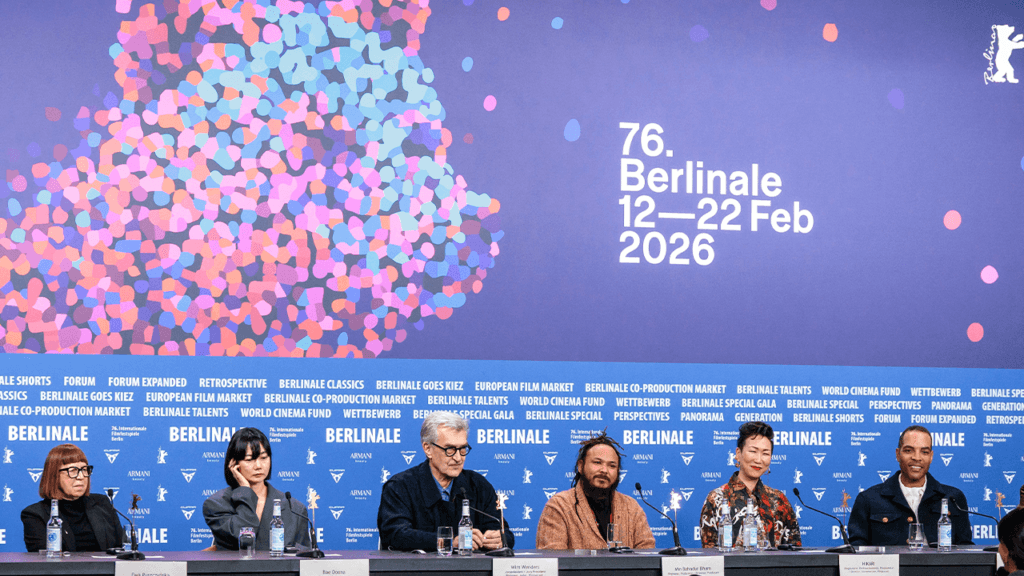
The 76th edition of the Berlin International Film Festival (Berlinale 2026) opened on February 12 under relentless winter rain, with umbrellas lining the red carpet and a damp chill cutting through Potsdamer Platz. Yet inside the Berlinale Palast, the mood was less stormy and more reflective. This year’s opening ceremony suggested a festival consciously shifting its emphasis back to cinema itself — to performance, authorship and craft — rather than foregrounding overt political confrontation.
International guests braved the weather, including Sean Baker, Bella Ramsey, Karim Aïnouz, Neil Patrick Harris, Radu Jude, Daniel Brühl and Lars Eidinger, reaffirming the Berlinale’s global draw even in a comparatively restrained edition. But the emotional centre of the evening belonged to one artist whose career has long transcended borders.
Michelle Yeoh received the Honorary Golden Bear, a tribute recognizing her decades-long contribution to international cinema. Introduced by Sean Baker, who described her as a performer who reshapes the emotional temperature of every room she enters, Yeoh accepted the award with characteristic grace and warmth. Her speech balanced humour and vulnerability, reflecting on her journey from a young performer determined to honour her parents’ faith in her, to a global screen icon whose career spans Hong Kong action cinema, Hollywood blockbusters and Academy Award-winning drama. The tribute concluded with a standing ovation that provided the night’s most resonant moment of collective emotion.

While past Berlinale openings have often been defined by pointed political statements, the 2026 ceremony adopted a more measured tone. The absence of extended on-stage political rhetoric was noticeable, particularly in contrast to previous years when the festival platform became a site for fiery speeches. Politics were not absent from the broader festival environment — demonstrators and attendees displayed signs referencing anti-fascist philosopher Hannah Arendt, and solidarity messages such as “Free Iran” appeared on the red carpet — but the official programme remained focused on filmmaking rather than polemics.
That emphasis was reinforced earlier in the day by competition jury president Wim Wenders, who framed cinema as a counterweight to politics rather than a direct instrument of it. His comments underscored a philosophy that art operates in a different register — shaping empathy and reflection rather than functioning as a substitute for political action. It was a tone that carried through the opening night’s pacing and programming.
The festival launched with No Good Men, directed by Afghan filmmaker Shahrbanoo Sadat, a romantic comedy set in Kabul in 2021. The film follows a television camerawoman who becomes entangled with her station’s star journalist shortly before the Taliban’s return to power. Its inclusion as opening film continues the Berlinale’s tradition of spotlighting international voices navigating complex realities. The film has drawn attention for reportedly including the first on-screen kiss in Afghan cinema, a creative choice Sadat has described as rooted in narrative authenticity rather than provocation. In selecting No Good Men to inaugurate the festival, Berlin once again positioned itself as a platform for bold yet intimate storytelling.
Under festival director Tricia Tuttle, now in her second year leading the Berlinale, the programme maintains a balance between established names and discovery. Among the anticipated premieres are Rosebush Pruning from Karim Aïnouz, featuring Callum Turner, Elle Fanning and Riley Keough, and At the Sea by Kornél Mundruczó, led by Amy Adams. The European debut of The Moment, a project associated with Charli xcx, adds a contemporary crossover appeal. While this edition may not feature the concentrated star frenzy seen in previous years, it compensates with a strong emphasis on auteur-driven cinema and performance-led narratives.
The opening night of Berlinale 2026 ultimately felt less like a battleground of declarations and more like a reaffirmation of purpose. In a divided global climate, the festival appears to be recalibrating its public posture — not by ignoring political realities, but by foregrounding cinema’s enduring capacity to interpret them through story, character and image. The rain outside may have dampened the red carpet glamour, but inside the theatre, the focus remained steady: honour the artists, elevate international voices and allow the films themselves to carry the conversation forward. The Berlin International Film Festival runs through February 22, continuing its role as one of Europe’s most significant stages for world cinema.
Read More: