
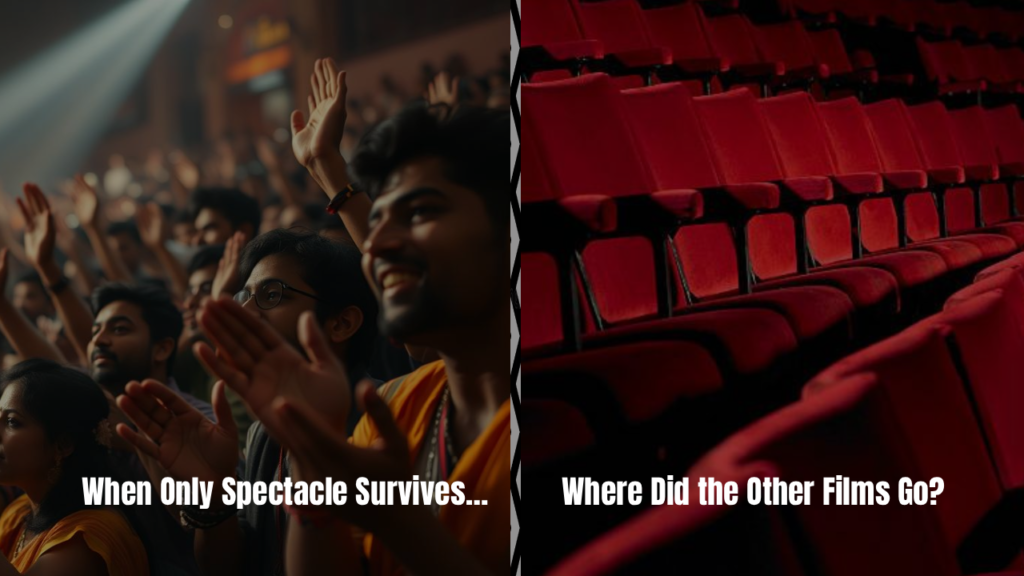
Walk into a theatre today, and the pattern is hard to miss. The screens are dominated by scale, action, spectacle, stars framed larger than life. The kind of cinema that demands to be seen on the biggest screen possible, with the loudest sound, with an audience reacting in unison. Somewhere along the way, the mid-budget film, the quiet drama, the character-driven story, the film that relied on feeling rather than force has slowly disappeared from theatres. Not entirely gone, but no longer central. No longer expected.
The theatre, it seems, has changed its purpose.
Cinema halls today are no longer just places to watch films. They are places to experience events. A film like Pathaan or Jawan doesn’t just release, it arrives. There is anticipation, scale, a sense of occasion. Similarly, Dhurandar, Border 2 were not just watched, they were celebrated inside theatres.
This shift isn’t accidental. The economics of theatrical exhibition have changed. With rising ticket prices and the convenience of home viewing, audiences now need a reason to step out. Spectacle provides that reason. Scale justifies the effort. In that sense, Bollywood hasn’t entirely misread the audience. It has responded to a reality, if you want people in seats, you have to offer something they can’t replicate at home.
But that’s only half the story.
It’s easy to assume that audiences no longer want smaller, intimate stories. But that assumption feels incomplete. There was a time when films like Udaan or The Lunchbox found their space in theatres. They didn’t open big, but they grew. They lingered. They relied on word-of-mouth, on patience, on discovery. Today, that breathing room barely exists.
The question then isn’t whether audiences rejected these films. It’s whether the system stopped supporting them. Limited screens, minimal marketing, shorter theatrical windows, these films often arrive quietly and disappear even more quietly. An audience cannot choose what it never gets the chance to see.
The rise of OTT platforms didn’t just create alternatives, it reshaped behaviour. Stories that once belonged to theatres, subtle, conversational, internal, found a natural home on streaming. And audiences adapted quickly. Watching a layered drama in the comfort of home became not just acceptable, but preferable.
At first glance, the dominance of spectacle looks like strategy. Give the audience what works. Repeat success. Scale up what draws crowds. But repetition has a way of revealing something deeper. When an industry begins to rely too heavily on what is already proven, it raises a question, is this confidence in understanding the audience, or a hesitation to risk being wrong?
Because understanding an audience is not just about recognizing what they currently respond to. It is also about anticipating what they might respond to next. And that requires risk.
Somewhere along the way, Bollywood seems to have grown cautious. Not incapable, but careful. Not disconnected, but perhaps unwilling to test that connection beyond what feels safe.
The disappearance of mid-budget films from theatres isn’t just a shift in distribution. It’s a shift in what cinema feels like. We are losing the “in-between” space, the films that weren’t massive, but weren’t minor either. The films that introduced new voices, new rhythms, new silences. Spectacle creates impact. But intimacy creates memory.
When everything becomes louder, faster, bigger, something else quietly fades, the chance to sit in a dark room and feel something unfold slowly, without urgency, without insistence.
Cinema, at its best, has always been both, the roar and the whisper.
Maybe the success of spectacle isn’t the problem. It’s real, and it’s deserved. The real question is what happens alongside it. Because an industry that only invests in what is already working eventually stops discovering what else could work.
And perhaps that is where Bollywood stands today, not lost, but at a crossroads. Not disconnected, but uncertain. Maybe the audience hasn’t changed as much as we think.
Maybe it’s still waiting, just not being invited in the same way. And maybe the real question isn’t why big spectacles are working.
It’s whether the industry still knows how to make us show up for anything else.
Read More: