
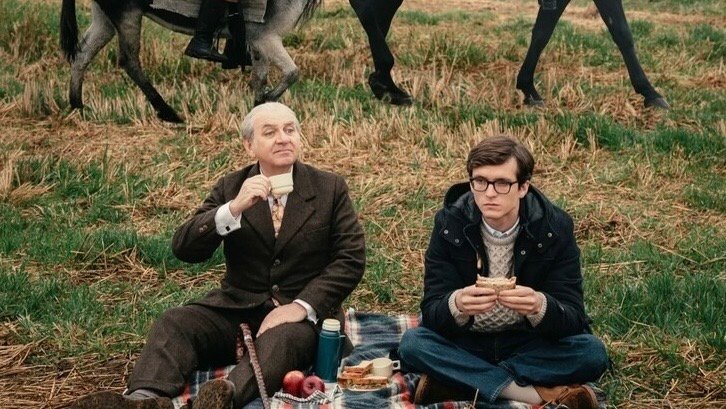
Borges and Me, directed by Marc Turtletaub and adapted from Jay Parini’s memoir of the same name, premiered at the Edinburgh International Film Festival before its wider release in August. The film is based on Parini’s real-life account of driving renowned blind Argentine writer Jorge Luis Borges across the Scottish Highlands in 1971, one of the stranger and more unexpectedly meaningful encounters in recent literary history.
Critics have found the film genuinely charming in places, consistently well performed and beautifully photographed, but also frustratingly uneven and unable to fully capture the transformative depth that its premise so clearly promises.
Jay Parini, played by Fionn Whitehead, is a 23-year-old American student at the University of St Andrews in 1971: quiet, conservative and carrying guilt over having inadvertently inspired his younger brother Billy to enlist in Vietnam. When the celebrated 70-year-old Borges, played by Chilean actor Luis Gnecco, arrives at the university, Parini is assigned to drive him across Scotland from St Andrews to Orkney via Inverness in a decrepit Morris Minor. As the journey progresses through rain-soaked coastlines and foggy highlands, the two men slowly find common ground: the young writer and the old master. Parini describes the encounter in his memoir as permanently changing the way he saw the world.
The film also features Alan Cumming as Alastair Reid, the Scottish poet and leading Borges translator who connects the two men, alongside Peter Mullan as Orcadian poet George Mackay Brown, Freya Mavor, John Gordon Sinclair and Morven Christie.
Deadline’s review, the most enthusiastic among the major publications covered here, called the film “smart, literary and playful,” describing Turtletaub’s direction as “hallucinatory” and the film as genuinely transporting. The review praised the screenplay by Oren Moverman, who co-wrote with Parini and Ross Clarke based on the memoir, for its wit and willingness to drift into surreal territory, including hallucinated versions of Don Quixote and Sancho Panza. Eye for Film’s Richard Mowe also responded warmly, calling it “a wealth of engaging detail” and praising Turtletaub for treating “the bonds of friendship with delicacy and insight.” Grand Goldman described the film as “a literary odyssey” that avoids the pitfalls of biopic reverence, praising its humanising approach to both Parini and Borges and calling the Scottish Highlands cinematography “a character in its own right.”
The most consistent area of agreement across the reviews is that Luis Gnecco’s performance as Borges is the film’s greatest asset. Variety called him “a commanding presence,” highlighting how the Chilean actor embodies Borges’ combination of priestly dignity, mischievousness and verbal extravagance with real force. Director Turtletaub told Deadline that Gnecco was “probably the best-prepared actor I have ever worked with,” explaining that he read everything written about Borges, tracked down a film Borges himself had made, watched live interviews, met someone who had known Borges personally and even learned Anglo-Saxon to deliver a single line in the script correctly.
Eye for Film similarly praised Gnecco and Whitehead as a nuanced central pair. The Reviews Hub, while more critical overall, still acknowledged Gnecco’s performance as one that delivers genuine Borgesian wit at its best, noting that his eccentricities can be amusing even when they lean into mannerism.
Fionn Whitehead’s performance as Parini has also drawn consistently warm notices. Quieter and less showy than Gnecco’s, it provides the film with a necessary counterbalance. Variety described his “shy, sweet earnestness” as making Parini an easy target for Borges’ good-humoured ribbing. Grand Goldman called his performance “nuanced,” tracing Parini’s arc from “initial grumpiness” toward “reluctant appreciation.” The Reviews Hub was more measured, describing Whitehead’s “attractively reserved rendition” as a compelling foil to Gnecco’s larger-than-life Borges, while observing that the script does not always give him enough to work with in the second half.
Alan Cumming’s role as Alastair Reid has divided critics. Variety described him as delivering “pleasingly Alan Cumming form,” bringing a warm and breezily bohemian presence to the film. Eye for Film praised him as “notably to the fore” among a strong ensemble of Scottish acting talent. The Reviews Hub, however, described his character as “frustratingly under-exploited,” arguing that Cumming’s Reid should have been a more important bridge between the generations than the film allows him to be. Peter Mullan’s appearance as George Mackay Brown has drawn praise across publications as one of the film’s highlights and one of its most vivid supporting performances.
The critical consensus ultimately lands at warm appreciation rather than full enthusiasm, with several reviewers identifying the same structural problem. The Reviews Hub offered the sharpest criticism, arguing that after “an excellent introduction,” the film begins to lose momentum, becoming a succession of platitudes about life, writing and friendship that rarely delivers the promised transformation. The review also suggested that Gnecco’s Borges sometimes leans too heavily into self-assured extravagance, revealing more about 1970s Latin American machismo than profound Borgesian wisdom.
Variety likewise acknowledged that the film begins to drag in its second half. An early Edinburgh attendee on Letterboxd described it as “rather enjoyable” but also noted that it “somewhat drags in the second half” and that some performances, particularly Cumming’s scenes, created a strange disconnect.
Volker Bertelmann, the Oscar-winning composer behind All Quiet on the Western Front, composed the score, with multiple reviews noting that his music effectively accompanies the film’s shifting tones. Christopher Norr’s cinematography has received near-universal praise, capturing the Scottish Highlands with a beauty that, as Grand Goldman put it, makes the landscape feel like a genuine character in the story.
Borges and Me works best when it trusts its central pairing and lets the mist, the Morris Minor and the miles do the work. When it reaches for deeper literary significance through dialogue rather than atmosphere, it sometimes loses its grip. Critics have broadly agreed that it is more enjoyable than essential: a charming and occasionally transporting road movie that falls short of the profound encounter at its heart. As one early Edinburgh viewer put it, “for about 90 percent of the time I am drawn in and loving it.” The remaining 10 percent is where the film’s real limitations live.
Borges and Me has the ingredients of a memorable literary road movie: an extraordinary real-life encounter, two very different personalities, the Scottish Highlands and a central performance that gives Borges plenty of eccentricity and charm. The reviews suggest that Marc Turtletaub succeeds most when he allows the journey itself to breathe. The film becomes less convincing when it tries to explain the significance of the encounter rather than simply letting the relationship reveal it.
That leaves Borges and Me in an appealing but slightly frustrating middle ground. It is beautifully made, well acted and often genuinely funny, but the profound transformation promised by Parini’s memoir never quite comes through with the same force. For audiences drawn to literary cinema and character-driven road movies, however, there is still plenty here to enjoy.
Film Details: Borges and Me
Director: Marc Turtletaub
Writers: Oren Moverman, Jay Parini, Ross Clarke
Based on: Borges and Me: An Encounter by Jay Parini
Cast: Fionn Whitehead, Luis Gnecco, Alan Cumming, Peter Mullan, Freya Mavor, John Gordon Sinclair, Morven Christie, Stuart Bowman
Cinematography: Christopher Norr
Music: Volker Bertelmann
Runtime: 1 hour 49 minutes
Countries: UK, Belgium, Netherlands
Production: Big Beach, Ossian International, Lemming Film, A Private View
Festival: Edinburgh International Film Festival 2026
Read More Review Roundups on POF