
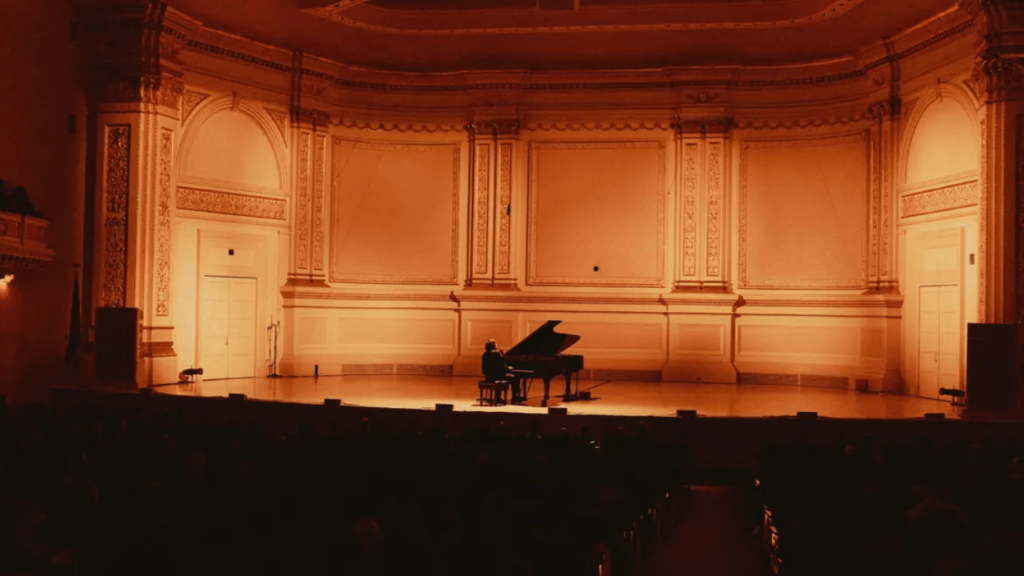
Paul Thomas Anderson’s Cameron Winter at Carnegie Hall has received largely positive reviews from critics following its world premiere at the New York Film Festival. The 72-minute concert documentary captures Geese frontman Cameron Winter performing a solo set at Carnegie Hall in December 2025, with songs mainly drawn from his debut solo album, Heavy Metal.
Instead of following the usual format of a music documentary, Anderson keeps the focus on Winter’s voice, piano arrangements and stage presence. Critics have praised the film’s cinematography, sound and intimate atmosphere, with some describing it as a deeply moving musical experience. However, its slow pace, minimal storytelling and similar musical arrangements have also divided opinion.
The Hollywood Reporter’s Frank Scheck describes the film as “beautifully done, though not for all tastes.” He praises Winter’s haunting baritone and meditative performance, noting how the singer appears completely absorbed in his music. Scheck also appreciates Anderson’s decision to keep the documentary simple, with the concert unfolding almost entirely without interviews, commentary or additional storytelling.
The director uses close-ups and different camera angles to give viewers a closer view of Winter than the live audience would have experienced. However, Scheck finds that the songs’ similar pace and less conventional melodies can make parts of the performance feel monotonous. Despite this, he considers the film an effective concert experience that brings the audience into the room.
The Guardian gives the film four out of five stars, describing it as a “sumptuous recording” and an “immediate classic.” The review praises the way Anderson balances the grandeur of Carnegie Hall with the intimacy of Winter’s solo performance. Shot on 35mm, the film uses minimal editing and effects, allowing the music and atmosphere of the venue to take center stage.
The Guardian also highlights Winter’s powerful baritone and evocative lyrics, which give the performance an almost hypnotic quality. While the documentary avoids conventional elements such as interviews and background explanations, the review sees its focused approach as a key part of its appeal.
Variety’s Owen Gleiberman also responds positively, praising the film’s ability to create a distinctive musical atmosphere. He highlights Winter’s voice as the central strength of the documentary, describing how the singer’s delivery brings emotional depth to songs that explore heartbreak, faith and personal uncertainty.
Variety appreciates the way Anderson allows the performance to unfold without unnecessary interruptions, turning the concert into a slow-moving musical journey. However, Gleiberman notes that many of Winter’s songs share a similar tempo and unconventional structure, which can make the film feel somewhat drawn out. For him, Winter’s expressive voice and emotional commitment help maintain the film’s impact.
IndieWire’s Ryan Lattanzio offers one of the film’s most enthusiastic responses, describing it as a “spellbinding” concert documentary and a “gorgeously tender performance.” He praises Anderson’s cinematography and the way the filmmaker captures Winter’s emotional connection to his songs.
IndieWire highlights the contrast between the scale of Carnegie Hall and the personal nature of Winter’s performance, with the singer alone at a piano creating an intimate experience for the audience. Lattanzio also points to Anderson’s mobile camera work, which moves around the stage and captures the changing expressions and movements of the performer. He finds that the stripped-down arrangements bring out the emotional strength of songs such as “$0” and “Love Takes Miles,” making the film feel immersive and deeply personal.
Paul Thomas Anderson’s direction is one of the most consistently praised aspects of the film. Rather than simply recording the concert from a fixed position, he uses close-ups, changing camera angles and carefully controlled lighting to create a cinematic experience. Frank Scheck notes that the camera occasionally shifts to unusual viewpoints, including shots from the rear of the stage and the ceiling, while Lattanzio praises the mobile camera work for capturing the emotional details of Winter’s performance.
The Guardian also highlights the film’s use of 35mm cinematography and minimal editing, which help preserve the atmosphere of the live event. These different approaches to filming allow the documentary to move between the scale of the venue and the quiet intensity of Cameron Winter’s music. For critics, Anderson’s restrained direction works particularly well because it does not compete with the performance or distract from the songs.
Cameron Winter’s performance is another major strength identified across the reviews. The Geese frontman performs alone at a Steinway grand piano, delivering songs with a deep, expressive voice and a distinctive vocal style. Critics have praised his ability to move between haunting, meditative passages and moments of greater emotional intensity. Lattanzio highlights the tenderness of his performance, while Scheck notes the singer’s almost trance-like focus on the music.
The film also captures Cameron Winter’s reserved stage presence. He spends much of the concert seated at the piano, with very little interaction with the audience. This approach gives the performance a personal quality, allowing viewers to focus on the music, lyrics and small changes in his expressions.
Despite the positive response, some critics have pointed to the film’s limited variation. The Hollywood Reporter feels that the similar pace and structure of several songs eventually become monotonous, while Variety also notes that the music can feel slow and repetitive. The film’s lack of interviews, background information and conventional documentary storytelling may also leave some viewers wanting to know more about Winter and his music.
However, these limitations are closely connected to Anderson’s decision to focus entirely on the concert. The film does not attempt to provide a complete portrait of Winter’s life or career. Instead, it offers an uninterrupted view of one performance, allowing the music and atmosphere to shape the experience.
Overall, Cameron Winter at Carnegie Hall has been praised for its intimate presentation, Winter’s distinctive musical performance and Paul Thomas Anderson’s thoughtful direction. While some critics find the slow pace and similar arrangements repetitive, the film’s cinematography, sound and emotional atmosphere have been widely appreciated. For viewers who enjoy experimental songwriting and stripped-down concert performances, the documentary offers a focused and immersive experience.
The film is set for a North American 35mm theatrical tour beginning November 20, 2026, giving audiences an opportunity to experience Cameron Winter’s Carnegie Hall performance on the big screen.
Film Details: Cameron Winter at Carnegie Hall
Director: Paul Thomas Anderson
Starring: Cameron Winter
Genre: Documentary, Music
Runtime: 72 minutes
Language: English
Premiere: New York Film Festival (NYFF) 2026
Release: November 20, 2026 (U.S. theatrical debut)