
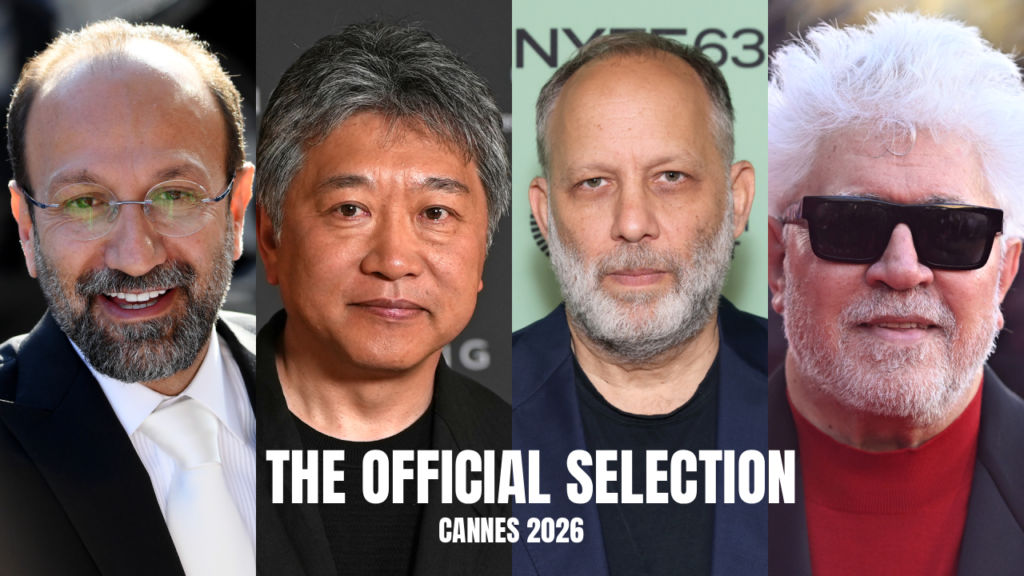
Cannes 2026 Lineup Reveals Its Official Selection, setting the stage for what promises to be one of the most globally diverse and auteur-driven editions in recent years. Scheduled to run from May 12 to May 23, the festival will open with Pierre Salvadori’s La Vénus Électrique, a 1920s-set French romantic comedy that immediately signals a return to character-driven storytelling at the heart of the Croisette.
As always, the Competition section remains the centerpiece of Cannes, and this year’s lineup reflects a strong convergence of established auteurs and internationally acclaimed filmmakers. Pedro Almodóvar returns with Amarga Navidad, continuing his long-standing relationship with the festival, while Asghar Farhadi’s Parallel Tales marks another anticipated entry from one of contemporary cinema’s most consistent storytellers. The presence of Hirokazu Kore-eda (Sheep in the Box) and Ryusuke Hamaguchi (All of Sudden) further strengthens the Asian representation in the lineup, reinforcing Cannes’ commitment to global storytelling.
European cinema continues to dominate the Competition slate, with Pawel Pawlikowski’s Fatherland and Andrey Zvyagintsev’s Minotaur standing out as major entries from filmmakers known for their distinct visual and thematic signatures. Alongside them, filmmakers like Lukas Dhont, Valeska Grisebach, and Charline Bourgeois-Tacquet contribute to a lineup that balances returning masters with voices that continue to evolve within the festival circuit. This mix is central to Cannes’ identity — a space where legacy filmmakers coexist with emerging auteurs, each contributing to a broader cinematic dialogue.
What becomes evident when looking at the Competition lineup is not just the strength of individual films, but the patterns that emerge. Cannes once again leans heavily into auteur-driven cinema, prioritizing directors with established voices and clear artistic identities. At a time when the global industry is increasingly shaped by franchise filmmaking and streaming platforms, Cannes continues to position itself as a counterpoint — a space where cinema is treated as an art form rather than purely a commercial product.
Beyond the main competition, the Un Certain Regard section offers a glimpse into the future of cinema. Opening with Jane Schoenbrun’s Teenage Sex and Death at Camp Miasma, the section is populated with a significant number of debut features and emerging filmmakers. This includes projects from a wide range of countries and creative backgrounds, emphasizing experimentation and new perspectives. Historically, Un Certain Regard has served as a launchpad for filmmakers who later move into the main competition, and this year’s lineup continues that tradition by prioritizing discovery and innovation.
The Out of Competition section, meanwhile, brings together a mix of high-profile and stylistically diverse films. Nicolas Winding Refn’s Her Private Hell stands out as one of the most anticipated titles in this category, alongside Guillaume Canet’s Karma and Andy Garcia’s Diamond. These films may not be competing for the Palme d’Or, but their inclusion ensures that Cannes remains accessible to a broader audience, blending prestige cinema with more mainstream appeal.
Cannes’ Midnight Screenings section continues to carve out space for genre-driven storytelling. Films like Quentin Dupieux’s Full Phil and Yeon Sang-ho’s Colony highlight the festival’s willingness to embrace bold, unconventional narratives that exist outside traditional arthouse frameworks. This section, while smaller in scale, plays an important role in diversifying the festival’s overall tone.
Similarly, the Cannes Premiere category showcases notable films that sit just outside the competition spotlight. Directors such as Kiyoshi Kurosawa and projects involving figures like John Travolta contribute to a lineup that ensures major works receive visibility without the pressure of competition. This approach allows Cannes to expand its programming while maintaining the prestige associated with its core sections.
The Special Screenings lineup further broadens the festival’s scope, with a strong emphasis on documentary and biographical storytelling. Names like Ron Howard and Steven Soderbergh bring additional weight to this section, particularly with projects like John Lennon: The Last Interview. These selections underline Cannes’ role not just as a showcase for fiction, but as a platform for diverse forms of cinematic expression.
Taken as a whole, the 2026 lineup reflects a festival that remains deeply rooted in its identity while subtly adapting to the changing dynamics of global cinema. The continued prominence of auteur filmmakers suggests that Cannes is committed to preserving a certain vision of cinema — one that prioritizes artistic intent, thematic depth, and cultural diversity. At the same time, the inclusion of genre films, documentaries, and emerging voices indicates an awareness of the need to evolve.
In an industry increasingly dominated by large-scale franchises and algorithm-driven content strategies, Cannes continues to operate as a distinct space — one that resists homogenization and instead celebrates the individuality of filmmakers. The 2026 edition, with its blend of established masters and new talent, reinforces that position.
As the festival prepares to welcome filmmakers and audiences from across the world, the official selection offers more than just a list of films. It provides a snapshot of where global cinema stands today — diverse, fragmented, and constantly evolving, yet still anchored by a shared commitment to storytelling.
Cannes 2026, once again, is not just a festival. It is a statement about cinema itself.
Read More:
- How much does responsibility seep into filmmaking? Or does it at all?
- Top 10 Visually Stunning Films Ever Made, Ranked by PoF
- Beyond Hype: The 10 Indian Films Defining Anticipation in 2026
- When Beauty Becomes a Prison: The Eternal Relevance of Jalsaghar
- When Fiction Predicts Reality: Movies That Became True