
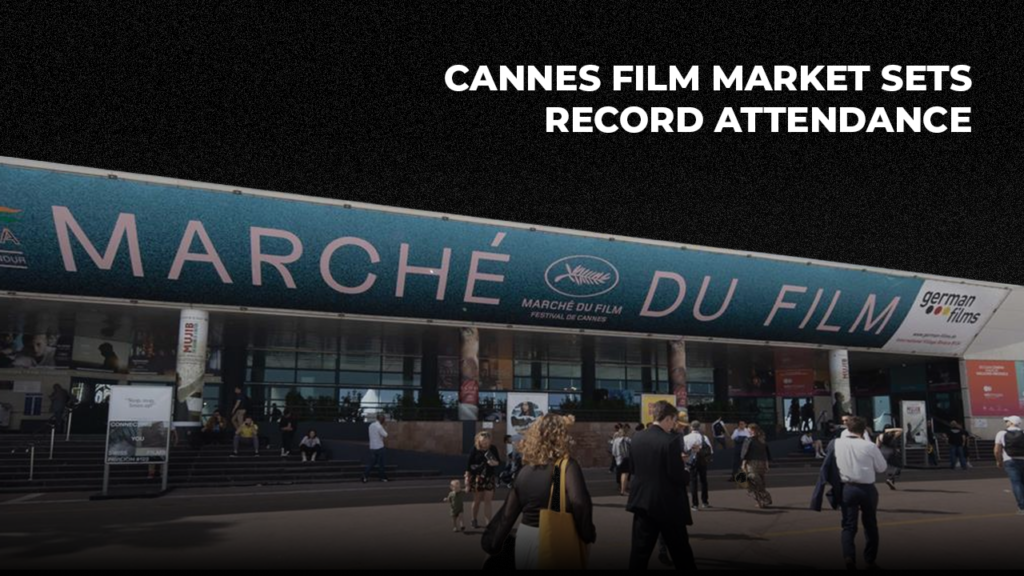
Cannes Film Market 2026 is opening its present edition with record attendance, reaffirming its position as the most important global marketplace for film sales, financing and international distribution. In a release issued ahead of its May 13 opening, the market said around 40,000 professionals are expected across the broader Cannes Film Festival ecosystem, with nearly 16,000 registered market participants from more than 140 countries.
The numbers are slightly higher than last year and arrive at a complicated moment for the global film industry. Theatrical recovery remains uneven, independent distributors are cautious, geopolitical tensions continue to affect co-production and sales conversations, and Hollywood’s red-carpet presence at Cannes appears lighter than usual this year. Yet the record registration shows that the industry still sees Cannes as the one place where the global cinema business gathers at full force.
Cannes Remains the Film Industry’s Business Hub
The Marché du Film runs from May 13 to 20 alongside the Cannes Film Festival. While the festival often attracts wider attention for its red carpets, premieres and auteur competition titles, the market is where much of the real business happens. Films are sold, projects are packaged, financing conversations begin, distributors compete for rights, and producers test the international appetite for upcoming titles.
Guillaume Esmiol, executive director of the Marché du Film, described the market as a place of action built around three essential pillars: a global marketplace for film sales, a platform where projects are created and financed, and a hub where the industry shares knowledge and shapes its future. That framing is especially relevant this year, as the film business continues to search for stability after years of disruption.
U.S., France and U.K. Lead Attendance
The United States, France and the United Kingdom remain the top three countries in terms of attendance, while Europe continues to be the most represented region overall. This confirms that the traditional centres of film sales and distribution still hold strong influence at Cannes. However, the broader attendance pattern also shows how the market is becoming increasingly global in scope.
Japan and Asia Drive a Major Attendance Surge
Asia is one of the major stories of this year’s market. Japan, which is the Country of Honour for the 2026 edition, has recorded a nearly 50% increase in attendance and has become the fifth most represented country at the market. That surge reflects the growing international importance of Japanese cinema, anime, IP-driven storytelling and Asian co-productions at a time when global buyers are looking beyond traditional Hollywood pipelines.
Africa and Latin America Expand Their Presence
Sub-Saharan Africa is also expanding its presence. Benin is taking a stand at the market for the first time, while Guinea is represented at the Village International. Latin America is strongly represented as well, supported by activities organized in collaboration with Ventana Sur, the leading Latin American audiovisual market. Together, these developments point toward a Cannes market that is no longer only about Europe and North America, but about a wider global film economy trying to claim more space.
Buyers, Screenings and Events Show the Scale of Cannes 2026
The scale of the 2026 market reflects that ambition. Cannes Marché du Film has registered around 1,700 buyers and 600 exhibiting companies this year. The event will also feature approximately 1,500 festival and market screenings, 250 industry events and 100 conference sessions. These figures show why Cannes remains central to the international film calendar: it is not simply a showcase, but a working marketplace where the next wave of films and deals begins taking shape.
Global Film Presence at Cannes 2026

The record attendance is also reflected in the range of films and projects being presented across regions. India has a visible presence through titles such as Balan: The Boy, Amma Ariyan, September 21, Shadows of the Moonless Nights, Lakadbaggha 2: The Monkey Business, Spirit of the Wildflower and Chardikala, covering market screenings, restored classics and festival-linked showcases.
The UK is also bringing several high-profile market packages, including star-driven and genre-facing titles such as John Doe, A Woman in the Sun, The Spacesuit, Starman, Night Swimming and Foxfinder. These projects show how the Cannes market continues to balance prestige cinema with commercially positioned packages built around recognizable talent.
Japan’s presence is especially important this year as the Country of Honour, with its increased participation expected to spotlight Japanese cinema, animation, genre storytelling and IP-driven projects. While the market focus goes beyond individual titles, Japan’s nearly 50% attendance surge reflects the growing global demand for Japanese film culture, anime and cross-border co-productions.
Latin America is represented strongly through activities connected to Ventana Sur, giving the region a platform for new films, co-productions and audiovisual projects from across Argentina, Uruguay and the wider Latin American industry. Africa’s growing footprint is also visible through new national participation, including Benin taking a stand for the first time and Guinea being represented at the Village International, signalling a broader push for African cinema to gain space in global sales and festival conversations.
Together, these regional showcases underline why Cannes remains central to the film business. The market is not only about established European and American players; it is increasingly becoming a place where Indian regional cinema, UK prestige packages, Japanese storytelling, Latin American co-productions and African industry voices compete for international visibility.
Lighter Hollywood Footprint, Stronger Market Energy
This year’s record attendance also stands in contrast to a reportedly lighter Hollywood premiere footprint at the festival. Several major studio titles are not expected to dominate the Cannes red carpet this year, with the festival side leaning more toward international auteurs and global cinema. But that does not mean Hollywood and major distributors are absent from Cannes. Many executives still attend the market to acquire finished films, evaluate packages, meet sales agents and look for projects that can fill future release slates.
That distinction is important. Cannes may look less Hollywood-heavy on the surface, but the market remains commercially intense. In fact, a lighter studio premiere lineup may make the business side even more important, because distributors and sales companies are still searching for films that can work in a theatrical environment that has become harder to predict.
Independent Film Business Remains Cautious
The independent film business remains cautious. While box office recovery has improved in some markets, the success is uneven. Industry executives have repeatedly pointed out that the market has become more binary: films that connect with audiences can perform strongly, but films that fail to create urgency can disappear quickly. That makes Cannes a high-pressure environment, where buyers are not simply looking for prestigious names, but for projects that can actually travel, generate conversation and survive in theatres.
This shift is also changing the kind of films that attract attention at the market. Specialty cinema is increasingly becoming more genre-driven and younger-audience focused. Buyers are looking for thrillers, horror films, action titles, erotic dramas, emotional prestige projects and hybrid stories that feel fresh enough to break through. The old model of quiet arthouse prestige alone is no longer enough for many distributors. Films now need a sharper hook, a stronger identity or a clearer audience path.
Cannes Market Shows Why the Industry Still Needs a Global Meeting Point
The larger story of Cannes Marché du Film 2026 is therefore not just about record numbers. It is about why those numbers matter. At a time when the global film industry is facing uncertainty, Cannes remains the one place where nearly every part of the business still converges. Producers arrive with packages, buyers arrive with caution, national film bodies arrive with ambitions, and distributors arrive searching for the few titles that can cut through a crowded and unpredictable market.
The record attendance suggests that the film industry still needs a central global meeting point. Even as streaming habits change, theatrical recovery remains uneven and consolidation reshapes the studio landscape, Cannes continues to function as a marketplace where cinema’s next direction is negotiated.
In that sense, the 2026 Marché du Film sends a clear signal. Cannes may be less Hollywood-heavy on the festival side this year, but its market energy remains stronger than ever. The red carpet may create the headlines, but the business of global cinema is still being shaped inside the Marché.
Read More: