
“Life no be Nollywood,” Nigerians often say when life gets hard or takes an unexpected turn. It is a familiar expression, usually said with a touch of humour.
But there is something worth thinking about in the fact that an entire film industry has become part of everyday language. Nigerian cinema has travelled far, finding a place in the way people speak, recognise themselves and make sense of the world around them. The industry did not begin with the resources or infrastructure that one might associate with a major film-producing country. Much of its modern growth came from a period when making films was itself an act of necessity.

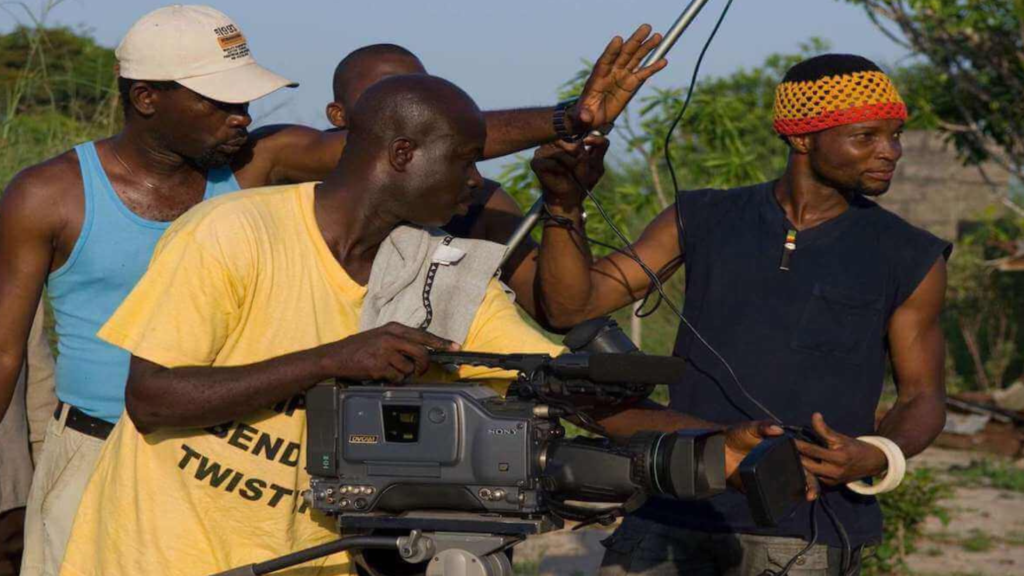
During the 1980s and 1990s, economic difficulties, a lack of production equipment and limited funding made traditional filmmaking increasingly unsustainable. Audiences, however, still wanted stories of their own. Filmmakers found another way to reach them through home videos, selling films on VHS tapes and distributing them directly to households.
Chris Obi Rapu and Christian Onu’s Living in Bondage (1992) became one of the defining successes of this period. Its popularity encouraged more people to take up video filmmaking, and an industry began to grow around a format that was accessible to both filmmakers and audiences. The productions were often made on modest budgets and at a remarkable pace. Their technical limitations were apparent, but so was the appetite for them.
People were watching stories that felt familiar, spoke their languages and reflected the lives and concerns around them.
The name Nollywood came later, coined in the early 2000s as international attention began to turn towards the scale of Nigerian film production. It is now commonly used to describe the country’s film industry, which is among the largest in the world by the number of films it produces. Yet the name does not quite capture how varied that cinema has always been.

Nigeria is home to hundreds of indigenous languages, and its films have grown through several distinct traditions. Hausa-language cinema, often referred to as Kannywood and centred in Kano, has its own relationship with music, performance and Islamic values. Yoruba cinema has long drawn from folklore, theatre and cultural traditions, while Igbo and English-language productions have explored urban life, family relationships and the changing aspirations of a growing society.
These are not just different ways of making films. They are different ways of telling stories about a country that cannot be understood through one language or experience alone.
The subjects of those stories have also changed over time. Family, faith, the conflict between traditional values and modern life, and the desire to escape poverty have remained notable concerns. Supernatural stories, often involving juju and the consequences of the pursuit of wealth, found a large audience in the early video-film era. Crime films turned towards corruption and the circumstances that push people into tough lives. More recent productions have also begun to confront subjects such as domestic and sexual abuse and human trafficking.
The stories have not abandoned the concerns that shaped earlier Nigerian cinema, but the range of experiences being brought to the screen has surely widened.

A change in the way films were made began to take shape in the 2000s. The home-video industry had established an audience, but there was growing interest in productions with larger budgets, more careful technical work and stories that could travel beyond the direct-to-video market. This period came to be associated with New Nigerian Cinema. Kunle Afolayan’s Irapada (2006) and The Figurine (2009) were among the films that helped demonstrate what a more professionally produced Nigerian film could look like. Kemi Adetiba’s The Wedding Party (2016), meanwhile, became a major box-office success, showing that local productions could draw large audiences into cinemas.
That shift was key, but it did not mean that the earlier form of Nigerian filmmaking had become irrelevant.
The home-video era had created the audience and the independent spirit on which much of the industry continued to depend. What changed was the number of avenues through which filmmakers could reach people. Cinema screens became increasingly essential, and later, streaming platforms offered another possibility.
Netflix’s acquisition of Genevieve Nnaji’s Lionheart (2018) opened up new opportunities for Nigerian cinema. This was followed by films such as Swallow (2021), The Black Book (2023) and Jagun Jagun (2023). Amazon Prime Video also stepped in, backing Nigerian productions such as Jadesola Osiberu’s Gangs of Lagos (2023). For filmmakers, these platforms offered access to audiences outside the country and the possibility of working with larger production budgets. Evidently, Nigerian stories were beginning to reach people who might have never encountered them through a local cinema or a home-video release.
But that relationship proved less certain than it first appeared.
In 2024, both Netflix and Amazon Prime Video began pulling back from Nigerian original productions, partly because of economic pressures and the strain of attracting a large enough subscriber base. The change exposed a concern that had existed long before streaming, that international visibility does not necessarily translate into a reliable system for financing and distributing films. It also left filmmakers having to think again about where their audiences were and how their work could reach them.
There has, meanwhile, been a growing reason for confidence in the domestic market.
Between 2019 and 2025, the number of cinema screens in Nigeria increased from 218 to 369. Nigerian films were also beginning to find larger audiences in cinemas, accounting for nearly half of box-office revenue in 2024. The following year, box-office collections across Anglophone West Africa reached ₦15.6 billion, a 36 per cent increase from 2024. Rising ticket prices and the cost of living are also part of this picture, but there is a rising intrigue in seeing local stories find their place on the big screen.
Funke Akindele’s films are a good example of this growing fascination. A Tribe Called Judah (2023) and Everybody Loves Jenifa (2024) drew large audiences, while Behind the Scenes (2025) crossed ₦1 billion at the box office within 19 days of its release. Their success is also suggestive about the way Nigerian audiences relate to their own cinema. There is a curiosity in stories that feel familiar, reflect their experiences and give people something they can connect to as their own.
The challenge is making that experience accessible to more people. Even with the growth in cinema screens, many audiences still have to travel considerable distances to reach one.
International recognition, on the other hand, has opened another chapter.

C.J. Obasi’s Mami Wata (2023), which received a Special Jury Award for Cinematography at Sundance, brought West African mythology and visual traditions to international attention. Daniel Oriahi’s The Weekend (2024) premiered at Tribeca, while Akinola Davies Jr.’s My Father’s Shadow (2025) became the first Nigerian film to be selected for the Cannes Film Festival’s official selection, where it also received a Special Mention for the Caméra d’Or.
These achievements are vital not just because they bring Nigerian filmmakers to the international stage, but because they allow stories rooted in their own history and culture to reach audiences all over without losing what makes them distinct.
However, international credit is only one part of the journey. A film may find a place at a major festival and still struggle to secure distribution or reach audiences in other countries. Even within West Africa, cultural differences can affect how humour, references and everyday experiences are understood. The large Nigerian diaspora provides a substantial audience in countries such as the United Kingdom, the United States and Canada, but reaching people beyond these communities remains a more strenuous task. Building those connections requires more than getting a film onto a streaming platform. It requires distributors, regional sales networks and a better understanding of the audiences a film might find elsewhere.
The difficulties begin much earlier, too. Production costs remain high, reliable electricity is not always available, and a shortage of dedicated soundstages means filmmakers often have to work around the limitations of available locations. The industry also continues to face gaps in technical training and professional development, along with struggles in securing funding. Piracy remains another concern, as it has been since the early days of home video, even though the Copyright Act of 2022 has brought stronger legal protection for creative work.
Some steps are already being taken to address these challenges.
The Africa International Film Festival (AFRIFF), through its Film and Content Market, has been working to connect filmmakers with buyers, distributors, and investors. Government initiatives, including tax incentives, co-production agreements and plans for studio facilities, are also intended to improve the conditions in which films are made. But these measures will matter most when they translate into opportunities for filmmakers to develop their skills, finance their projects and reach audiences without having to depend on a small number of international platforms.
What makes Nigerian cinema’s journey worth paying attention to is not simply the number of films it produces or the recognition it receives. It is the distance between the circumstances in which the industry first grew and the possibilities now opening up for it. An industry that once depended on home videos and the determination of people working with very little has built a substantial audience and found its way into cinemas and film festivals around the world. Its growth has never been without setbacks, and the next stage will depend on whether the structures supporting that creativity can grow alongside it.
For all the attention Nollywood now receives, the impulse that brought it into being remains crucial, and that’s the desire to tell stories of one’s own people, in one’s own voice, and to find an audience willing to listen. The industry has already shown that those stories can travel. The question now is whether it can build the means to keep telling them and ensure they reach as many people as they deserve.