
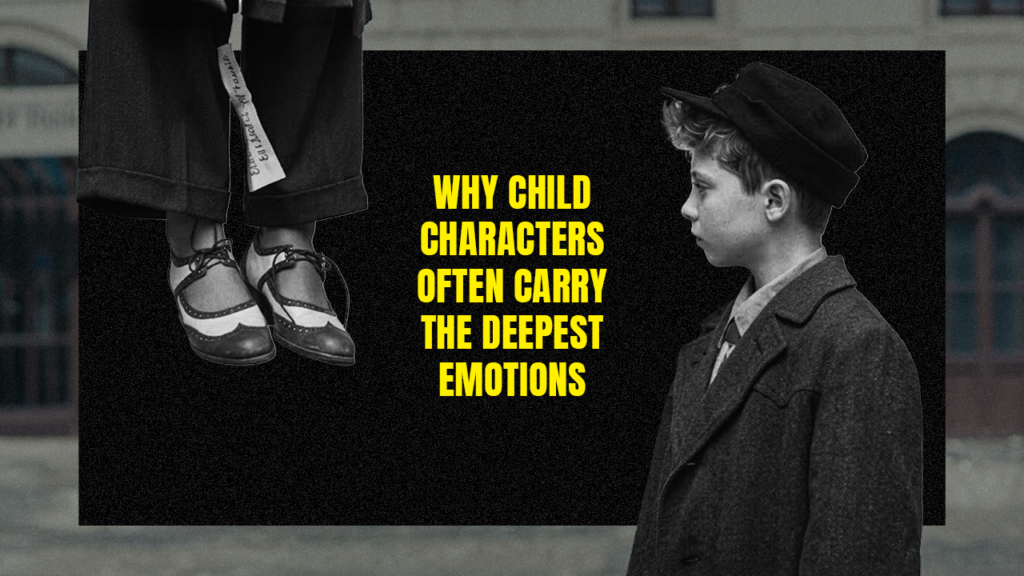
There’s something about child characters in cinema that cuts deeper than almost anything else. Maybe it’s because children haven’t yet learned how to hide emotion. They haven’t mastered performance the way adults do. Their grief is direct. Their joy is complete. Their curiosity has no filter. When a filmmaker chooses to tell a difficult story through a child’s eyes, the world suddenly feels more exposed, more fragile, more unfair.
You look at a child and you see someone untouched by the machinery of the world. Someone whose understanding of life is still forming in real time. Their eyes haven’t yet hardened because of disappointment or routine or survival. They ask questions adults stopped asking years ago. They notice things others ignore. And cinema has always understood that.
Children experience life before it becomes fully processed. Through them, films reveal situations to their rawest emotional truth.
Take divorce, for example. Two adults separating is painful enough for the two of them. You understand the grief of losing someone you once thought would stay forever. But naturally, your mind goes elsewhere first, what of the child? The silent sufferer in the corner of the room. The one who didn’t choose any of this but still has to absorb all of it. Suddenly, a kid who should only be worried about school, games, scraped knees, and friendships is forced into the problems of adulthood.
And if something as common as separation already feels heavy through a child’s perspective, then imagine war. That’s why films centered around children often become some of cinema’s most emotionally devastating works.
Take Jojo Rabbit (2019), for instance, directed by New Zealand filmmaker Taika Waititi and set in Nazi Germany during World War II. The film follows Jojo, a lonely child trying to understand nationalism, war, masculinity, and fear all at once. He asks questions adults around him no longer ask because ideology has already numbed them. And then comes the scene that completely shifts the film. Jojo discovering his mother. But Waititi does not immediately show us her face. He frames the moment from Jojo’s height. We first see her shoes hanging still. Earlier in the film, those same shoes danced joyfully with him in the streets. Now they become the image through which a child recognizes death.
That is cinematic perspective. The emotional devastation comes not from showing death directly, but from showing how a child processes it visually.
Italian filmmaker Roberto Benigni uses a similar emotional contradiction in Life Is Beautiful (1997), set during the Holocaust in Nazi-occupied Italy. Inside a concentration camp, Guido convinces his son Giosuè that everything happening around them is part of a game. Hide properly, stay quiet, obey rules, and you win a tank. The brilliance of the film is not simply that Guido protects his son. It’s that he performs optimism until the very end because he understands that once innocence disappears, it cannot be rebuilt. Near the end, Guido passes by his son’s hiding place one last time before being executed. He exaggerates his walk into a comic march to make the boy laugh. The child smiles, but the audience breaks.
Iranian cinema understood that innocence existing beside horror is what gives cinema its emotional force long before much of the world started paying attention to it. Directors from Iran repeatedly used children as the face of the films. Through them, everyday struggles suddenly became profound.
In Children of Heaven (1997) by Majid Majidi, the conflict revolves around a lost pair of shoes. That’s it. Ali loses his sister Zahra’s shoes, and because their family cannot afford another pair, the siblings begin sharing one pair between school timings in Tehran. In most films, this would barely qualify as conflict. Here, it becomes emotionally consuming. Because to children, small things are never small. Ali starts behaving older than he is. He hides the truth from his parents because he already understands financial strain. There’s tenderness and care in the way that he waits anxiously every day so that he can grab the shoes from Zahra and sprint across crowded streets to reach his own classes before the gates close. Majidi films these runs almost like survival sequences.
And then comes the final race. Ali participates in a marathon because third prize is a pair of sneakers. Not first, but third. Throughout the race, the camera remains close to his exhausted face, his breathing, his desperation. And then, by accident, he wins first place instead. Everybody celebrates. Ali quietly collapses emotionally. That ending hurts because adults understand the irony, but Ali only understands disappointment. A child succeeding and still losing.
Majidi explored another extraordinary child perspective in The Color of Paradise (1999). The film follows Mohammad, a blind child who experiences the world primarily through touch and sound. The camera slows down around him. You hear birds before seeing them. You notice textures, wind, water.
What makes the film devastating is the contrast between Mohammad and his father. The father increasingly sees him as a burden, while Mohammad continues searching for God through nature itself. At some point, he even wonders why God made him blind if He loves him. A child asking spiritual questions always lands harder because children ask without performance. They ask because they genuinely need answers.
In the film The Kid (1921), made during the silent era in the United States by English filmmaker Charlie Chaplin, the story is simple of a poor tramp and an abandoned child surviving together. But Chaplin understands something crucial, poverty becomes emotionally unbearable when seen through a child’s presence. The brilliance of the film is that it constantly shifts between humour and desperation without warning. One moment the Tramp and the kid are improvising ways to survive, and the next, authorities arrive to separate them. And because this is silent cinema,
Chaplin cannot rely on dialogue either. Everything comes through movement and expression.
Children-centric cinema takes emotionally simple truths and presents them without armour.
Post-war Italian cinema carried that same emotional honesty decades later. In Cinema Paradiso (1988), Italian filmmaker Giuseppe Tornatore transforms childhood memory into something almost sacred. Set in Sicily after World War II, the film follows young Salvatore, a boy enchanted by cinema and by Alfredo, the aging projectionist who quietly becomes a father figure to him. The film works because Salvatore experiences films with complete and newly found wonder, and a child’s gaze transforms even the ordinary into extraordinary.
That same emotional transformation exists in the most renowned Indian filmmaker Satyajit Ray’s Pather Panchali (1955), one of the defining works of Bengali and Indian cinema. Made in post-independence India and heavily influenced by Italian neorealism, the film follows Apu and his sister Durga growing up inside rural poverty in Bengal. But Ray never frames them as “poor children” first. He frames them as children. You can’t help but notice that distinction.
Apu doesn’t yet fully understand economic struggle the way adults around him do. He experiences life through moments. And then comes one of the most celebrated moments in world cinema, Apu and Durga running through vast kaash fields to see a train passing in the distance for the very first time. The scene lasts only minutes, but it feels enormous because Ray shoots it entirely through discovery. The train is not depicted as a means of transportation to them. It represents possibility. Another world existing somewhere beyond the one they know. It’s due to such sequences that Pather Panchali is considered “poetry on celluloid” in the world of cinema.
Children give scale to things adults stop noticing. That is what filmmakers understand. Children feel everything before they learn how not to. That is why child-centered films linger for decades regardless of where they come from. Childhood is one of the few emotional languages cinema makes universally understood.
Even our parent company’s film Chidiya (2016), written and directed by Mehran Amrohi, understands this deeply. The film follows two young brothers living in a Mumbai chawl after their father’s death. Their dream is simple, they want to play badminton. That simplicity is precisely what makes it emotional. Because children continue dreaming even when reality gives them every reason not to. Yet the film never loses the boys’ perspective. Their world still carries imagination. Their ambitions still feel huge to them. A cramped neighborhood becomes their dream palette. Grief exists, but so does play.
And that may be the real reason child characters carry the deepest emotions in cinema. Not because they are innocent alone. But because they haven’t yet learned emotional concealment.
They haven’t, yet, become tame.
Read More: