
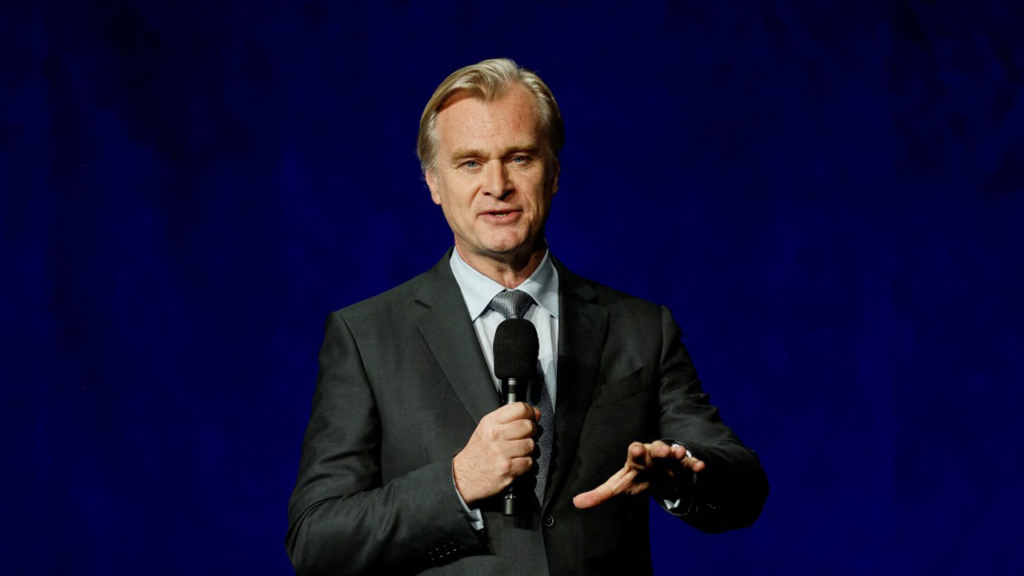
As Christopher Nolan prepares for the release of his epic The Odyssey, the Oscar-winning filmmaker has shared his thoughts on the growing role of artificial intelligence in Hollywood, arguing that generative AI is arriving at “exactly the wrong time” for filmmaking. Speaking to The Telegraph, Nolan said audiences—particularly younger viewers—are increasingly rejecting AI-generated creative content, while embracing more authentic and tactile forms of storytelling.
“I’ve never seen a more rapid wholesale dismissal of a supposedly foundational jump in technology in my lifetime,” Nolan said. “So much energy has been expended on bringing in AI, but if you look at that generation’s reaction, they’re utterly rejecting it.”
The director clarified that he is not opposed to artificial intelligence as a whole. Instead, he drew a distinction between AI as a technological tool and the growing use of generative AI in creative work. While acknowledging that “not every aspect of the technology is useless or meaningless,” Nolan argued that its increasing presence in filmmaking comes at a moment when audiences are showing renewed interest in stories that feel tangible and human.
“My children’s judgment of AI slop has been immediate and harsh,” he said, referring to his children, who are now in their late teens and early twenties. “They see it for what it is very quickly—and it’s much easier for them to identify it, because it grew out of an online world they know really well.”
According to Nolan, the industry’s growing fascination with AI contrasts with what he sees happening among moviegoers. After years in which digital filmmaking, virtual production, and computer-generated environments became increasingly common, he believes audiences are gravitating back toward more practical filmmaking and authentic visual experiences.
“After years of driving towards heavily virtual environments, we’re seeing a renewed interest in more tactile, more real forms of storytelling,” he explained.
The comments also reflect the philosophy behind The Odyssey, Nolan’s upcoming adaptation of Homer’s epic poem. The production was filmed across multiple international locations using practical sets, real-world environments, and large-scale photography. The film has also been described as the first feature shot entirely on IMAX film, continuing Nolan’s long-standing preference for large-format photography and practical filmmaking techniques over extensive digital production.
Alongside his comments on AI, Nolan expressed optimism about the future of cinema, pointing to a new generation of filmmakers whose work he believes demonstrates that audiences continue to value originality.
“I think cinema is vital and essential and continues to transform itself,” Nolan said. “We’ve got all these great new young voices in movies, making the medium their own and moving it forward.”
Among those filmmakers, Nolan singled out Curry Barker, director of the breakout horror hit Obsession, and Kane Parsons, the filmmaker behind Backrooms. Both films have emerged as some of this year’s biggest surprise commercial successes and, according to Nolan, demonstrate that audiences remain willing to embrace unconventional storytelling.
Released in May, Obsession became one of the year’s most remarkable box office stories, grossing more than $400 million worldwide against a reported production budget of just $750,000. After premiering at the Toronto International Film Festival, it went on to become the highest-grossing festival acquisition of all time and the highest-grossing release in Focus Features’ history.
Nolan also praised Backrooms, which has surpassed $350 million worldwide and established itself as one of A24’s biggest global successes. Directed by Kane Parsons, who became the youngest filmmaker to top the domestic box office, the film earned particular praise from Nolan for its willingness to embrace ambiguity and atmosphere.
“Parts of Backrooms are like David Lynch at his most obscure,” Nolan said, adding that younger audiences have enthusiastically embraced the film despite its unconventional storytelling.
The success of those films, he argued, challenges a common assumption within the industry—that younger viewers have shorter attention spans and are less willing to engage with ambitious or slower-paced cinema.
“This is why I never bought into the arguments that young audiences’ attention spans are too fried to enjoy a three-hour Greek epic,” Nolan said. “Those films are so mysterious and ruminative… and yet young people can’t get enough of them.”
Nolan’s latest remarks arrive as Hollywood continues to debate the role of artificial intelligence in filmmaking. Studios and technology companies are increasingly exploring AI-assisted tools for visual effects, post-production, script development, and other aspects of production. At the same time, the technology remains one of the industry’s most closely watched and debated topics following the writers’ and actors’ strikes, during which AI protections became a central issue.
While acknowledging that artificial intelligence has practical applications, Nolan suggested that cinema’s future will continue to be shaped by filmmakers with distinctive creative voices rather than by technology alone. Pointing to the success of films like Obsession and Backrooms, he argued that audiences are still responding most strongly to originality, practical craftsmanship, and stories that feel unmistakably human.
Read More: