
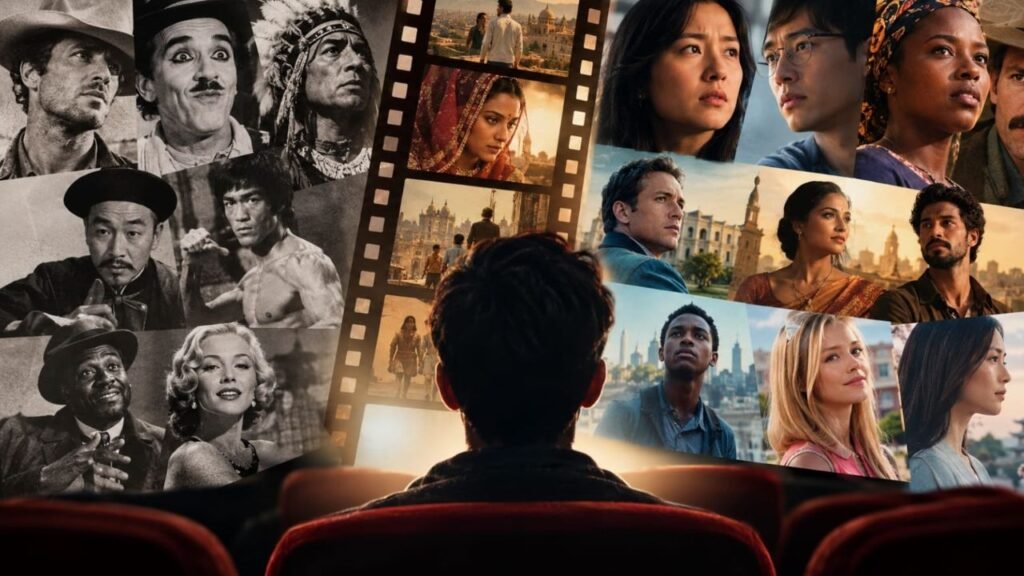
We may think of stereotypes as something that already exists in society, and cinema simply as bringing them to the screen. But sometimes, it works the other way around too.
We see a certain kind of person often enough in films, in the same clothes, speaking in the same way, behaving in the same manner, until that image begins to feel familiar. And once something feels familiar, it becomes easy to believe that it must also be true.
This is one of the strange powers of cinema. A film may only be showing us a character, but sometimes what stays with us is not the character. It is the idea of what that character is supposed to represent.
Western cinema has been doing this for a very long time. Some of its earliest films were already creating racial and cultural caricatures that audiences would repeatedly encounter. Native Americans were often shown as hostile savages or raiders, while Black characters were reduced to racist caricatures through blackface and minstrelsy, a form of theatre developed in the 19th century for entertainment by comically stereotyping and mocking African-Americans. Asian characters were turned into exaggerated versions of the “Yellow Peril,” mysterious foreigners, martial artists, spies or socially awkward geniuses.
These images did not appear out of nowhere. Many of these stereotypes existed before cinema, shaped by colonialism, racism and the way different societies had already been described by those with power.
But film gave those ideas a face. And once an idea has a face, it can become much harder to forget.

One of the clearest examples is Mickey Rooney’s Mr. Yunioshi in the film Breakfast at Tiffany’s (1961). The character was played as a caricature of a Japanese man, with exaggerated makeup, mannerisms, and speech. Today, the performance is widely recognised as a particularly uncomfortable example of yellowface. But for audiences at the time, it was presented within a comedy, making it easier for the stereotype to pass as entertainment.
The same thing happened with Asian characters in many other films. Chinese men could be gamblers or connected to crime. Japanese women could be mysterious and oversexualised. Later, Asian characters became the smart ones, the doctors, scientists, engineers, and mathematics geniuses. The stereotype changed, but it was still a stereotype.
There’s something interesting about this because being represented positively does not automatically mean being represented fairly and fully.
The “model minority” image may sound flattering compared to a racist caricature, but it can still reduce people to a narrow expectation. The Asian character is intelligent, hardworking and technically gifted, but often socially awkward or lacking individuality beyond these traits. The “Asian and nerdy” stereotype simply replaces one box with another.
Even the popularity of martial arts created its own kind of image. Bruce Lee, Jackie Chan and Jet Li became hugely influential figures, but the visibility of martial arts also meant that Asian characters were frequently expected to be physically skilled in a way that had little to do with who they were supposed to be as people.
And then there is the idea of the “Mighty Whitey, Mellow Yellow” dynamic, where the white protagonist becomes the central figure while the Asian character remains the skilled sidekick, guide or exotic companion. The story may be set in Asia, involve Asian culture and even revolve around an Asian character, but the perspective still belongs to someone else.
Black representation has its own long history of changing stereotypes without always escaping them.
Black characters who were once presented as buffoons or servants later became the loud, angry or dangerous man, the criminal, the drug dealer or the person coming from a supposedly blighted neighbourhood. Black women were often written as loud, sassy or endlessly strong, leaving little room for vulnerability or ordinary complexity.
Even a more modern trope like the Black Best Friend can become limiting. The character is there to support the white protagonist, make them more likeable, guide them through a difficult moment, or add diversity to the story, but their own life remains somewhere in the background. There is also the familiar moment when the Black character dies first. It may seem like a small storytelling choice when seen in one film. But when audiences repeatedly see the same kind of person being placed in the same kind of role, those choices begin to form a pattern.
Latino characters have similarly been caught between the “Latin lover” and the criminal. Women are often written as fiery, seductive or dangerous, while men can be reduced to gang members, drug dealers or undocumented immigrants. A culture that is much larger than these images gets compressed into a few recognisable traits: the accent, the sexuality, the desert, the cartel.
The same simplification happens with other nationalities too.
Russians have often been presented as tough, rough, heavily drinking and cold, particularly through the lens of the Cold War. Germans are still frequently associated with Nazis or the “Herr Doktor” scientist. British characters, meanwhile, have often been given a polished accent and placed on the other side of the conflict, as the sophisticated villain, the strict teacher or the charming antagonist.
Sometimes, the stereotype is not even about what a character does. It is simply about how they sound. An accent can tell an audience where a character is from before the character has even said anything important.
And cinema has also had a long history of deciding who gets to play whom.

White actors appeared in blackface, yellowface and redface, turning entire communities into performances. Even as some of these practices became less socially acceptable, the idea of replacing people from a particular culture with white actors did not disappear completely. Films like Ghost in the Shell (2017), Doctor Strange (2016), and Aloha (2015) all faced criticism for whitewashing characters who were originally written as Asian or Asian-American. The question was not only about casting. It was also about who gets to occupy certain stories and whose face is considered acceptable for a character to have. Because what we are talking about here isn’t simply a personality trait or even sexuality. It is about defining a character through everything a white person is not and can never be.
This becomes even more noticeable when we look at how western films have portrayed India.
For a long time, India on Western screens seemed to exist somewhere between poverty and mysticism. There were snake charmers, gurus, crowded streets, cows, colourful clothes, and exaggerated accents. Indian characters were often scientists, software employees or comic relief. The country itself could become a backdrop of dirt, chaos and exoticism.
The Darjeeling Limited (2007) and Slumdog Millionaire (2008) are very different films, but both have been discussed in relation to the way Western cinema looks at India. In Slumdog Millionaire, the poverty surrounding Jamal is an important part of the story, but it also raises the larger question of how easily poverty can become the image through which an entire country is seen.
The problem is not that poverty should not be shown. It should. The problem begins when that becomes the image.
When India is repeatedly shown through poverty, mysticism, arranged marriages, oversized weddings, Bollywood songs, and people with exaggerated accents, someone who has never been here can begin to believe that these are not just parts of India, but India itself.
There is another kind of stereotype that appears across cultures: the person who exists mainly to help someone else become a better person.
The wise Black mentor. The mystical Indian guru. The spiritual Asian guide. The Native American character who understands nature in a way the white protagonist does not. The character from another culture who seems to possess some special wisdom that the protagonist needs.
These characters can be meaningful. But when their entire purpose is to help someone else’s story, they stop feeling like people with lives of their own.
Gender stereotypes work in much the same way.

The dumb blonde. The helpless woman. The seductive woman. The hysterical woman. The woman who exists only as the love interest. Even something as simple as repeatedly presenting blonde women as unintelligent can become a cultural idea that exists beyond the films themselves. Legally Blonde (2001) plays with this stereotype, but the fact that the stereotype is so recognisable is part of what makes the joke work.
Cinema does not invent every stereotype. But it can make one easier to recognise. And that recognition can become dangerous when it starts replacing curiosity.
A person meets an Indian and expects a certain accent. Meets an Asian person and expects them to be good at mathematics. Sees a Black man and reads danger into them. Sees a woman and expects her to behave a certain way. None of these assumptions come from knowing the person. They come from having seen the image before.
This is where cinema becomes more than entertainment.
We now live in a world where a film made in one country can be watched almost anywhere. Streaming platforms have made it easier for audiences to encounter stories that they may have never found in theatres. A Korean film can become a global phenomenon. An Indian film can find audiences far beyond India. A film from Iran, Japan, or Mexico can reach someone who has never been to those countries.
And that changes the responsibility of representation too.
Films like Crazy Rich Asians (2018), The Farewell (2019) , Parasite (2019), and RRR (2022) have all reached audiences beyond the cultures they come from, while offering characters and worlds that cannot be reduced to a single familiar image. Their existence does not mean stereotypes have disappeared. It simply means audiences are being given more than one way to see people from these cultures.
Indian cinema has also increasingly moved towards stories that look at lives beyond the images that have traditionally dominated mainstream films. The film Gully Boy (2019) looks at the aspirations of young people in Mumbai’s rap scene. Masaan (2015) moves through grief, caste, and desire. Article 15 (2019) confronts caste discrimination directly.
These films do not need to make their characters perfect to make them human. And maybe that is what has been missing from stereotypes all along.
A stereotype is easy to remember because it is simple. A person is not.
A person can be contradictory, funny, insecure, ambitious, selfish, generous, afraid, and brave, sometimes all within the same day. Cinema has the ability to show all of that. It can take someone we thought we understood and make us realise that we never really did.
That is why representation matters.
Because when we keep seeing the same people in the same roles, those roles can slowly become the way we imagine them outside the screen too. Cinema can reinforce the image we already have. But it can also interrupt it. It can make us look at someone we thought we knew and notice something we had never seen before.
And the purpose of representation should not be to give us another stereotype to recognise. It should be to give us a person we did not expect to understand.