
Cinema has always had the ability to influence the way we see the world. A film can make us sympathise with someone we have never met, fear someone we have never encountered, or believe in a place and time we have never lived in. We often perceive this as the magic of cinema.
But the same ability to shape emotion, perception and memory can also make cinema an extremely effective tool for propaganda.
When we think of propaganda, we often imagine something loud and obvious. A political leader being glorified, a speech about patriotism, or a film openly asking us to hate an enemy. But propaganda does not always have to look like propaganda. Sometimes it can be hidden inside entertainment, history, comedy, romance, or even fantasy. Sometimes it does not tell us what to think at all. It simply decides what we should see.
This is what makes the history of propaganda cinema so compelling. Different governments have used cinema in very different ways, but the intention has often been similar, to shape how people understand their country, their enemies, their leaders and even themselves.=
Nazi Germany is one of the most extreme examples. After Hitler came to power in 1933, Joseph Goebbels and the Reich Ministry of Public Enlightenment and Propaganda, brought the German film industry under extensive state control. Filmmakers had to belong to the Reich Film Chamber, scripts could be controlled before production, and Jewish and politically undesirable filmmakers were pushed out of the industry. The state gradually took control of major studios as well.
But the interesting part was that Nazi cinema was not made up entirely of political films. A large proportion consisted of comedies, romances and musicals. Entertainment itself became useful because people did not need to be constantly reminded of politics. They could simply be distracted from war, hardship and restrictions while still being exposed to ideas about obedience, traditional gender roles, authority and the supposed unity of the German people.
And when the regime wanted to be direct, it knew exactly how to use cinematic language.

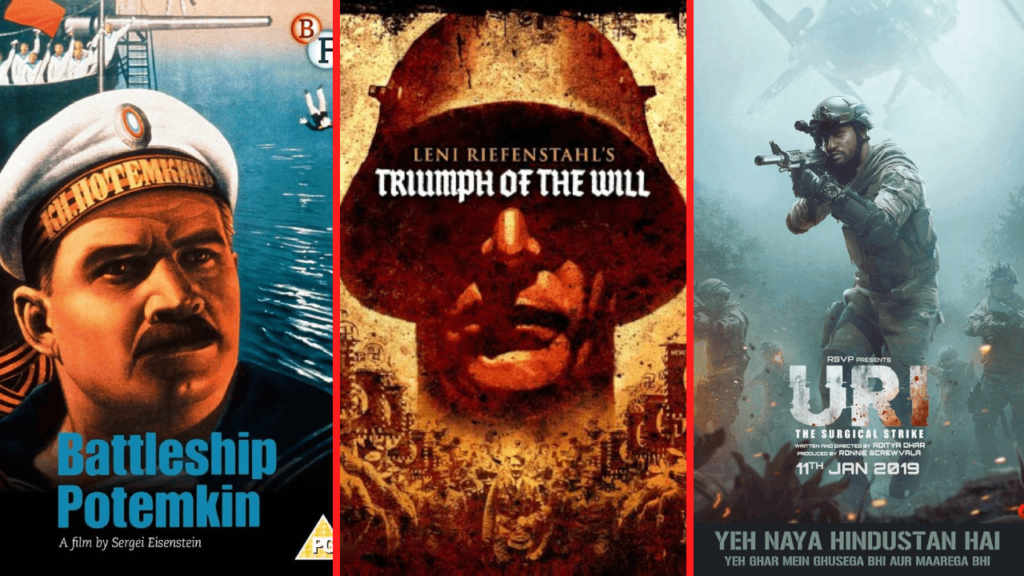
Leni Riefenstahl’s Triumph of the Will (1935) did not merely tell audiences that Hitler was powerful. It made him look powerful. The aerial arrival, enormous crowds, geometric formations, monumental architecture, and low-angle shots turned a political rally into a spectacle. Other films went further. The Eternal Jew (1940) used dehumanising imagery to spread antisemitism, while Jew Süss (1940) disguised antisemitic propaganda inside a historical drama. The film I Accuse (1941) attempted to make the idea of euthanasia emotionally acceptable through a personal tragedy.
Cinema was being used not just to promote an ideology, but to prepare audiences emotionally for what the regime wanted to do.
The Soviet Union developed a different but equally significant relationship with cinema. After the Bolshevik Revolution in 1917, film was treated as a tool for educating a largely illiterate population and spreading the values of the new socialist state. Sergei Eisenstein’s Battleship Potemkin (1925), for instance, turned the story of a mutiny into a powerful celebration of revolutionary resistance, while October: Ten Days That Shook the World (1928) recreated the Russian Revolution through a strongly ideological lens. At the same time, filmmakers were expected to follow Socialist Realism, which presented the ideal Soviet worker, soldier and citizen as disciplined, collective and committed to the state.
By the 1930s, Soviet cinema was increasingly governed by socialist realism, which expected films to present socialism as a force of historical progress. But, just like Nazi Germany, the Soviet Union understood that cinema could not survive simply by lecturing its audience. Entertainment mattered too. Soviet cinema therefore existed somewhere between ideology and popular entertainment, with the state controlling what could ultimately be shown.

China has also used cinema to build and reinforce the image of the nation and the Communist Party. After 1949, filmmaking came under strong state control, and films increasingly focused on revolution, workers and the building of a socialist society. Films like The Red Detachment of Women (1961) presented the revolution as a path to freedom, while The East Is Red (1965) celebrated Mao Zedong and the Communist Revolution through music and spectacle. During the Cultural Revolution, this control became even stricter, leaving very little room for films outside the officially approved narratives.
Even after the industry became more commercially oriented, historical films and large patriotic productions continued to play an important role in constructing ideas of Chinese unity, sacrifice and national strength. The difference is that propaganda here often works by making the story of the nation and the story of the party feel inseparable.
North Korea represents an even more direct relationship between cinema and political power. It is a clear example of what happens when cinema exists almost entirely under state control. Kim Il Sung and later Kim Jong Il understood film as an important way of constructing the country’s mythology, and Kim Jong Il was personally involved in the country’s film industry. Movies repeatedly present the Kim family as the source of national strength while portraying foreign enemies, particularly the United States and Japan, as cruel and threatening. Pulgasari (1985), although presented as a fantasy film inspired by Godzilla, was made within this tightly controlled system.
Films about the Korean War and the country’s revolutionary history have similarly been used to reinforce the idea that North Korea is a nation that has constantly had to defend itself against outside forces. Here, cinema is not simply trying to persuade the audience of an argument. It helps construct the reality in which the audience is expected to live.
The United States presents an unusual example because Hollywood was never simply turned into a state-owned industry. Instead, the government often worked with a commercially driven and independently operated film industry.
During World War II, the Office of War Information (OWI) reviewed Hollywood productions in depth and encouraged films that supported American war aims. Frank Capra’s Why We Fight series was commissioned for this purpose, while Disney produced wartime animation. Hollywood could entertain audiences while also encouraging patriotism and support for the war.
This relationship continued in different forms. The military could provide filmmakers with access to aircraft, ships, bases and personnel, while filmmakers seeking that assistance could be expected to portray the military in ways acceptable to the institution. Films such as Top Gun (1986) became particularly interesting examples because military power was presented not as something frightening, but as something exciting, technologically sophisticated and aspirational.
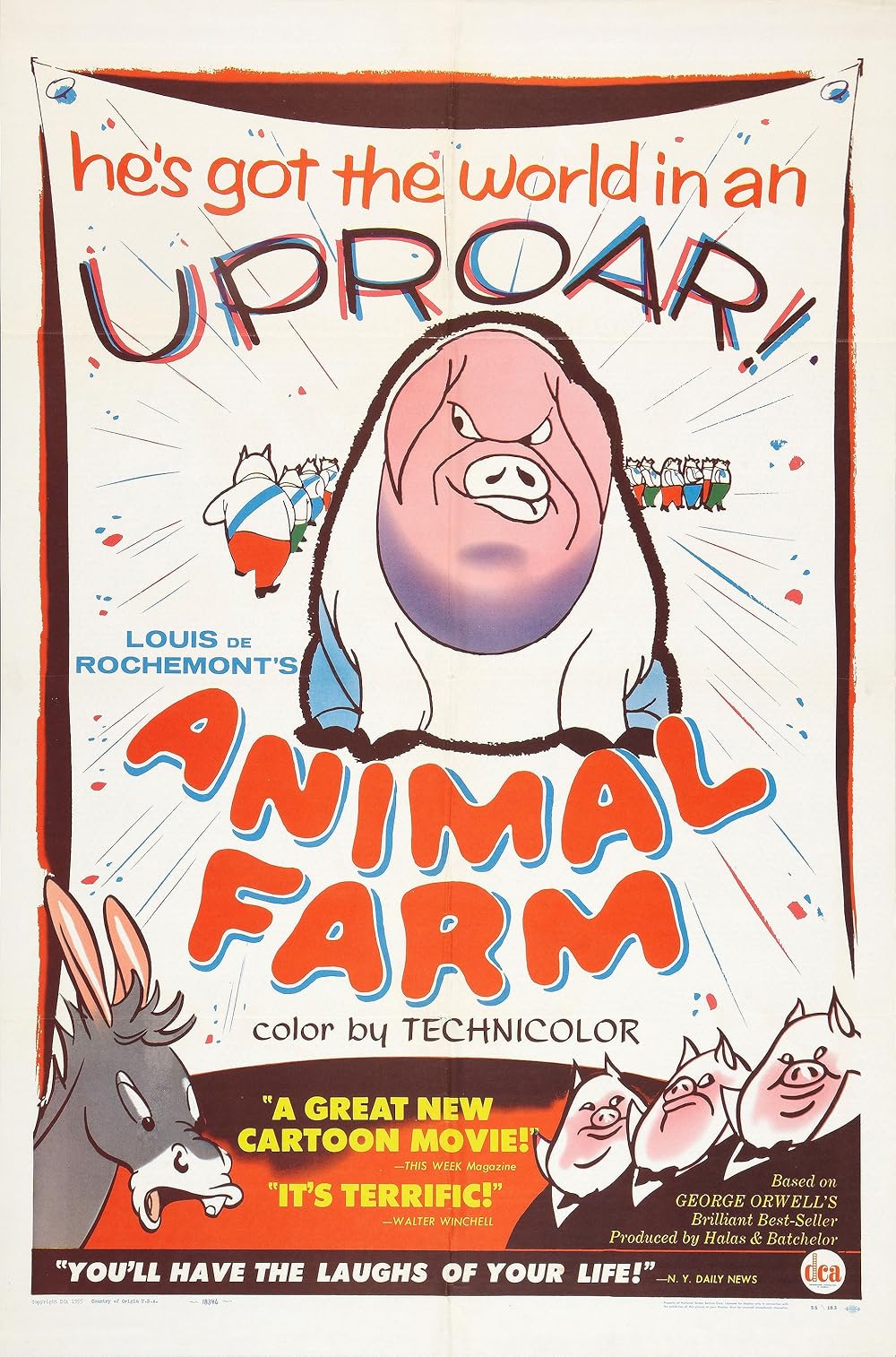
During the Cold War, propaganda became more complicated. The CIA covertly supported the 1954 animated Animal Farm, changing aspects of the story to make its anti-communist message stronger. Other American films presented the Soviet Union and communism as threats, while films supported by government institutions projected American prosperity and democracy as an attractive alternative. Cinema was selling a political system without necessarily calling itself political cinema. Later films such as Zero Dark Thirty (2012) raised questions about how cooperation with intelligence agencies can influence the way controversial events are remembered.=The American model is therefore interesting precisely because the propaganda does not always look like direct propaganda. It can arrive as a blockbuster, a thriller or a patriotic action film.
India has had its own long relationship with this idea. Even before independence, colonial authorities closely monitored cinema through censorship. After independence, the state used Films Division documentaries to promote development, industrialisation, agriculture and nation-building. Cinema was therefore part of the larger process of imagining what the new country should become.
But mainstream Hindi cinema largely remained more interested in romance, family, melodrama and social issues than in direct political propaganda. There were exceptions, of course. During the Emergency, Kissa Kursi Ka (1978) became a striking example of how uncomfortable the state could become with political satire, with the film being banned during that period.
What has become more noticeable in contemporary India is the way political ideas and interpretations of history have increasingly found their way into commercial cinema.

Films such as The Accidental Prime Minister (2019), The Tashkent Files (2019), Uri: The Surgical Strike (2019), The Kashmir Files (2022), Article 370 (2024), and Swatantrya Veer Savarkar (2024) approach political subjects and contested historical events through the language of mainstream entertainment. Dhurandhar (2025) became another prominent example of how a commercially successful film can generate discussion around political messaging, while its sequel, Dhurandhar: The Revenge (2026), pushed that conversation further. At the same time, films such as Toilet: Ek Prem Katha (2017) and Pad Man (2018) show a softer form of government-aligned messaging, where social issues associated with public policy are placed inside accessible commercial stories.
But not every film that reflects a political idea, supports a government position, or promotes a social cause is necessarily propaganda. The more interesting question is where persuasion begins to replace complexity, when one version of history is presented as unquestionable, when an enemy is reduced to a caricature, or when political institutions are portrayed as incapable of wrongdoing.
This makes contemporary Indian cinema’s relationship with propaganda particularly interesting. The message does not always arrive as a political speech or an obviously political film. Sometimes, it arrives as entertainment, history, patriotism, social reform, or simply as a very successful blockbuster.
Russia adds another layer to this history because it sits between two different eras. Soviet cinema was deeply connected to state ideology, while contemporary Russian cinema has also seen the state use historical films and war narratives to reinforce ideas of patriotism, national identity, and Russia’s place in the world. Films such as Panfilov’s 28 Men (2016) turn wartime sacrifice into a story of national heroism, while T-34 (2018) uses a fast-paced action format to turn the Soviet war experience into an accessible patriotic spectacle. The Crimean Bridge. Made with Love! (2018), meanwhile, was openly associated with the celebration of the construction of the bridge connecting Crimea with Russia.
The shift in the political system does not necessarily mean that the relationship between cinema and power disappears. It simply changes form.
And that is the larger story of propaganda cinema: it is not lost, rather, it has evolved over the years.
It once needed the state to control the entire film industry. Then it learned that it could work through censorship, funding, and access. It learned that a government did not necessarily have to make a film itself. Sometimes it only had to decide which stories were supported, which were discouraged, and which were allowed to reach a large audience.
And eventually, propaganda learned how to hide inside entertainment.
A film can make us admire a soldier before we have thought about the war. It can make us fear a particular community before we have questioned the image being presented. It can make a political decision appear heroic because the person making it has been framed as heroic. It can turn a complicated historical event into a simple story of good and evil.
Cinema does not only give us information. It gives us emotion. We may forget facts, but remember faces. We may forget the details of a war, but remember the music that played when the soldiers entered. We may never have met a historical figure, but after watching a biopic, feel as though we know exactly who that person was.
The most effective propaganda is not the film that tells us, this is what you should think. It is the film that makes us believe we arrived at that thought ourselves.