
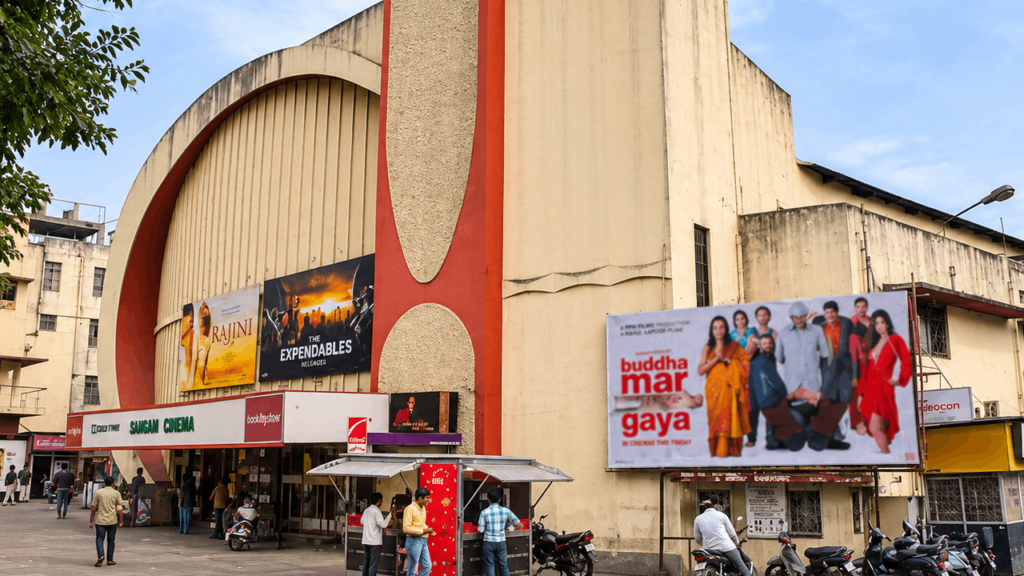
There is something about watching a film in a theatre that cannot quite be replaced by watching it anywhere else. It is not only the size of the screen or the sound that surrounds you. It is the feeling of sitting among strangers and realising that, for a few hours, all of you are looking at the same thing. A room full of people begins to breathe together with a film.
For a country like India, where cinema has always been so much more than entertainment, this experience should not feel like something available only to those who can afford it or those who happen to live close enough to a theatre.
And yet, that is increasingly what it can feel like.
India has around 10,000 cinema screens for a population of more than 1.4 billion. The United States, with roughly one-fourth of India’s population, has around 40,000 screens, while China has around 90,000. Aamir Khan highlighted this disparity at the World Audio Visual and Entertainment Summit, pointing out that even the biggest Indian films reach only a small fraction of the country’s population in theatres. “Only two per cent of the population in our country, which is recognised as a film loving country, watches our biggest hits in theatres. Where is the rest — 98 per cent — watching a movie?” he questioned.
It is a question that stays with you because the answer is not difficult to imagine. People are watching films on television, phones, laptops, and on streaming platforms. But there are also people who are not being given enough opportunities to watch them in a theatre. There are districts and large parts of the country where there is no cinema hall at all. And that makes the conversation about India’s theatrical future different from simply asking how to make people return to cinemas.
We first need to give more people a cinema to return to.
Shah Rukh Khan made a similar point when he called for “simpler, cheaper theatres in smaller towns and cities” so that Indian films could reach a larger majority of Indians at affordable prices. The word simpler matters as much as the word cheaper. Because India does not necessarily need every new theatre to be another version of the most expensive multiplex experience. There should be space for premium cinemas, of course. There should also be space for theatres that are modest, affordable, and built around the people who live around them.
A family should be able to go to the movies without treating it as an expensive outing. A ticket should not have to be accompanied by an equally expensive food bill. And a theatre does not have to be extravagant to give someone a memorable experience. It needs to be comfortable, clean, hygienic, and accessible. The magic of cinema has never really depended on how luxurious the seat was.
For some audiences, the theatre could be a premium experience. For others, it could be a place they can afford to visit every weekend. Both should exist, and not at the cost of the other. Because when there is only one model of the theatre, we also begin to create one idea of who the theatre is for.
And that is where the problem becomes more than an economic one. It becomes a question of access.
There was a time when the single-screen theatre was one of the most democratic public spaces in Indian cinema. People from different walks of life could occupy the same auditorium. Families arrived together. Young people came with friends. The audience shouted, whistled, clapped, and sometimes even danced. The film was on the screen, but the audience became part of it too. Many of these theatres have now disappeared.
India’s single-screen count has fallen sharply over the years, with rising operating costs, taxes, competition from multiplexes, real-estate pressures, and the pandemic making survival increasingly difficult. In Mumbai, only a small fraction of the city’s once-large network of single-screen theatres remains. Some have been demolished. Some have been converted. Some simply sit empty. And there is some sadness that comes with the thought of an empty cinema.
Indian cinematographer Hemant Chaturvedi, who has travelled across India documenting hundreds of its surviving single-screen theatres, once spoke of the silence of an abandoned cinema as being more deafening than anything else. It is an evocative thought because a theatre is a place that is supposed to be full of noise. The projector. The music. The audience. The reactions. A cinema without people feels almost unnatural. But preserving every old single screen exactly as it was is not necessarily the answer either. The way people watch films has changed, and the economics of exhibition have changed with it.
What India needs is not to choose between the old theatre and the new multiplex. It needs more possibilities.
There should be large multiplexes in cities where they make sense. There should be smaller theatres in towns. There should be affordable screens in semi-urban areas. There should be theatres that can show regional cinema to the audiences for whom those films are made. And there should be more ways of bringing cinema to areas where there is currently nothing.
China’s expansion offers one indication of what happens when theatrical infrastructure is treated as something that can grow with the audience. Its screen count expanded from thousands of screens to tens of thousands over the years, eventually creating one of the world’s largest exhibition networks. India, meanwhile, remains one of the most under-screened major film markets. That matters not only because films could make more money. It matters because films could reach more people.
Aamir Khan has used the example of India’s biggest films to explain this potential. If a film that already performs strongly across roughly 5,000 screens could reach 10,000 or 15,000, the possibilities are obvious. The audience that exists outside the major theatrical centres could finally become part of the theatrical market.
More screens mean more room for different kinds of cinema.
A regional film does not have to remain restricted to a handful of cities. A smaller film can find an audience without having to compete entirely on the terms of a blockbuster. A film from one part of the country can travel further into another. The theatre becomes a doorway rather than a bottleneck.
There is also no reason why the theatre experience itself cannot become more interesting. Why should going to the movies only mean buying a ticket, sitting in a dark room and leaving?
There can be affordable food. Spaces for children. Small cafes. Gaming areas. Local cultural performances. Film discussions. Special screenings. Community events. The theatre can become a place people want to spend time in, without making the experience unaffordable. Because there are parts of India where people know a film has been released without having anywhere nearby to watch it. Aamir spoke specifically about places such as Konkan, where audiences may hear about films and participate in the conversation around them, but do not necessarily have a theatre in which to experience them.
That feels like an odd distance to exist between a film and the people it is meant for.
We often say that India is a country that loves cinema. Maybe we should make it easier for that love to find a screen. More theatres would certainly mean more revenue, more tickets, and a larger theatrical market. But that is not the only reason we need them.
We need them because cinema is one of the few experiences that can still make strangers sit together in the same room and feel something at the same time. We need them because a child in a small town should have the same chance to fall in love with the big screen as a child growing up in a metropolitan city. We need them because the theatrical experience should not quietly become something reserved for a particular economic class. And we need them because, in a country this large, there should not be districts where the films everyone is talking about exist everywhere except in a theatre nearby.
India does not lack people who want to watch films. It lacks enough places for them to watch them together. And that is where Indian cinema needs to direct its attention.