
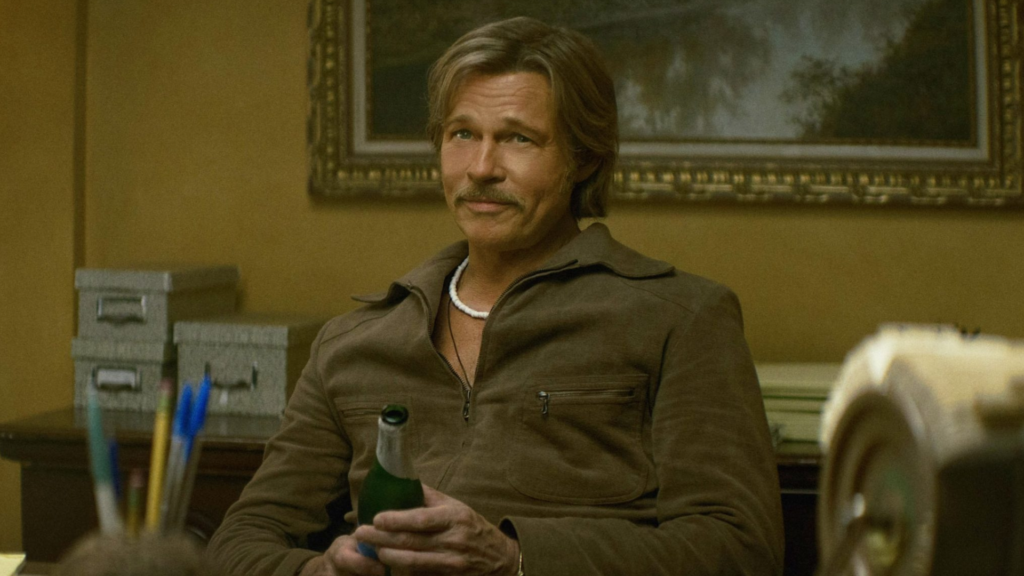
Eight years after the events of Once Upon a Time in Hollywood, Brad Pitt returns as stuntman-turned-fixer Cliff Booth in The Further Mis-Adventures of Cliff Booth. Directed by David Fincher and written by Quentin Tarantino, the film continues Cliff’s story in 1977 Los Angeles, bringing together three major Hollywood names for another chapter in the character’s life.
The film has received a largely positive response from critics, with Brad Pitt’s performance, its recreation of 1970s Los Angeles and its supporting cast emerging as some of its most appreciated elements. However, reviewers have differing opinions on its narrative structure and the combination of Fincher’s direction with Tarantino’s screenplay. While some consider the collaboration an entertaining success, others find the storytelling uneven and the film less engaging than its predecessor.
Set eight years after the events of the 2019 film, The Further Mis-Adventures of Cliff Booth follows Cliff as he moves away from stunt work and takes on various jobs around Los Angeles, including working as a projectionist and a Hollywood fixer. His involvement with television star Charlie Peters, played by Scott Caan, talent agent Karen Crosby, portrayed by Elizabeth Debicki, and a pair of violent gangsters gradually draws him into a dangerous situation. The film also features Yahya Abdul-Mateen II, Carla Gugino and Peter Weller.
One of the strongest points of agreement among the reviews is Brad Pitt’s return to the role. Writing for Deadline, Pete Hammond describes the film as an entertaining follow-up that delivers on the expectations of fans of Once Upon a Time in Hollywood. He considers Cliff Booth a memorable screen character and praises Pitt for bringing the same relaxed charm to the role while exploring a darker stage in the character’s life. Hammond also highlights the supporting performances, particularly those of Debicki, Scott Caan and Peter Weller.
Peter Bradshaw of The Guardian similarly praises Pitt’s performance, describing Cliff as an endlessly watchable character whose calm and unbothered attitude gives the film much of its appeal. Bradshaw finds that Pitt maintains the character’s familiar personality while bringing out the experience and mystery associated with his changed circumstances. He considers the actor’s portrayal one of the film’s biggest strengths, while also appreciating its energy, dark comedy and filmmaking style.
David Rooney of The Hollywood Reporter also points to Pitt’s screen presence as the element that holds the film together. He appreciates the actor’s charisma and chemistry with Debicki, while noting that Scott Caan, Carla Gugino and Peter Weller make strong contributions to the ensemble. Rooney particularly highlights Debicki’s performance as Karen Crosby, praising her chemistry with Pitt and her commanding screen presence.
The reviews become more divided when assessing the collaboration between Fincher and Tarantino. Hammond is particularly enthusiastic, describing the combination of Tarantino’s screenplay and Fincher’s direction as a successful creative partnership. He praises the film’s dialogue, references to popular culture and its blend of crime, comedy and violence. For Hammond, the film retains the distinctive qualities of Tarantino’s writing while benefiting from Fincher’s direction.
Peter Bradshaw also finds plenty to appreciate in the collaboration. He highlights the film’s energetic storytelling, black comedy and stylistic confidence, while observing that Fincher brings a quicker pace to some of the scene transitions. However, Bradshaw feels that the film occasionally repeats elements of its predecessor and that its ending feels somewhat truncated. Despite these reservations, his assessment remains positive about the film’s overall entertainment value and the appeal of its central character.
David Rooney offers a more measured assessment. While he appreciates the creative combination and describes the film as entertaining, he believes the storytelling is less focused than its predecessor. The narrative moves between romance, crime, comedy and nostalgia, taking time to establish its central storyline. He also notes that its episodic nature makes it feel less substantial as a feature-length narrative, even though its individual sequences remain engaging.
The most critical response comes from Brian Tallerico of RogerEbert.com, who finds the combination of the two filmmakers’ styles unsuccessful. He argues that Fincher’s controlled approach does not always complement Tarantino’s more playful and unpredictable writing. Although he acknowledges the film’s production design and the performances of Pitt and Peter Weller, Tallerico finds the story slow and occasionally dull. He also feels that the film relies too heavily on references to the original without developing those connections into a stronger narrative.
The film’s technical aspects and period setting receive attention as well. Pete Hammond of Deadline praises its cinematography, editing, sound design, costumes and production design. David Rooney appreciates the recreation of late-1970s Los Angeles and the soundtrack, while Peter Bradshaw responds positively to the film’s visual style and its combination of crime elements and dark humour. Tallerico, however, is less impressed with the cinematography, finding its visual approach comparatively flat.
Overall, the critical response suggests that The Further Mis-Adventures of Cliff Booth works best as a return to a familiar character rather than as a tightly structured continuation of the original film. Pitt’s performance, the supporting cast and the recreation of 1970s Los Angeles emerge as its most consistently praised elements. However, its loose narrative and the contrast between Fincher’s direction and Tarantino’s writing remain points of disagreement.
Among the four reviews considered here, Deadline offers the strongest praise, with The Guardian also responding positively to the film’s performances and style. The Hollywood Reporter takes a more balanced view, appreciating its entertainment value while identifying weaknesses in its structure. RogerEbert.com is considerably more critical, questioning whether the collaboration successfully brings the two filmmakers’ approaches together.
The film currently holds an 84% score on Rotten Tomatoes, based on 77 critic reviews. The score reflects a broadly favourable critical response, although the individual reviews indicate that the film’s appeal may depend on how much viewers enjoy its central character, nostalgic setting and more free-flowing storytelling.
The Further Mis-Adventures of Cliff Booth will be released in theatres on November 25, 2026, before arriving on Netflix on December 23, 2026.
Watch Trailer:

Film Details: The Further Mis-Adventures of Cliff Booth
- Director: David Fincher
- Screenwriter: Quentin Tarantino
- Cast: Brad Pitt, Elizabeth Debicki, Scott Caan, Carla Gugino, Yahya Abdul-Mateen II, Peter Weller, Matt Groove, JB Tadena, Corey Fogelmanis, Karren Karagulian and Timothy Olyphant
- Genre: Comedy, Drama
- Runtime: 2 hours 20 minutes
- Theatrical Release: November 25, 2026
- Streaming Release: December 23, 2026
- Distributor: Netflix