
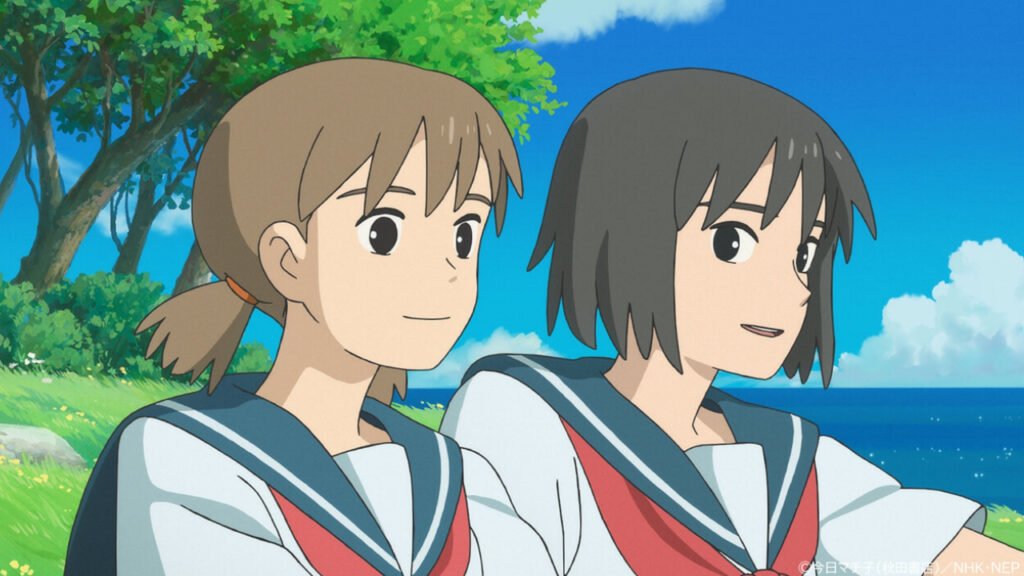
Cocoon: One Summer of Girlhood has now reached North American theatres, with GKIDS releasing Yukimitsu Ina’s Japanese animated war drama on September 4, 2026. Based on Machiko Kyo’s manga, the film has arrived with strong early reviews praising its animation, emotional weight and treatment of wartime trauma, although some critics have questioned its heavy Ghibli influence, symbolism and abbreviated storytelling. The film is a 2025 Japanese release receiving its North American theatrical rollout this year.
The film is the debut feature from Yukimitsu Ina and animation studio SASAYURI, founded by former Studio Ghibli animator Hitomi Tateno. The project also brings together veteran animators Akihiko Yamashita and Shinji Otsuka with younger talent. But Cocoon is not simply a Ghibli-style children’s anime. It is a serious wartime drama about death, fear, forced service and the loss of childhood.
At the centre are San and Mayu, two schoolgirls attending an all-girls school on a peaceful tropical island. Everything changes when World War II reaches their home. Along with their classmates, they are ordered to help nurse wounded soldiers in a military hospital hidden inside a cave. San is shy and insecure, while Mayu is more confident and outspoken. Their friendship gives the story its emotional centre as war gradually strips away the world they understood.
The film draws inspiration from the Himeyuri students, Okinawan schoolgirls and teachers who were mobilised as nurses during the Battle of Okinawa in 1945. Cocoon should not be treated as a literal documentary recreation of that battle. Instead, it uses a fictionalised story inspired by those experiences to explore girlhood, survival and the destruction of innocence. The title itself becomes meaningful through the idea of a cocoon representing adolescence: a protected stage before adulthood that war brutally interrupts.
The New York Times’ Maya Phillips gave the film a Critic’s Pick, calling it a “succinct but quietly devastating antiwar drama” that tells a story of patriotism and loss through the viewpoint of a girl in wartime Okinawa. She praised the way the film establishes the girls’ everyday lives before gradually allowing the violence of war to consume them. Phillips also highlighted the painted backgrounds and the way the film filters its most disturbing moments through San’s fearful imagination.
One of the film’s most striking creative choices is its treatment of violence. Instead of relying on conventional blood and graphic imagery, some wounds release flowers and petals. The result is delicate but unsettling, placing beauty beside destruction. Phillips noted how the girls’ bodies and the violence surrounding them can resemble classical artworks, with blood transformed into flower petals. The contrast becomes central to the film’s identity: the beauty of the natural world continues even as the girls’ childhood is destroyed.
Kensuke Ushio’s score adds another layer, using a restrained musical approach rather than turning every moment into conventional wartime melodrama. A review from USA Anime also singled out Ushio’s music as one of the film’s strongest production elements, noting the care given to how each scene sounds.
The animation is among the areas drawing the strongest praise. The New York Times highlighted the film’s painted backgrounds, including its verdant forests and ruined village landscapes, while noting the contribution of veteran Studio Ghibli animators. The visual approach allows the film to move between beauty and horror without making the imagery feel gratuitous.
The Ghibli connection, however, is also where some criticism begins. Fran Kursztejn of In Review Online argues that Yukimitsu Ina closely imitates Hayao Miyazaki’s visual language. The criticism is not that the film looks poor; rather, the resemblance can make its visual identity feel less original. Kursztejn’s review frames the problem as one of artistic identity, questioning whether the film develops a sufficiently distinctive voice of its own.
Other critics have questioned whether the film’s short runtime gives its ideas enough room to develop. The New York Times notes that the film’s cocoon metaphor can feel “heavy-handed” given how abbreviated the film is, even while describing it as a clever way of exploring San’s struggle with a society demanding unquestioning loyalty in the face of death and terror.
The current Rotten Tomatoes page reflects an early critical picture rather than a settled consensus, with only a small number of reviews currently listed. Its synopsis similarly emphasises the film’s central conflict: San and Mayu’s attempt to find solace in their fragile lives as war brings escalating death and brutality.
USA Anime’s review was broadly positive, awarding the film a B+ and arguing that viewers should not be discouraged by its slower first third. The review praised the way the film ultimately completes its central theme, while suggesting that the ending could have made an even stronger statement.
That leaves Cocoon: One Summer of Girlhood with a critical picture that is positive but not entirely unanimous. Critics broadly recognise it as a visually distinctive and emotionally serious anti-war film, but they differ on how effectively its symbolism, adaptation and Ghibli-influenced style work together. The strongest praise is reserved for its visual language, its treatment of wartime violence and the emotional relationship between San and Mayu, while the main reservations concern its brevity and the extent to which it establishes an identity beyond its obvious influences.
Ultimately, Cocoon: One Summer of Girlhood is arriving in North America as more than an international anime release. It is the feature debut of SASAYURI, carries the creative influence of experienced Japanese animation veterans and turns a story inspired by wartime history into an intimate account of girls losing the chance to grow up normally. Its early reviews suggest that the film’s beauty and emotional seriousness are difficult to dismiss, even for critics who question whether its short runtime and Ghibli-influenced aesthetic allow it to become as distinctive as it wants to be.
Watch Cocoon: One Summer of Girlhood Trailer:

Film Details: Cocoon: One Summer of Girlhood
Director: Yukimitsu Ina
Based on: Machiko Kyo’s manga
Genre: Animated, War, Drama
Country: Japan
Original Release: 2025
North American Theatrical Release: September 4, 2026
Distributor (North America): GKIDS
Animation Studio: SASAYURI
Music: Kensuke Ushio
Cast: Maria Abo, Chinatsu Akasaki, Akane Amasawa, Izumi Aoyagi, Yui Arai
Read More Review Roundups on POF