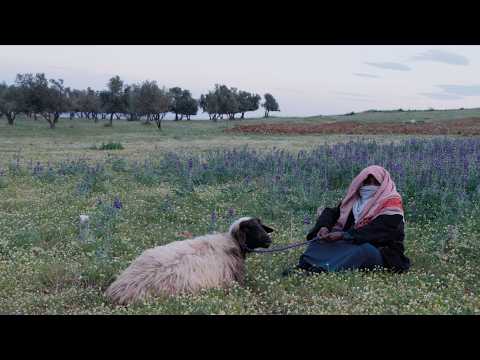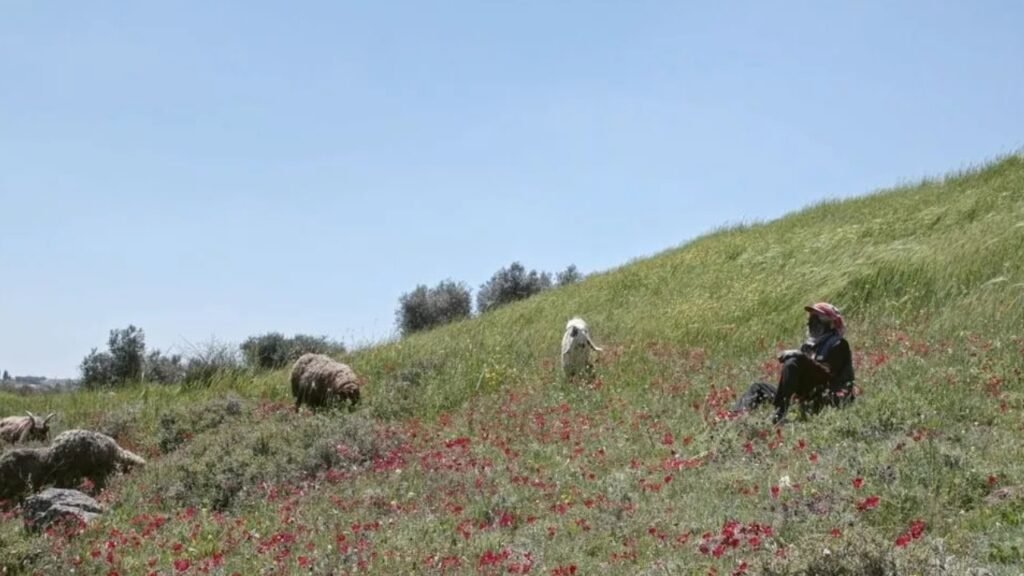
Concrete Land, the debut feature documentary from Palestinian-Jordanian director Asmahan Bkerat, is screening at the London Film Festival this month. The film tells the story of a Palestinian Bedouin family facing displacement in Jordan, offering a rare look at a nomadic way of life that is seldom seen on screen.
The documentary follows three generations of the Najar family, one of Jordan’s last Afro-Palestinian Bedouin families, as relentless development and encroaching luxury villas close in on their grazing land on the outskirts of Amman. At the center of the story is 10-year-old Eman, growing up amid meals, songs, arguments, labor and the family’s care for their beloved sheep, Badrya.
Facing eviction and an increasingly uncertain future, the family struggles to hold on to a way of life in an environment that is growing more unlivable and unrecognizable by the day. The film observes their daily existence as the pressure surrounding their land becomes increasingly difficult to ignore, while keeping its focus on the family and the relationships that define their lives.
Bkerat first met the Najar family by chance in 2016, alongside her colleague Ban, a producer and editor on the project, and the two quickly became close with the family. She was not initially looking to make a documentary, but the relationship deepened over time. When the family’s eviction threat began, the idea for Concrete Land was born.
Bkerat began filming in 2018 and continued for eight years, visiting the family almost every day and ultimately gathering more than 400 hours of footage. That material was then shaped over two years of editing into the final film. The extended production process allowed Bkerat to document the family over a significant period while maintaining the close relationship that had developed between the filmmaker and her subjects.
The title reflects a deliberate contrast at the heart of the film. Bkerat has explained that Jordan’s rapid development is closely tied to concrete construction, and as that construction expands, the family’s land continues to shrink. She described concrete as rigid, cold and lifeless, standing in direct opposition to the land, which she sees as living and breathing. That tension between construction and the natural landscape shapes the documentary’s visual and emotional core throughout.
Bkerat is a Palestinian-Jordanian documentary filmmaker who began her career as a photographer and social justice advocate before moving into filmmaking. Her first short documentary, Badrya, released in 2017, won the Jury Prize for Best MiniDoc at the Sebastopol Documentary Film Festival.
Concrete Land marks her feature directorial debut. She is also currently producing two other feature documentaries, Harvest Moon and If These Stones Could Talk, alongside several short films.
Concrete Land had its world premiere in the Critics’ Week section of the Locarno Film Festival earlier this year before its current run at the London Film Festival. The film is also set to screen at the Vancouver International Film Festival, continuing its festival journey across three international events.
Speaking to The Hollywood Reporter, Bkerat said she wants people to understand that Bedouin life does not equate to poverty. She has also described the family’s grandparents as representing the last generation to live an authentic Palestinian Bedouin way of life, calling the film both a document of history and a deeply personal project given how intertwined her own life became with the family’s story over the eight years she spent filming them.
That personal connection is central to the film’s approach. Rather than presenting the Najar family solely through the broader issue of displacement, Concrete Land remains grounded in the rhythms of their everyday lives. Meals, songs, work, arguments, family relationships and their care for Badrya all become part of the portrait, allowing the documentary to capture what is at stake when a way of life is placed under increasing pressure.
With its festival run continuing from Locarno to London to Vancouver, Concrete Land offers audiences an intimate, unhurried look at a family and a way of life under growing pressure. At the center of the documentary is nearly a decade of trust built between Bkerat and the Najar family, giving the film both a personal perspective and a record of a way of life facing profound change.
Watch Trailer: