
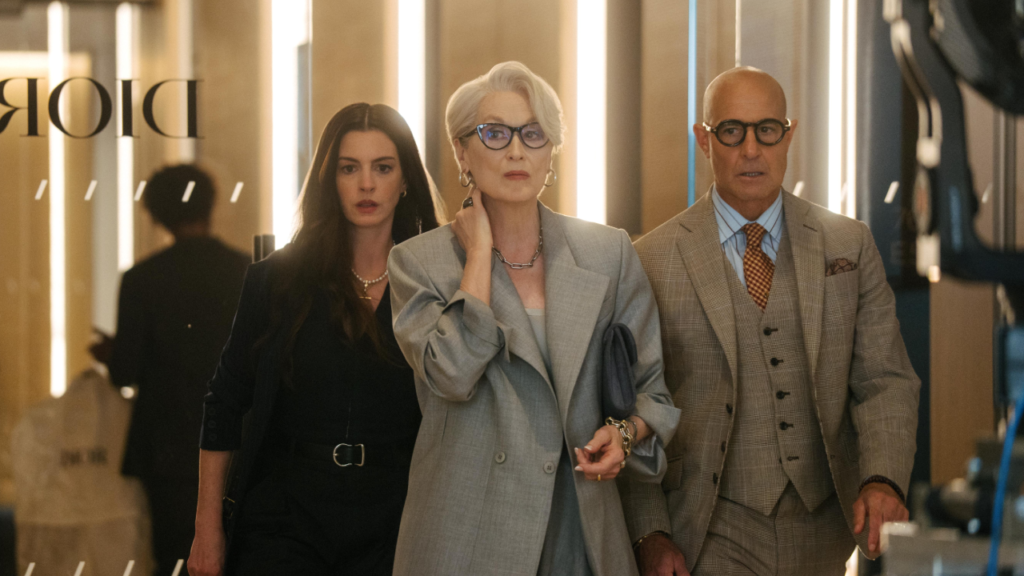
Two decades after The Devil Wears Prada became a pop culture phenomenon, its long-awaited sequel arrives carrying the weight of nostalgia, expectation, and a radically transformed media landscape. Directed again by David Frankel and bringing back Meryl Streep, Anne Hathaway, Emily Blunt, and Stanley Tucci, the film attempts to revisit the world of Runway magazine in a digital-first era.
From the very first frame, the film positions itself as both a continuation and a reflection. The fashion world has evolved, journalism is under siege, and legacy institutions are struggling to stay relevant. Yet, ironically, the film itself becomes a mirror of that very struggle — caught between honoring its past and justifying its present.
Critics largely agree that nostalgia is the film’s strongest weapon. Writing for The Guardian, Peter Bradshaw describes it as a “sprightly and amiable sequel,” noting how it reuses many of the original’s narrative beats while still managing to remain enjoyable. That sense of familiarity runs through most reviews. Variety critic Guy Lodge goes a step further, calling the film less a true sequel and more a “tribute act,” arguing that it faithfully recreates the original’s rhythms without adding significant new layers .
A similar sentiment appears in The Hollywood Reporter, where David Rooney notes that the film hits “familiar beats that fans will eat up,” even if it ultimately leans too heavily into comfort over innovation . Meanwhile, IndieWire is more critical, describing the film as “the cinematic equivalent of fast fashion” — visually appealing, instantly gratifying, but lacking depth and staying power .
That tension between familiarity and originality becomes even more evident when critics turn to the film’s story. While the premise — Miranda Priestly fighting to save Runway in a collapsing media landscape — offers timely thematic potential, many reviews suggest the screenplay never fully capitalizes on it. Deadline bluntly states that “the film doesn’t really have a story,” arguing that it follows a predictable sequel template rather than building meaningful stakes . IndieWire echoes this, noting that the film “apes the original nearly beat for beat,” while Variety calls it narratively and emotionally flatter than its predecessor.
Even when the film introduces contemporary ideas — the decline of journalism, corporate consolidation, digital disruption — critics feel these themes are more decorative than transformative. Variety points to its commentary on the “corporate repackaging of media,” while The Hollywood Reporter highlights its exploration of the “death of journalism” . Yet, as SlashFilm observes, there’s an irony at play: the film critiques late-stage capitalism while simultaneously embodying it, functioning as a glossy product built on nostalgia rather than risk .
If the storytelling divides critics, the performances unite them. There is near-universal agreement that the returning cast elevates the material. Meryl Streep’s Miranda Priestly remains the film’s gravitational center, with The Hollywood Reporter praising her “acid tongue and supreme poise” . Even when the script gives her fewer sharp edges, her presence continues to command attention.
Anne Hathaway’s Andy Sachs returns more experienced and self-assured, though some critics argue that this evolution makes her less compelling as a protagonist. Emily Blunt, on the other hand, is widely seen as a standout once again, bringing both sharp comedic timing and unexpected emotional texture. Stanley Tucci continues to provide warmth and grounding, his Nigel acting as the emotional bridge between past and present.
Beyond performances, the film’s surface pleasures remain intact. Critics consistently highlight its visual appeal, fashion spectacle, and humor. The Guardian calls it “good-natured, buoyant entertainment,” while The Hollywood Reporter describes it as “frothy, fun, stuffed with one-liners” . SlashFilm emphasizes that the costumes and production design remain a “feast,” ensuring the film never loses its sensory appeal even when the narrative falters .
However, beneath that glossy exterior lies the film’s biggest limitation: a lack of bite. IndieWire argues that the sequel lacks the detail and sharpness that made the original resonate, while Deadline points to weak subplots, overuse of cameos, and an unfocused tone . Variety similarly notes that the emotional stakes never quite land, making it difficult for the film to achieve the cultural impact of its predecessor . SlashFilm goes further, calling it an “expensive knock-off” — a film that looks premium but feels creatively restrained .
A broader perspective emerges when looking at aggregated responses from Rotten Tomatoes, where critics reflect a mixed-to-positive consensus. Many acknowledge the film’s entertainment value while questioning its necessity. Casey Chong describes it as a “worthy sequel blending nostalgia and modernity,” while Carla Hay suggests it plays like a “self-aware sitcom version” of the original. David Poland compares the experience to something that starts strong but struggles to sustain momentum, and Matt Goldberg labels it an “inoffensive victory lap.”
More positive voices like Katie Walsh highlight its cultural relevance and scale, while others like Nadine Whitney and Serena Seghedoni emphasize that it ultimately lacks the sharp edge needed to truly stand out. Across these perspectives, a clear pattern emerges: the film succeeds as a comfort watch but falls short as a defining cinematic moment.
That duality defines the overall critical consensus. On one hand, The Devil Wears Prada 2 delivers exactly what audiences might expect — strong performances, polished visuals, and a return to beloved characters. On the other, it rarely pushes beyond those expectations, choosing safety over reinvention.
In many ways, the film becomes a reflection of the industry it portrays. Just as Runway struggles to remain relevant in a rapidly changing world, the sequel itself grapples with how to justify its existence in an era dominated by legacy franchises and nostalgia-driven storytelling. It understands the cultural shifts around it — the decline of print media, the rise of digital platforms, the changing dynamics of power and influence — but it never fully translates that awareness into bold storytelling choices.
By the time the credits roll, the impression is clear. This is a film that works — but only within a certain comfort zone. It entertains, it revisits, it reminds. But it rarely challenges, surprises, or transforms.
Release Date: May 1, 2026
Director: David Frankel
Cast: Meryl Streep, Anne Hathaway, Emily Blunt, Stanley Tucci
Runtime: ~1h 59m
Rating: PG-13
Genre: Comedy, Drama

Read More Review Roundups on POF