
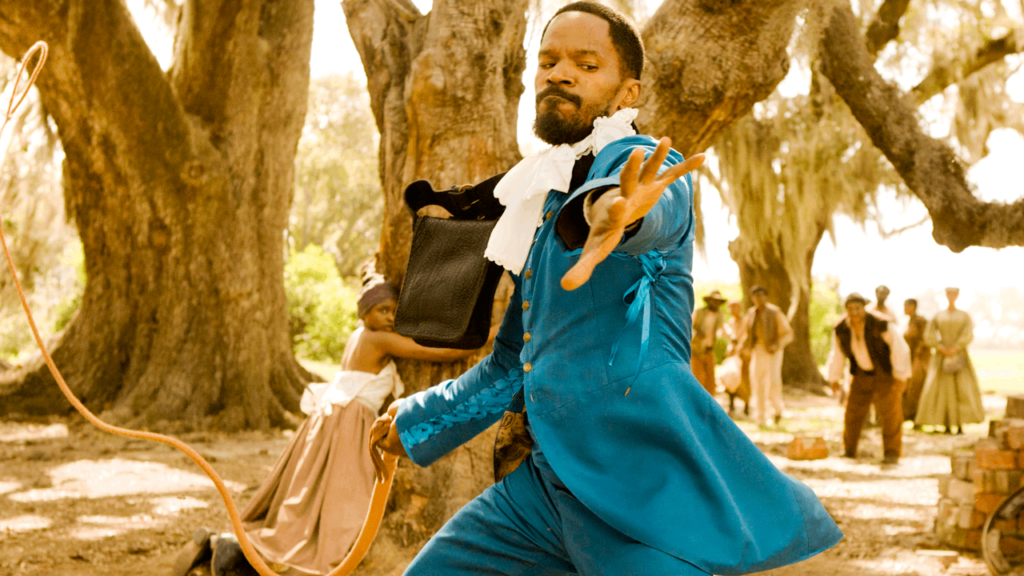
There are some films that make you think. And then there are films that make you remember something you did not expect to remember.
Django Unchained is one of them for me.
When I think about Quentin Tarantino’s film Django Unchained, I think of the guns, the violence, the revenge and Calvin Candie’s Candyland. It is a very different world from the Ramayana. And yet, if you have grown up hearing the Ramayana, there is something strangely familiar about Django’s journey.
Not because Django is Rama. Not because Calvin Candie is Ravana. And certainly not because Django Unchained is a retelling of the Ramayana.
It isn’t.
But watch the film with the Ramayana somewhere in the back of your mind, and you may suddenly feel that you have seen the shape of this story before.
A man is separated from the woman he loves. She ends up in the world of a powerful man. The man she loves sets out to find her. But bringing her back means entering the enemy’s world. And eventually, that journey leads to a confrontation with the man who has taken her away.
That is one of the central movements of the Ramayana. And, in a very different way, it is also the journey of Django Unchained.
In the Ramayana, Sita is taken away from Rama and brought to Lanka by Ravana. Rama cannot simply walk into Lanka and take her back. He has to travel a great distance, find allies and eventually enter a world controlled by a powerful enemy.
In Django Unchained, Broomhilda is separated from Django and eventually ends up at Candyland, the plantation owned by Calvin Candie. Django knows where she is, but knowing where she is does not mean he can simply rescue her. He has to enter Candyland.
And that is where the two stories begin to feel strangely close.
The places could not be more different. Lanka belongs to an ancient Indian epic. Candyland belongs to the brutal world of American slavery. Rama is a prince. Django is an enslaved man who has been denied even the most basic freedom. Ravana is a king. Candie is a wealthy plantation owner. But the journey has a similar shape. The hero has to enter the enemy’s world to bring back the woman he loves. And Candyland is more than just the place where Broomhilda is being held. It is Candie’s world. It is a world built around his wealth, his power and his control over the people around him. Everyone knows who is in charge. Django, when he arrives there, is an outsider entering a world that seems completely controlled by another man.
That is not very different from the feeling we get when Rama eventually reaches Lanka. Lanka is Ravana’s world. Candyland is Candie’s world. And in both stories, the hero has to enter that world before he can take the woman he loves out of it. But there is something else about Django Unchained that makes this comparison even more interesting.
Tarantino had already named Django’s wife Broomhilda. While writing the screenplay, Christoph Waltz introduced Tarantino to Wagner’s Ring cycle and explained the story of Siegfried to him. Tarantino then recognised the striking similarity between Siegfried and Brünnhilde and Django and Broomhilda. He has said that the parallels were so close that he didn’t want to see the later opera because he didn’t want to know how it ended.
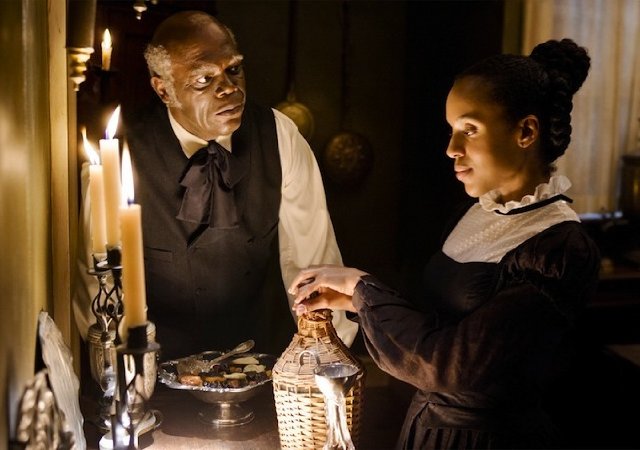
In the film, when Django tells Schultz about his wife, Schultz recognises the name and tells him about a German legend. Broomhilda was a princess, he says, placed on a mountain, surrounded by fire and guarded by a dragon. She can only be rescued by a hero brave enough to cross the fire and defeat the dragon. That hero is Siegfried. And Django begins to see himself in that story. Because he knows exactly what it means to want to rescue Broomhilda.
The story inside Django Unchained is therefore already carrying an older story inside it.
Tarantino has spoken openly about this connection to Wagner’s Ring cycle and the story of Siegfried and Brunnhilde. He has even described Broomhilda as the princess in an evil castle and Django as the knight who goes through hell to save her.
So Tarantino found an old heroic story hiding inside the story he was already writing, and then leaned into the connection. A German princess becomes an enslaved Black woman. A legendary hero becomes a former slave with a gun. The dragon, the mountain and the fire are transformed into a very different kind of world, the brutal world of slavery.
The old story changes its clothes.
And this is where, for someone who knows the Ramayana, another connection can appear. Because the Ramayana also gives us a man who has to cross into the world of a powerful enemy to rescue the woman he loves.
Rama has to reach Lanka. Django has to reach Candyland. Rama has to confront Ravana. Django has to confront Candie. The stories are not the same. But the feeling of the journey can be.
And that distinction is important. Django is not Rama. Candie is not Ravana. Broomhilda is not Sita. Dr. Schultz is not Hanuman. If we try to match every character and every event, the comparison quickly falls apart.
The Ramayana is much larger than the story of a man rescuing his wife. It is a story about duty, exile, morality, loyalty, kingship and the struggle between righteousness and evil.
Django Unchained comes from a completely different place. Django is fighting against slavery. He wants his freedom. He wants his wife back. And he wants revenge on the people who treated them as property.
Rama’s journey is connected to duty. Django’s journey is driven by love and revenge. Their worlds are different. Their meanings are different. Their cultures are different. And yet, something about the journey remains recognisable. Maybe that is the interesting part.
Stories do not have to be the same to remind us of one another. A man loses the woman he loves. She is taken into another world. That world is controlled by a powerful man. The man who loves her has to cross a great distance to reach her. He has to enter the enemy’s world. And eventually, that world cannot remain the same.
We have seen this kind of story in myths, legends and films across different cultures. Sometimes the hero carries a bow. Sometimes he carries a sword. Sometimes he carries a gun. Sometimes the enemy lives in a mythical kingdom. Sometimes he lives in a plantation in Mississippi. The story changes with the world around it.
But something at its centre remains.
And perhaps that is why a person who grew up with the Ramayana can watch Django Unchained and suddenly feel that strange sense of recognition.
Not because Tarantino copied the Ramayana. There is no need to make that argument. But perhaps that is what makes the comparison even more fascinating.
One filmmaker can look back at an old German legend and turn it into the story of a Black man searching for his wife in the American South.
And an Indian viewer can watch that film and think of Rama searching for Sita.
Two cultures. Two stories. Two very different worlds. And yet, somehow, the journey feels familiar. Maybe this is what stories have always done. They travel. They change. They forget where they came from. They take new names, new faces and new worlds. But every once in a while, an old story appears in a completely unexpected place.
And when it does, we recognise it. Not identical. Not copied. Just familiar. Maybe stories change. Maybe the worlds around them change. But some journeys are so deeply human that we recognise them wherever we find them.
Read More:
- Conclave: Faith and Power Collide Behind Closed Doors
- Stop-Motion Animation and Guillermo del Toro’s Pinocchio
- The Evolution of Indian Cinema: From Satyajit Ray to Anurag Kashyap
- How Cinema Helped Fight Racism: A Look at Films That Changed Society
- The Best World War 2 Films: A Cinematic Journey Through History