
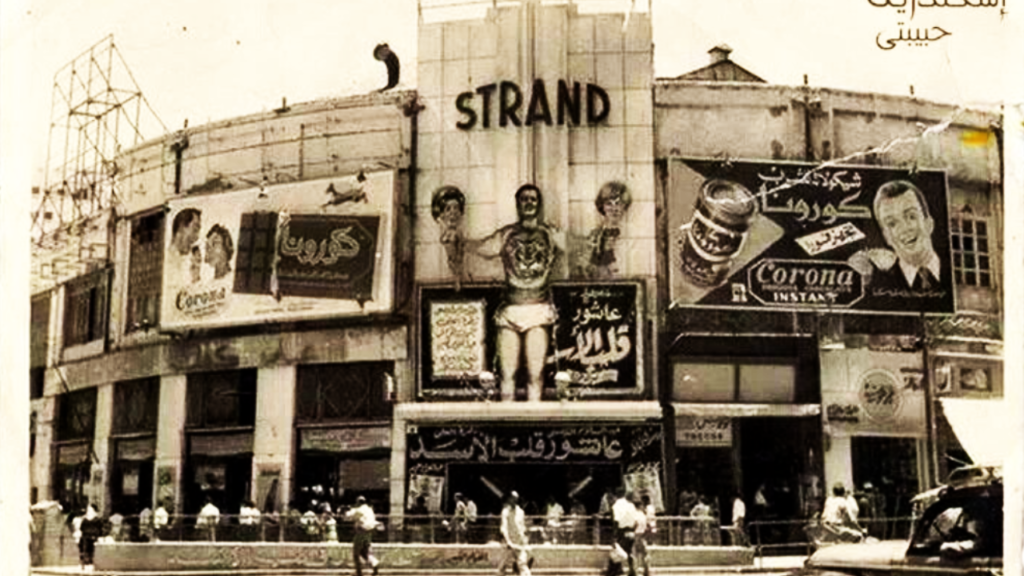
Long before conversations around Korean cinema or Bollywood’s global reach became common, Egypt had quietly built something extraordinary. Cairo wasn’t simply making films. It was producing the stories, stars, music and cinematic language that an entire region grew up with. It became so influential that people began calling it the “Hollywood of the Middle East”, or sometimes “Hollywood on the Nile.”
But that reputation wasn’t created overnight. It was the result of decades of investment, wonderful filmmakers, unforgettable actors, and most importantly, an understanding that cinema could become a nation’s cultural identity.
Ironically, Egypt’s cinematic journey didn’t begin with Egyptian cinema at all.
Motion pictures arrived in Cairo and Alexandria in 1896, barely months after the Lumière brothers introduced cinema in Paris. By 1908, Egypt already had eleven movie theatres. Less than a decade later, that number had grown to around eighty. Yet the screens were overwhelmingly occupied by European and American productions. Egyptians loved going to the cinema, but they weren’t watching stories that belonged to them or included their traditional values.
Local filmmakers tried to establish a domestic industry between 1917 and 1926, however the road was anything but easy. Egypt was under British occupation, and nearly eighty percent of the country’s rural population struggled with poverty, unemployment and disease. Building a national film industry in such circumstances seemed almost impossible.
And yet, against those seemingly impossible odds, it was made to happen.
The turning point arrived in 1935, when Studio Misr emerged as the leading Egyptian equivalent to Hollywood’s major studios, financed by industrialist Talaat Harb. More than just another production company, Studio Misr was a statement of intent. Harb believed Egyptian filmmakers deserved the infrastructure to create films that reflected Egyptian culture, society and values rather than simply imitating or adapting foreign cinema.
The studio brought together modern sound stages, editing facilities, laboratories and technical expertise that allowed filmmakers to compete with international productions. For the first time, Egypt possessed an organised film industry rather than scattered filmmaking efforts.
Its impact was immediate.

One of Studio Misr’s earliest successes was Weddad (1936), also the studio’s first production, starring the legendary singer Umm Kulthum in her screen debut. The film became a commercial success in Egypt and the Arab world. Several other successful films were released in the following years like Salama Is Fine (1937), gradually building audience trust in Egyptian productions.
What Studio Misr ultimately created was not just successful films, but confidence. Confidence that Egypt could build its own stars, develop its own cinematic voice, while competing with industries that had decades of head start. This is the confidence that soon transformed Cairo into the beating heart of Arab cinema.
The decades that followed are remembered as the golden age of Egyptian cinema.
Between the 1940s and the 1960s, Cairo became the undisputed centre of filmmaking in the Arab world. Every year, studios produced musicals, romances, comedies, historical epics, thrillers and social dramas at a scale no neighbouring country could match. The industry was no longer finding its feet, it was setting the standard for everyone else.
What made Egyptian cinema stand out while also being amazing was that it wasn’t just commercially successful. It knew how to tell stories that ordinary people recognised. Films spoke about family, love, class, poverty, ambition and social change without losing their entertainment value. Audiences laughed, cried and sang along, but they also saw their own lives reflected on screen.
This was also the period that produced some of the biggest stars in Arab cinema.

Actors like Omar Sharif, Faten Hamama, Rushdy Abaza, Hind Rostom became legendary icons across the Middle East and North Africa. Their popularity was often compared to Hollywood icons. Hind Rostom came to be known as the “Marilyn Monroe of the East,” while comparisons with Clark Gable were earned by Rushdy Abaza.
Filmmakers behind the camera were equally influential.
Directors such as Youssef Chahine pushed Egyptian cinema towards international recognition, mixing deeply personal stories with political and social commentary. Salah Abu Seif, often referred to as the godfather of neorealist Egyptian cinema, turned everyday Egyptian life into powerful cinema, while filmmakers like Henry Barakat, Kamal El Sheikh and Hassan el-Imam expanded the industry’s range through romance, suspense and commercial entertainment. Hassan el-Imam was coined the nickname “the box-office king” and “the director of masterpieces,” among others.
By this point, Cairo wasn’t merely producing films, it had become a magnet for artists from across the Arab world.
Many actors, musicians and writers migrated to Egypt in search of opportunities that simply didn’t exist elsewhere. Much of the region was still dealing with colonial rule, political instability or economic hardship. For countless aspiring artists, Cairo represented possibility. Its studios offered steady work, its audiences were enormous, and success there meant recognition over the entire Arab-speaking world.
But talent alone wasn’t enough to make Cairo the Hollywood of the Middle East.
One of Egypt’s greatest advantages was language.
Films were made in the Egyptian Arabic dialect, which, thanks to the country’s booming film and music industries, became widely understood throughout the Arab world. Whether someone lived in Morocco, Lebanon, Iraq or Kuwait, they could easily follow Egyptian films without feeling disconnected. This gave Egyptian cinema a reach that few other regional industries could match.
The industry’s influence extended far beyond cinema halls. Songs from Egyptian films travelled across borders on radio stations. Dialogues became part of everyday conversations. Fashion trends, mannerisms and even expressions from films found their way into homes throughout the Middle East and North Africa. Egyptian cinema wasn’t simply exporting entertainment, it was exporting culture.
That is what truly separated Cairo from other filmmaking centres.
Hollywood dominated through global distribution. Bombay became a giant because of India’s vast domestic audience. Cairo, meanwhile, became a cultural powerhouse because nearly the entire Arab world embraced its stories as their own. What makes Cairo’s story even more remarkable is that it never depended on a single kind of cinema. As Egypt evolved, so did its films.
The musicals that defined the 1930s and 1940s gradually made room for romantic dramas, thrillers and social melodramas. The 1960s saw the rise of war and action films, while the following decades embraced lighter comedies that often hid sharp criticism behind their humour. Egyptian filmmakers rarely stopped covering the society around them. Whether the subject was corruption, bureaucracy, inequality or the changing values of the country, cinema became a space where difficult conversations could quietly come forth.
That willingness to evolve kept the industry alive.
Today, the industry faces challenges that every major film industry faces like economic pressures, changing audience habits and the rise of streaming platforms. Yet, Egypt continues to produce the majority of the Arab world’s screen output, remaining the region’s largest and most established film industry. The scale may have changed from its golden years, but its position within Arab cinema has not.
Its influence can even be seen in something as simple as language. When Disney released Monsters, Inc. in Egyptian Arabic in 2001, audiences all around the Arab world embraced it. More than a decade later, the studio released another Arabic dub in Modern Standard Arabic, expecting it to appeal to an even wider audience. Instead, many viewers felt the humour and warmth of the original had disappeared.
The reaction wasn’t really about a Disney film. It was about decades of Egyptian cinema.
For generations, millions of people had grown up watching Egyptian films and listening to Egyptian music. The dialect had become so familiar that it naturally became the language of entertainment over much of the Arab world. It wasn’t simply understood, it felt authentic. That is the kind of cultural influence very few film industries ever achieve.
And maybe that is the real reason Cairo earned the title of the Hollywood of the Middle East.
It wasn’t because it copied Hollywood. Nor was it because it produced the most films. It earned that title because it became the region’s creative centre. It built world-class studios when few others had them. It nurtured generations of actors, directors and musicians whose work travelled far beyond Egypt’s borders. It told stories that audiences across the Middle East and North Africa saw themselves in. In doing so, it shaped not just Arab cinema, but Arab popular culture as well.
More than a century after cinema first arrived in Egypt, Cairo continues to be recognised as the Hollywood of the Middle East. Not just as a nostalgic nickname that once was, but as a testament to an industry that transformed one city’s stories into the shared cinematic language of an entire region.
Read More: