
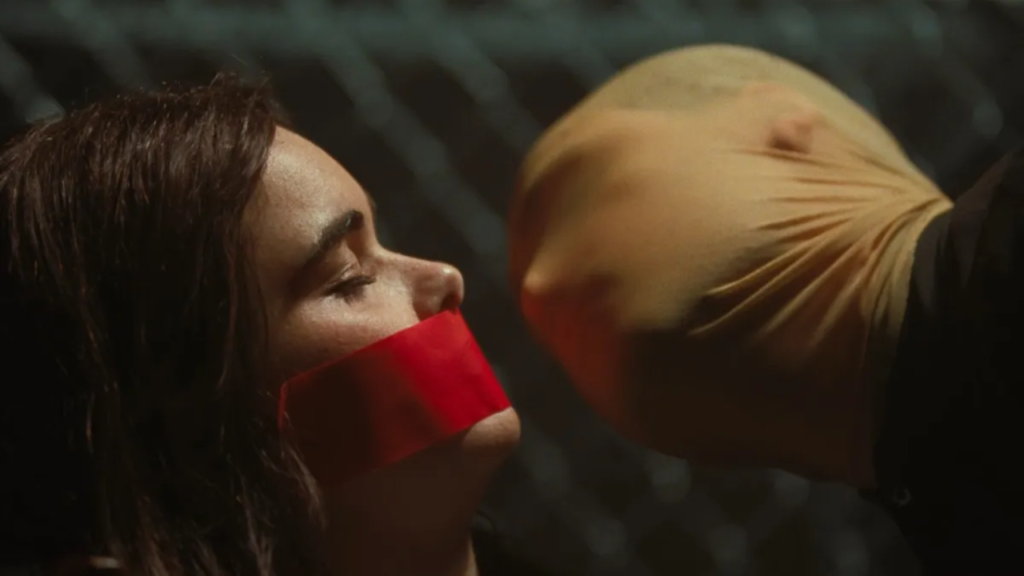
Faces of Death review reactions have begun surfacing across major publications, and much like the infamous source material it draws from, the 2026 remake is proving to be as divisive as it is provocative. Directed by Daniel Goldhaber, the film attempts to reimagine one of horror’s most controversial titles for the digital age, shifting its focus from shock-value spectacle to a commentary on modern media consumption. Early critical responses suggest a film that is ambitious, unsettling, and thematically relevant, yet often uneven in execution — a project that intrigues as much as it frustrates.
Faces of Death follows a young content moderator who stumbles upon a disturbing pattern of videos circulating online — clips that appear to recreate infamous death sequences associated with the original 1978 film. As she digs deeper, the line between staged content and real violence begins to blur, pulling her into a dangerous investigation that explores the mechanics of virality, anonymity, and digital voyeurism. Rather than replicating the exploitative tone of its predecessor, the remake reframes the premise through a contemporary lens, positioning the internet itself as both a tool and a threat, where violence becomes currency and attention its ultimate reward.
Critics largely agree that the film’s biggest strength lies in its conceptual ambition. Reviews from IndieWire describe the film as a modern update that “gets smartly resurrected for the social media era,” emphasizing how it translates the shockumentary legacy into something more reflective of current viewing habits. Similarly, Polygon highlights the film’s ability to give the notorious concept “a clever makeover for the post-internet era,” pointing to its attempt to contextualize horror within the frameworks of algorithm-driven content and digital consumption.
This thematic shift has resonated with critics who see the film as more than just a remake. Several responses frame it as a commentary on the normalization of violence in online spaces, where disturbing imagery is consumed, shared, and often detached from real-world consequences. The film leans heavily into this idea, presenting its horror not just through what is shown on screen, but through the act of watching itself. In doing so, it positions the audience in an uncomfortable space — one where the distinction between observer and participant begins to collapse.
At the same time, the film’s tonal execution has drawn mixed reactions. While some critics appreciate its oppressive atmosphere and slow-building dread, others feel that its ambition comes at the cost of narrative cohesion. Variety notes that the film taps into a “growing appetite for horror that’s real,” but also suggests that its hybrid approach — blending slasher elements with social commentary — doesn’t always fully land. The result is a film that feels caught between genres, unsure whether to prioritize visceral impact or intellectual exploration.
Performance-wise, the film finds a more consistent footing. Barbie Ferreira, in particular, has been singled out as a compelling presence, grounding the film’s increasingly surreal narrative in emotional reality. Her portrayal of a character navigating both professional detachment and personal vulnerability adds a human dimension to the film’s otherwise conceptual framework. Critics note that her performance serves as an anchor, even when the film itself begins to drift into more abstract territory.
However, not all responses have been favorable. Some critics argue that the film’s reliance on its central idea ultimately works against it. Reviews from The Hollywood Reporter describe the project as a “gratuitous horror remake,” suggesting that its commentary does not fully justify revisiting such controversial material. Similarly, reactions highlighted across aggregator platforms point to a recurring criticism: that the film has “too much on its mind,” juggling themes of media ethics, trauma, and spectacle without fully committing to any single perspective.
This sense of overload is further compounded by the film’s metafictional tendencies. By constantly drawing attention to the act of watching and the construction of violent imagery, the film risks distancing its audience from the emotional core of the story. Instead of heightening the horror, this self-awareness can dilute its impact, making certain sequences feel more analytical than visceral. For a genre that often thrives on immediacy and immersion, this becomes a significant point of contention.
Another recurring critique centers on the film’s inability to match the notoriety of its predecessor. While the original Faces of Death gained infamy for its raw and disturbing presentation, the remake opts for a more controlled, stylized approach. For some critics, this is a necessary evolution — a way of engaging with the material responsibly in a modern context. For others, it results in a film that feels comparatively restrained, lacking the shock factor that defined the original’s legacy. As one review suggests, it ultimately plays out as “a tame reimagining that fails to live up to its infamous legacy,” reflecting a broader sentiment among those who expected a more intense experience.
Despite these criticisms, there remains an appreciation for what the film attempts to achieve. Its exploration of digital culture, particularly the ways in which violence is packaged and consumed, gives it a level of relevance that many genre films struggle to attain. In an era where real-world events are often filtered through screens and reduced to shareable clips, Faces of Death taps into a collective unease about the ethics of viewing. It raises uncomfortable questions about complicity, curiosity, and the human tendency to look — even when we know we shouldn’t.
Ultimately, Faces of Death (2026) emerges as a film that is easier to admire than to fully embrace. It is bold in its intentions and thoughtful in its thematic construction, yet inconsistent in its delivery. Its strengths lie in its ideas and performances, while its weaknesses stem from an overextension of those same ideas into areas that the narrative struggles to support. For some viewers, this imbalance will feel like a missed opportunity; for others, it will be part of what makes the film so compelling to discuss.
In the end, Faces of Death is not simply trying to shock — it is trying to interrogate why we are drawn to shock in the first place. Whether it succeeds in that ambition depends largely on the viewer’s tolerance for discomfort and their willingness to engage with a film that prioritizes questions over answers. It may not fully satisfy as a traditional horror experience, but it undeniably reflects the anxieties of a media landscape where the line between reality and performance grows increasingly difficult to define.
Read More: