
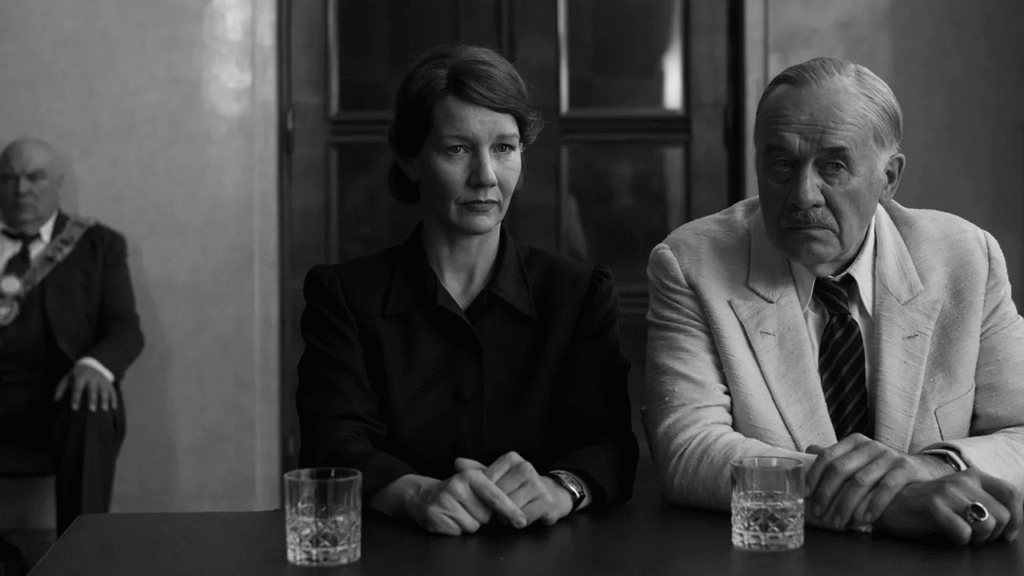
Fatherland Cannes Film Festival Screenings Review Roundup: Paweł Pawlikowski’s Cannes Competition drama has received one of the stronger early responses from this year’s festival screenings, with critics praising its restraint, emotional precision, black-and-white craft and quietly powerful performances. Led by Sandra Hüller as Erika Mann and Hanns Zischler as Thomas Mann, the film is being described as a compact historical road movie that turns postwar Germany into a space of memory, guilt, exile and unresolved grief.
Set in 1949, Fatherland follows Nobel Prize-winning German writer Thomas Mann as he returns to Germany after years of exile in the United States. He is accompanied by his daughter Erika Mann, who is not only his closest companion on the journey but also his editor, protector and emotional counterweight. Their road trip moves through a devastated and politically divided Germany, including Soviet-occupied Weimar, at a time when the country is still trying to process the horrors of Nazism and the new pressures of the Cold War. The death of Klaus Mann, Thomas’s son and Erika’s brother, becomes the film’s emotional wound. While Thomas continues with public commitments and intellectual distance, Erika carries the grief more openly, forcing the journey to become not just a return to the homeland, but a confrontation with family pain, political responsibility and the cost of exile.
The broad critical response suggests that Pawlikowski’s greatest achievement lies in control. Instead of turning history into a large-scale drama, he compresses it into an 82-minute chamber-like road movie. Critics have responded strongly to that discipline. Peter Bradshaw of The Guardian praised the film as elegant, poised and emotionally resonant, highlighting Pawlikowski’s ability to build historical pain through brevity and restraint. For Bradshaw, the film’s power comes from what it leaves unsaid as much as what it states directly.
Deadline also responded positively, describing Fatherland as a masterclass in artistic discipline. That phrase captures much of the praise around the film. Pawlikowski does not appear to be chasing dramatic excess. He works through silence, glances, pauses and controlled framing. The result, according to the more enthusiastic reviews, is a film that feels small in scale but large in moral and historical implication.
The Times called the film small but perfectly formed and positioned it as one of the highlights of Cannes. That response fits the larger mood around Fatherland: critics are not treating it as a sprawling biopic of Thomas Mann, but as a concentrated historical moment shaped by emotional and political pressure. The film’s short runtime has also been seen as a strength, allowing Pawlikowski to avoid the weight of conventional literary biography and instead focus on one decisive journey.
The performance response has been especially strong. David Rooney of The Hollywood Reporter frames the film around Sandra Hüller playing Erika Mann, the daughter of Death in Venice author Thomas Mann, in what he describes as Pawlikowski’s exquisitely nuanced road movie. That framing is important because the film does not appear to treat Erika as a secondary figure orbiting a famous father. Instead, she becomes central to the drama’s emotional and moral force.
TheWrap praised Hüller as quietly dazzling, while Jonathan Romney of Screen Daily described Hüller and Zischler as commanding Pawlikowski’s finely honed literary drama. Their dynamic seems to be the film’s central engine: Thomas Mann as the controlled, distant public intellectual, and Erika Mann as the sharper, more emotionally exposed figure who understands both the political stakes and the family’s private damage.
ICS Film also singled out Hüller’s performance, noting how she conveys grief, anger and restraint through small gestures and through her eyes. The review also praised Hanns Zischler’s Thomas Mann, saying he matches Hüller beat for beat. This is one of the key reasons the film seems to have worked for many critics. It does not rely on loud emotional confrontation. Instead, it lets the father-daughter relationship build through tension, silence and difference.
Erika Mann appears to be the film’s moral center. While Thomas Mann is the globally respected writer returning to the country that once forced him into exile, Erika carries the sharper emotional burden. She is grieving Klaus Mann’s death, watching her father maintain his public role, and confronting a Germany that has not fully reckoned with itself. Financial Times highlights Erika as Mann’s editor, co-pilot and moral compass, which gives the film a clearer emotional direction. Through Erika, the journey becomes less about Thomas Mann’s symbolic return and more about the cost paid by those around him.
This is also where Fatherland gains its deeper political force. Critics have noted that the film is not only about one family, but about Germany’s attempt to rebuild itself after catastrophe. Variety describes it as a meticulous meditation on Cold War Germany, Holocaust memory and whether a broken society can heal. That is a major part of the film’s Cannes appeal. Pawlikowski is not simply staging a historical return; he is examining what it means to come back to a country that has changed beyond recognition and yet still carries the same buried dangers.
The film’s postwar setting allows it to explore political pressure from multiple directions. Thomas Mann returns to a Germany divided between competing ideologies. He is pulled into public appearances, symbolic gestures and political expectations. The Soviet side wants to use him. The American-backed West also carries its own influence. The question becomes whether an intellectual can remain neutral after atrocity, or whether neutrality itself becomes a kind of evasion.
ICS Film reads the film’s political subtext as especially relevant, noting that its period setting carries a warning for the present, particularly in relation to the rise of fascism again. This gives Fatherland a contemporary charge without forcing modern parallels too heavily. The film appears to trust the audience to understand that history is not sealed in the past. The ruins, silences and compromises of postwar Germany become part of a larger warning about how societies remember, forget or excuse what has happened.
Pawlikowski’s formal craft has also drawn major praise. Shot in black and white by Łukasz Żal, Fatherland continues the visual discipline associated with the director’s earlier films such as Ida and Cold War. The Guardian praised the film’s monochrome cinematography, while ICS Film called Pawlikowski a master of mise-en-scène and highlighted Żal’s crisp imagery. The black-and-white style is not being treated by critics as decorative nostalgia. It appears to function as a way of stripping the film down to faces, rooms, roads, ruins and moral tension.
The film’s visual restraint also supports its road-movie structure. Rather than using the journey for scenic expansion, Pawlikowski seems to use movement to tighten the drama. Each stop reveals another layer of political pressure or emotional avoidance. The road does not offer escape; it forces Thomas and Erika closer to what they are trying to manage, suppress or survive.
At the same time, some critics have noted that Pawlikowski’s restraint may limit the film’s emotional reach for certain viewers. IndieWire offers a more reserved response, suggesting that the director’s elliptical style has limits when it comes to emotional impact. This is not necessarily a rejection of the film’s craft, but it does point to the main reservation: Fatherland may be too controlled, too quiet or too chilly for viewers expecting a more openly dramatic historical story.
That concern appears in some other responses as well. The film’s precision, which many critics admire, may also create distance. Pawlikowski’s style often asks viewers to read emotional meaning through absence and restraint. For some, that makes the film more powerful. For others, it can make the drama feel sealed off. ICS Film acknowledges that some viewers may find Fatherland colder than Ida or Cold War, even while arguing that the film ultimately lands on a warm and touching note.
The Cannes Film Festival screenings response, however, is clearly positive overall. Peter Bradshaw of The Guardian sees the film as elegant, poised and emotionally resonant. David Rooney of The Hollywood Reporter frames it as an exquisitely nuanced road movie led by Sandra Hüller and Hanns Zischler. Variety reads it as a careful meditation on Cold War Germany and Holocaust memory. Deadline calls it a masterclass in artistic discipline. Jonathan Romney of Screen Daily says Hüller and Zischler command the drama. Financial Times highlights its treatment of memory, complicity and Erika’s moral role. ICS Film calls it an important work of art with political subtext beyond its small drama. IndieWire offers balance by admiring the craft while questioning the limits of its emotional restraint.
What makes the response to Fatherland interesting is that critics are not praising it for scale. They are praising it for compression. Pawlikowski appears to have taken a major historical subject — Thomas Mann’s return to Germany, the legacy of Nazism, the beginning of the Cold War, the grief around Klaus Mann, and the moral position of the artist — and reduced it to a tightly held journey between father and daughter. That reduction seems to be the source of the film’s strength.
From a Planet of Films perspective, Fatherland seems to work because it does not treat history as spectacle. It treats history as pressure. The film’s power appears to come from rooms, roads, faces and silences. It understands that exile is not only geographical. It can exist inside a family, inside a country and inside a person who no longer knows how to belong to the place that formed them.
The final consensus from Cannes is that Fatherland is one of the more respected Competition titles of the festival. It has been praised for Pawlikowski’s controlled direction, Sandra Hüller’s restrained but forceful performance, Hanns Zischler’s quiet authority, Łukasz Żal’s black-and-white cinematography and the film’s ability to connect private grief with national memory. Some critics find it emotionally cool or too controlled, but even those reservations do not weaken the larger response. Fatherland is being received as a compact, elegant and politically resonant work — a film that finds its weight not in dramatic volume, but in the silence between what history records and what families carry.
Film: Fatherland
Original Title: Vaterland
Director: Paweł Pawlikowski
Writers: Paweł Pawlikowski, Hendrik Handloegten
Cast: Hanns Zischler, Sandra Hüller, August Diehl, Anna Madeley, Devid Striesow, Joanna Kulig
Runtime: Around 82 minutes
Language: German
Countries: Poland, Germany, Italy, France
Festival: Cannes Film Festival 2026, Main Competition
Cinematography: Łukasz Żal
Music: Marcin Masecki
Distributor: Mubi in several territories, including North America, UK, Germany, Italy, Spain, Australia, New Zealand and India; Kino Świat in Poland
Read More Review Roundups on POF