
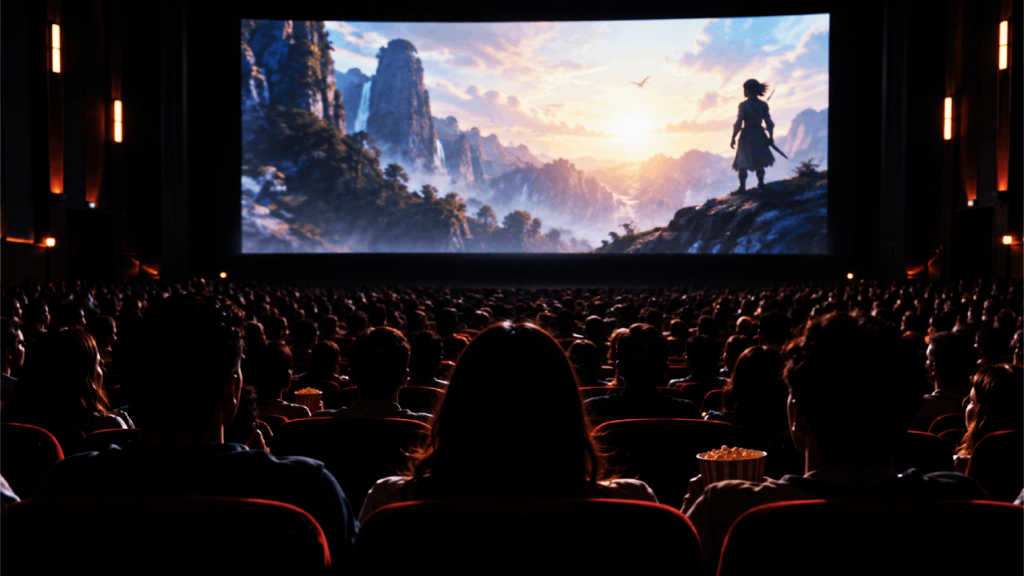
Why do people still go to the movie theatres?
It might be a strange question when you think about it. We have reached a point where almost every film we could possibly want to watch is sitting somewhere inside a streaming library. We can watch it from our beds, on our phones, on our televisions, or even on a laptop while eating lunch or dinner. We can pause it, rewind it. Stop it halfway and come back three days later.
So why leave home?
For more than a century, the answer seemed obvious. Because watching a movie was never only about watching a movie. The movie theatre was an experience in itself. You dressed up. You made plans. You bought a ticket, stood in a queue, found your seat, and waited for the lights to go down. The theatre was not just where the film was shown. It was where the film happened. And that is what makes the story of the movie theatre so interesting. Because the theatre has been declared dead many times before.
When television entered people’s homes, cinema had to find ways of making itself bigger and more spectacular. Widescreens, colour, stereo sound, and new formats became ways of reminding audiences that some experiences were better on the big screen. Then came the VCR. Then DVDs. Then home theatre systems. And now streaming. Every new technology has brought the same question with it. Why pay to leave your house when you can simply watch the movie here?
Yet, the movie theatre kept surviving.
For a long time, it was almost impossible to imagine cinema without it. Going to the movies became part of everyday life. Multiplexes made the experience even more convenient. Instead of one screen showing one film, audiences could choose between several films, several timings, and several kinds of experiences under the same roof.
But somewhere along the way, something changed. Going to the movies stopped being an automatic decision. Audiences became more selective.
The cost of a ticket went up. Food and drinks became expensive. The comfort of watching something at home became increasingly difficult to compete with. And streaming did something that theatres could never really offer: it removed the effort. You didn’t have to travel. You didn’t have to find parking. You didn’t have to sit beside strangers. And you definitely didn’t have to pay for popcorn that somehow costs almost as much as the ticket, and most times more.
More importantly, audiences slowly became accustomed to having everything available immediately. This is where the decline of the traditional movie theatre begins to make sense. It is not simply that people stopped loving films. They didn’t. They simply stopped feeling that every film needed a theatre.
Suffice to say that audiences do still turn up when a film feels like an event. A major franchise film. A Christopher Nolan film. A horror film that is amplified by a dark room and big screen. A concert film. A live performance. A film connected to a cultural moment.
The casual moviegoer may have become harder to attract, but the audience willing to make an occasion out of cinema is still very much there. And the numbers reflect that shift. In the United States, for instance, domestic box office revenue reached around $11.4 billion in 2019, with roughly 1.2 billion tickets sold. By 2025, box office return had been around $8.8 billion, but admissions were closer to 780 million. The difference is revealing. Fewer people are going to the movies, but the people who do go are often paying more for the experience.
The theatre is becoming less about quantity and more about value. This is also why premium cinema has become so important. IMAX. Dolby Cinema. 4DX. Recliner seats. Larger screens. Better sound.
The question is no longer simply, “Why should I watch this film in a theatre?” It is, “What can the theatre give me that my television or laptop screen cannot?”
And that is a much better question. Because if one can watch a film on a screen at home, the theatre has to give one a reason to choose the bigger screen. This has led to the rise of what is increasingly being called event cinema. The idea is simple. A theatre cannot depend on audiences showing up for every film anymore. Instead, it has to create moments that people feel they need to be present for.
This is why midnight releases still matter. Why fans line up for anniversary screenings. Why theatres sell merchandise, themed food, and collectibles. Why some films are marketed almost like concerts. This way, cinema becomes an occasion again. And this does not only apply to giant Hollywood releases.
And then there is something else that streaming cannot quite recreate, and that’s people. There is a strange intimacy in watching something with strangers. Everyone laughs at the same joke. Everyone becomes silent at the same moment. Everyone screams when the horror film wants them to scream. For two or three hours, you are experiencing the same thing.
That shared reaction has always been one of cinema’s greatest strengths.
This is also why theatres are increasingly trying to build communities around films. Film clubs, director Q&As, themed screenings, fan events, and anniversary re-releases turn cinema into a social space rather than simply a commercial one.
And social media has only made this more interesting. People do not just want to watch experiences anymore. They also want to share them. A packed midnight screening, a special event, a giant screen or a themed screening can itself become something worth posting about. The theatre becomes part of the memory. And that matters because memory is something streaming has a harder time creating.
Think about how we remember certain films. Sometimes we remember the film. But sometimes we remember who we watched it with. The theatre where we saw it. The audience reaction. The person sitting beside us. The ridiculous amount we paid for popcorn, or the wrong popcorn that got mixed up. Even the argument we had afterwards about how everyone found the film. That is the strange thing about cinema. We think we are paying for a film, but sometimes we are really paying for a memory.
And yet, reinvention does not mean the problems have disappeared.
Thousands of screens have disappeared in major markets, and many traditional multiplexes have struggled to survive. The theatres that are most vulnerable are often the large mid-tier complexes that offer little beyond the basic screening experience.
A bigger screen is not enough anymore if the screen is not noticeably better. A seat is not enough if the audience can have a better one at home. And a film is not enough if the same film will arrive on a streaming service a few weeks later. The theatrical window itself has also become shorter. Films that once had long exclusive runs in theatres can now reach homes much sooner. That has changed the psychology of the audience.
Why rush? If the movie is not an event, people can simply wait.
And this is where the future of the theatre becomes less about bringing back the past and more about accepting that the past is gone. The movie theatre probably cannot return to being the default place for every film. And it doesn’t need to. Not every movie needs a giant screen. Not every story needs surround sound. Some films are perfectly capable of finding their audience at home.
But some films are not. Some films demand scale, sound, darkness. And some simply demand other people. That may be why the future of the movie theatre is not necessarily bigger theatres everywhere, but better theatres in the places where they matter. Fewer screens, but more distinctive experiences. More premium formats, events, community, and more reasons to actually get out of the house.
Because the theatre is no longer only competing against another theatre. It is almost competing against the entire world inside our homes. Streaming gives us convenience. The theatre has to give us something more. And maybe that is why it has survived every time we thought it would disappear.
Television changed it. Home video changed it. The internet changed it. Streaming changed it. And now the theatre is changing itself. The movie theatre is not dying in the simple way people like to predict. It is shrinking, adapting, becoming more selective and, in many ways, becoming more ambitious about what it offers.
The question is no longer whether people will watch movies. Of course, they will. The question is whether they will still feel that some movies are worth leaving home for. And I think they will because you can watch a film alone. But there is something different about watching it in a dark room on a big screen where the rest of the world feels gone, and there’s just you and the film. And that is something a streaming service, no matter how enormous its library becomes, still cannot quite reproduce.
Maybe that is what the movie theatre has been selling all along. Not just the movie, but the feeling of watching it in the movie theatre.