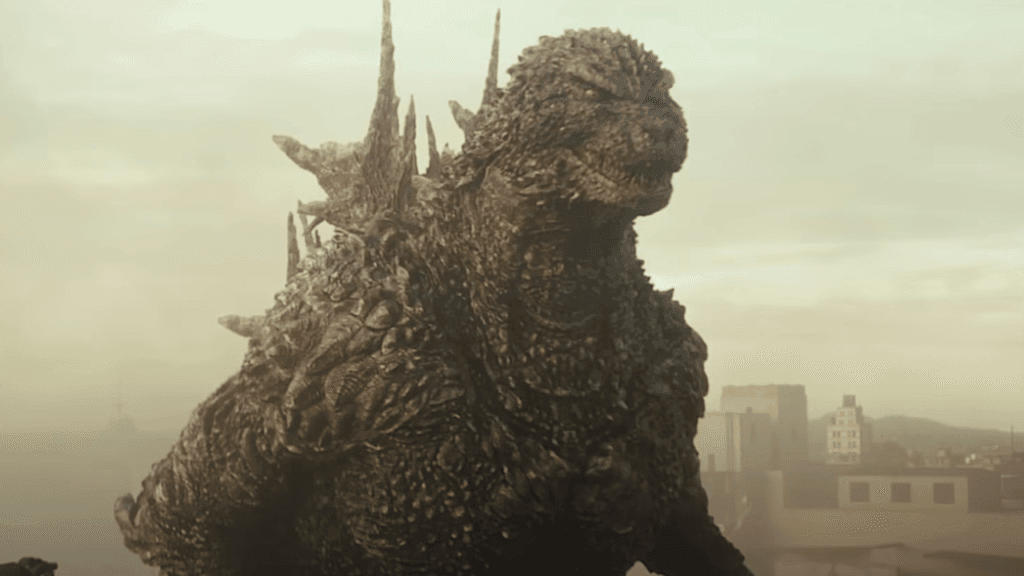
The sequel to one of the most unlikely global hits in recent memory is officially on the calendar. Godzilla Minus Zero, the follow-up to 2023’s breakout success Godzilla Minus One, will rampage into North American theaters on Nov. 6, just three days after its Japanese debut on Nov. 3. The tight theatrical window signals a clear shift in strategy from rights holder Toho, which is moving swiftly to capitalize on the rare convergence of box office success, critical acclaim, and awards recognition achieved by the previous film.
Distributed in North America by GKIDS, the release positions Godzilla Minus Zero not as a conventional genre sequel, but as a continuation of a prestige-driven experiment that redefined what a Godzilla film could be in the global marketplace. Unlike many franchise follow-ups that lean on scale escalation, the sequel arrives carrying a different kind of expectation — one rooted in craft, restraint, and emotional weight.
That expectation was earned by Godzilla Minus One, which began life as a modestly budgeted production and quickly transformed into a phenomenon. Made for approximately $15 million, the film went on to gross $113 million worldwide, a remarkable figure for a Japanese-language live-action release. In North America alone, it became the highest-grossing live-action Japanese film in theatrical history, sustaining its run through strong word of mouth and innovative exhibition strategies, including a subsequent black-and-white re-release that further extended audience interest.
Crucially, the film’s success was not limited to ticket sales. Godzilla Minus One earned the Academy Award for Best Visual Effects, marking the first Oscar win in the franchise’s 70-year history. That recognition altered the film’s standing overnight, shifting it from cult success to industry benchmark and forcing a reassessment of Japanese effects-driven cinema on the world stage. For Toho, the Oscar win validated a creative approach that prioritized storytelling and ingenuity over raw spending power.
At the center of that approach was filmmaker Takashi Yamazaki, who returns to direct the sequel. Yamazaki’s involvement is one of the most telling aspects of Godzilla Minus Zero. In a franchise historically defined by rotating creative teams, his return suggests an unusual level of confidence in auteur continuity. Yamazaki was instrumental in balancing intimate human drama with large-scale destruction, using visual effects as narrative tools rather than spectacle for its own sake. That balance resonated with audiences far beyond traditional kaiju fans and gave the film a distinctly human core.
The original film was set in post–World War II Japan and followed a disgraced kamikaze pilot, Koichi, portrayed by Ryunosuke Kamiki, whose struggle for personal redemption mirrored a nation grappling with collective trauma. While no casting or story details have been revealed for Godzilla Minus Zero, the choice of title alone suggests thematic continuation rather than a hard reset. The “Minus” branding has come to represent a stripped-down, emotionally grounded interpretation of Godzilla, one that treats the monster less as a pop icon and more as a force shaped by historical context.
The decision to again partner with GKIDS for the North American release reinforces that positioning. Known primarily for its work with animated and international cinema, the distributor has developed a reputation for carefully curated theatrical rollouts that target cinephile audiences without alienating mainstream viewers. For Godzilla Minus One, that strategy paid off handsomely, allowing the film to grow organically rather than burn out after an opening weekend. Repeating that model suggests Toho is prioritizing longevity and audience trust over short-term spectacle.
Industry perception also played a significant role in elevating the first film’s profile. Praise from high-profile filmmakers, including Steven Spielberg, helped reframe the movie as a serious cinematic achievement rather than a niche genre entry. That kind of endorsement, combined with awards recognition, expanded the film’s reach and reshaped how Hollywood views Japanese genre filmmaking — not as an export curiosity, but as a viable competitor in the global prestige space.
With Godzilla Minus Zero, Toho is effectively testing whether that perception shift can be sustained. The sequel arrives at a time when Hollywood’s own monster franchises are increasingly defined by scale, shared universes, and escalating budgets. In contrast, the Minus films represent a counter-model: controlled budgets, singular vision, and thematic specificity. If the sequel succeeds, it could further establish a parallel path for franchise filmmaking — one where emotional resonance and craftsmanship matter as much as box office muscle.
The stakes, then, extend beyond Godzilla himself. Godzilla Minus Zero will measure whether prestige kaiju cinema can survive sequelization without losing its identity, and whether global audiences are willing to return for a follow-up that promises depth rather than excess. Few Godzilla films have arrived with such a burden of expectation — not to be louder or larger, but to prove that the monster’s most powerful era may lie not in destruction alone, but in meaning.
Godzilla Minus Zero Release Date Set as Toho Expands Prestige Godzilla Era