
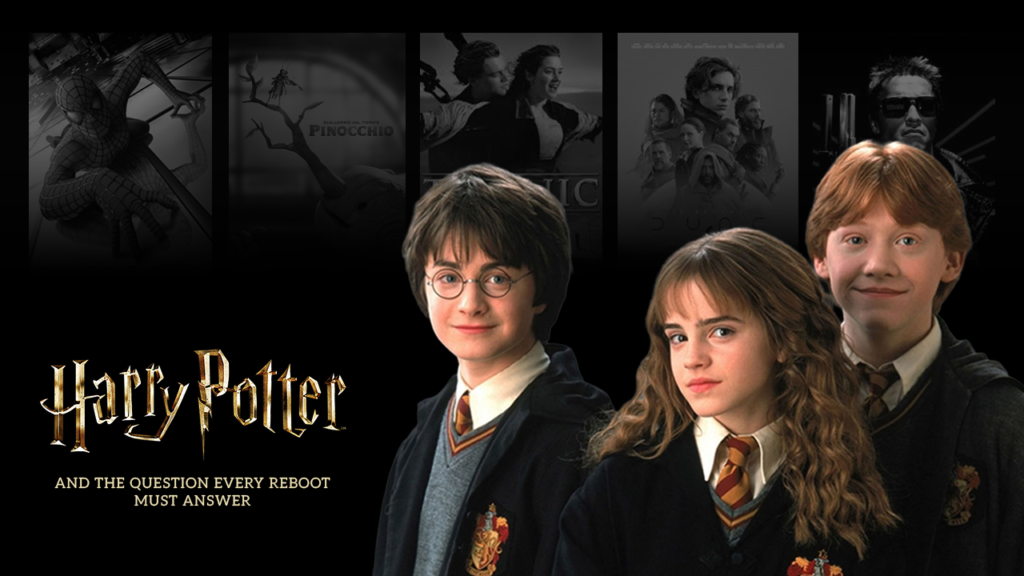
When you’re a kid, everything you experience deeply becomes nostalgia. You don’t just associate yourself with it, you associate your entire world around it. Harry Potter was one such world. And I was one such child.
It didn’t just give us spectacle in the form of cinema, it did much more than that. It defined a generation. It became a phenomenon. And it continues to be one, as new generations keep discovering it, making it their own, and defining it on their own terms.
There are broadly two kinds of Harry Potter fans, those who read the books as they came out, and those who experienced the films alongside or instead of them. Their memories are layered, reading the books, then watching that same world unfold on the big screen. Then there are fans like me, who were introduced primarily through the films.
I remember watching most of the Harry Potter films on television. To me, everything about them felt larger than life, grand, vast, almost overwhelming in scale. The only film I watched on the big screen was Deathly Hallows – Part 2, and I remember feeling an unexpected sadness when I saw the newspaper images of the cast and crew at the premiere. It felt like the end of something real, something that had quietly been a part of my growing up. Maybe it was because, in a way, it was the last time that world would exist in that form.
Over time, I’ve also heard from fans who read the books. They love the films, but they often say the same thing, the depth of the books could never fully translate into a two-hour film. And that’s fair. A single book holds far more nuance, detail, and emotional layering than a film can capture. That’s why, this time as a long-form Harry Potter reboot series, with each book getting its own season, feels both exciting and complicated.
On one hand, it promises depth. It promises justice to the material. On the other hand, it challenges something deeply personal, our attachment to the original cast. We know these characters through certain faces. And when those faces change, it feels strange. Almost like something has been taken away. Because for many of us, those actors are those characters. That’s what we grew up with.
But then comes the bigger question, why does reboot trend in Hollywood at all?
From a production standpoint, the answer is obvious. It’s commercial. A well-known franchise with a deeply rooted fan base guarantees attention. Even people who might not end up liking it will still watch it, if only out of curiosity. That’s not a creative reason, that’s a business one. A statistical one.
But cinema is art. And the soul of any film or series lies in its creative intent. So, if a reboot is being made, what should justify it?
As a viewer, and more importantly, as a fan, I would hope it’s because there is something new to say. A deeper exploration. Something that adds value, not just revisits familiarity. Because the world of Harry Potter is expansive. It’s flexible. You can reinterpret it in countless ways.
But the question remains, should you? And if you do, are you doing justice to the material, or just capitalizing on its legacy? This tension between art and commerce isn’t new. It exists across the industry.
Take Spider-Man, for example. There have been multiple versions over the years, each shaped by a different creative vision. For me, the most recent version felt the most engaging, not just because of the storytelling, but because it expanded the world by connecting it to something larger. It felt fresh. It felt like it had something new to offer. And that’s when a reboot works, when it brings a different outlook, when the filmmaker sees the same world through a new lens.
But how often do Hollywood reboots really happen?
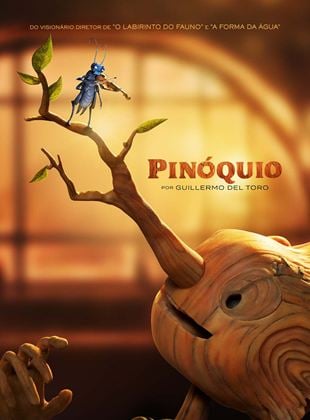 There are also cases like Pinocchio, where multiple versions exist, some similar, some forgettable. And then there are versions that truly stand apart because they bring something entirely new, not just in storytelling but in form and intent. Guillermo del Toro’s Pinocchio is one such example. It didn’t simply retell the story, it reinterpreted it. Through stop-motion animation and a much darker, more emotional lens, Del Toro used the world of Pinocchio to explore deeper themes of grief, fascism, love, and disobedience. It felt personal and purposeful. The reboot justified itself because it brought a completely fresh perspective, adding value not just to Pinocchio as a story, but to cinema itself.
Technology is another factor. Sometimes, stories are revisited because we now have the tools to tell them better. Dune is another example of a story revisited because cinema finally had the technological and creative capability to fully realize its scale. Frank Herbert’s world had previously been adapted, but Denis Villeneuve’s version felt closer to the grandeur, complexity, and atmosphere the story demanded. The advancement in filmmaking technology allowed that universe to breathe in a way earlier adaptation struggled to achieve. That’s a valid reason to revisit a story. But even then, technology alone isn’t enough. Without a strong creative core, it simply becomes spectacle without substance.
And then there are franchises that aren’t rebooted as often, or at least not in the same way. Take The Terminator, for instance. Despite being one of the most iconic and commercially successful science-fiction franchises ever made, it has never really undergone a complete reboot in the way franchises like Spider-Man or Batman repeatedly have. There have been sequels, continuations, and alternate timelines, but the original still feels so definitive in its identity and impact that one wonders if filmmakers themselves feel hesitant to fully recreate it. Maybe some stories feel so complete, so rooted in the time and vision in which they were made, that revisiting them risks losing what made them special in the first place.
All of this leads back to a larger concern, does reboot culture stifle originality?
When studios rely heavily on existing material, does it reduce the space for new ideas? Is it easier to build on something that already exists than to create something from scratch? Because while cinema is art, it is also business. And as long as that balance exists, reboot culture isn’t going anywhere.
It’s safer. It’s more predictable. It’s, in many ways, easier money. You don’t have to start with a blank page, you start with something that already works. You bring in talented writers you know are prominent names in the industry, reinterpret the whole thing with their expertise, and present it again. But ease doesn’t always equal value.
And that brings us back to Harry Potter. For many, it isn’t just a story. It’s a part of who they are. It’s something that gave them comfort, lessons, and a sense of belonging. For them, magic isn’t just fictional, it’s emotional. It’s lived. They quote it. They carry it with them. They see parts of their life through it. So, when that world is revisited, the expectations are different. It’s not just about whether it’s good, it’s about whether it means something.
At the same time, there’s also a new generation growing up, one that might experience this world for the first time through a reboot. For them, this version might become their Harry Potter, like it once was for me. And maybe that’s part of the reason these reboots exist.
Reboots, at their best, are not repetitions, they are reinterpretations. They should expand, deepen, or reframe what already exists. They should justify their existence not through familiarity, but through meaning. Yes, commerce will always be a driving force. That’s unavoidable. But when it becomes the only reason, something is lost. The real challenge, and responsibility, lies in balancing the two. Because stories like Harry Potter don’t just belong to studios. They belong to the people who grew up with them, who found pieces of themselves in them.
And if you’re going to revisit something that powerful, it shouldn’t just be to recreate it. It should be to add to it.
Read More: