
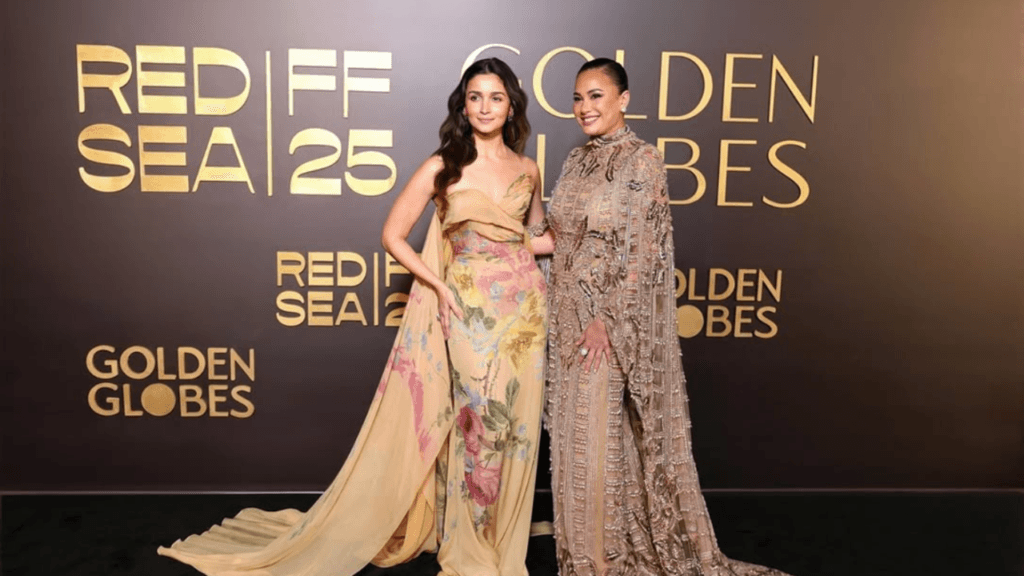
The Golden Globes brought a global spotlight to Jeddah as they honored Tunisian icon Hend Sabry and Indian star Alia Bhatt at a glittering gala dinner during the fifth edition of the Red Sea International Film Festival. Sabry received the prestigious Omar Sharif Award, while Bhatt was presented with the Golden Globes Horizon Award, marking a night that celebrated two women whose careers continue to shape cinema across continents.
Set against the Red Sea Festival’s soaring international profile, the event transformed the evening into a remarkable cultural intersection point. With acclaimed filmmakers, global actors, and industry powerhouses in attendance, the awards symbolized more than recognition — they captured the festival’s ambition to become a central home for world cinema.
The Golden Globes’ presence at the Red Sea Festival has grown significantly over the years, and this edition mirrored that evolution with its glamorous staging, international turnout, and focus on artistic excellence. The gala dinner unfolded with warmth, reverence, and a palpable sense of pride as both Sabry and Bhatt were celebrated not only for their achievements but also for the pathways they continue to carve for artists in their regions.
Hend Sabry Receives the Omar Sharif Award
For Hend Sabry, one of the Arab world’s most respected and enduring performers, the Omar Sharif Award marks a profound milestone. Named after the legendary Egyptian actor who became an international cinematic ambassador, the award honors artists whose careers embody cultural resonance, longevity, and cross-border impact. Sabry’s selection reflects her unmatched contribution to the evolution of Arab cinema and her ability to seamlessly bridge artistic worlds.
Sabry’s presence at the gala was met with overwhelming admiration. Over her decades-long career, she has become a voice of strength, complexity, and authenticity, representing Arab women in ways both deeply rooted and daringly contemporary. The recognition highlights her enduring ability to engage audiences across language and geography while consistently choosing stories that challenge societal norms and elevate regional cinema’s global standing.
Hend Sabry’s legacy is built on a body of work that has shaped modern Arab storytelling. Her breakout role in “The Silences of the Palace” (1994) remains one of the most striking performances in Tunisian cinema — a film that positioned her early on as an actor of rare depth. She continued to build that reputation through films like “Asmaa” (2011), where she portrayed an HIV-positive woman fighting stigma with unwavering resilience. The performance is widely considered one of the finest of her career, earning her numerous accolades and placing her firmly at the center of socially conscious Arab cinema.
In “Cairo 678”, Sabry delivered another emotionally charged performance, tackling sexual harassment in Egypt with honesty and strength. Her portrayal resonated across the region, sparking conversations far beyond the screen. She has also delivered acclaimed performances in commercial hits and television dramas, striking a balance between artistic integrity and mass appeal. This versatility — the ability to move from intimate drama to popular entertainment while retaining her creative identity — is a major reason why the Omar Sharif Award feels both timely and richly deserved.
Alia Bhatt Honored with the Golden Globes Horizon Award
Indian actor Alia Bhatt, one of the most prominent contemporary voices in global Indian cinema, received the Golden Globes Horizon Award, an honor reserved for rising international stars whose work signals exceptional cultural reach. Bhatt’s ascent from a promising debutant to a performer shaping the global conversation around Indian storytelling has been swift, consistent, and influential. The award recognizes her growing presence across world cinema — from Bollywood to streaming platforms to Hollywood.
At the gala, Bhatt was celebrated not just as one of India’s leading actors but as a performer who has transcended borders through craft, charisma, and carefully chosen roles. The Horizon Award underlines her position as an international face of modern Indian cinema — youthful yet experienced, commercially successful yet artistically grounded.
Alia Bhatt’s filmography showcases an impressive range of characters, anchored by her instinctive emotional intelligence on screen. Her breakthrough performance in “Highway” (2014) established her as a serious actor capable of internal, layered portrayals. She followed this with the critically acclaimed “Raazi” (2018), delivering a performance of remarkable control as a young Indian spy navigating love, loyalty, and duty — a role that earned her numerous Best Actress awards.
Her starring turn in “Gully Boy” (2019) showcased her versatility and energy, while “Gangubai Kathiawadi” (2022) cemented her as one of the finest performers in contemporary Indian cinema. As Gangubai, Bhatt delivered a commanding, career-defining performance under the direction of Sanjay Leela Bhansali, combining vulnerability with steel and transforming a real-life figure into a cinematic titan.
Bhatt’s global visibility rose even further with “RRR”, which became an international sensation, and her English-language debut in “Heart of Stone”, which expanded her footprint in Hollywood. Each of these performances reflects her ability to adapt across genres while maintaining a distinctive artistic identity — an essential quality that aligns perfectly with the Horizon Award’s vision.
A Night of Global Cinema and Influential Voices
The awards ceremony unfolded amid a constellation of internationally acclaimed guests, reflecting the Red Sea Festival’s growing prominence. Among the distinguished attendees were directors Sean Baker and Darren Aronofsky, names synonymous with bold, uncompromising filmmaking. Actors Sigourney Weaver, Naomie Harris, Shailene Woodley, Olga Kurylenko, and Édgar Ramírez added a wave of Hollywood and European star power. Also present were Henry Golding, Riz Ahmed, and Bollywood superstar Salman Khan, each representing different cinematic cultures converging on a single platform. Actor-director Idris Elba added further gravitas, underscoring the event’s global pull.
The presence of such a diverse group of industry figures not only amplified the glamour of the evening but also reflected cinema’s increasingly borderless nature. Their attendance at the Golden Globes gala dinner signaled confidence in the Red Sea Festival’s vision — a festival that is positioning itself as a dynamic international arena where East meets West, and where established cinematic traditions intersect with rising talent.
Red Sea Festival’s Growing Influence
Now in its fifth edition, the Red Sea International Film Festival has evolved from a regional showcase to a global cultural force. Its programming, industry labs, international juries, and filmmaker initiatives are steadily restructuring the cinematic ecosystem of West Asia and North Africa. By collaborating with the Golden Globes and hosting international talent of this scale, the festival continues to assert its place as a bridge between continents — a space where Arab, Asian, African, European, and American voices find equal resonance.
This year’s gala dinner was a testament to that ambition. The spotlight on Hend Sabry and Alia Bhatt demonstrated the festival’s commitment to honoring artists who represent cultural transformation, narrative bravery, and global impact.
As the Red Sea Festival continues to grow, these awards signal its crucial role in spotlighting voices that push cinema forward. For audiences, artists, and the global film community, the evening served as a reminder of how stories travel, how culture connects, and how festivals like Red Sea are becoming essential in shaping tomorrow’s cinematic landscape.