
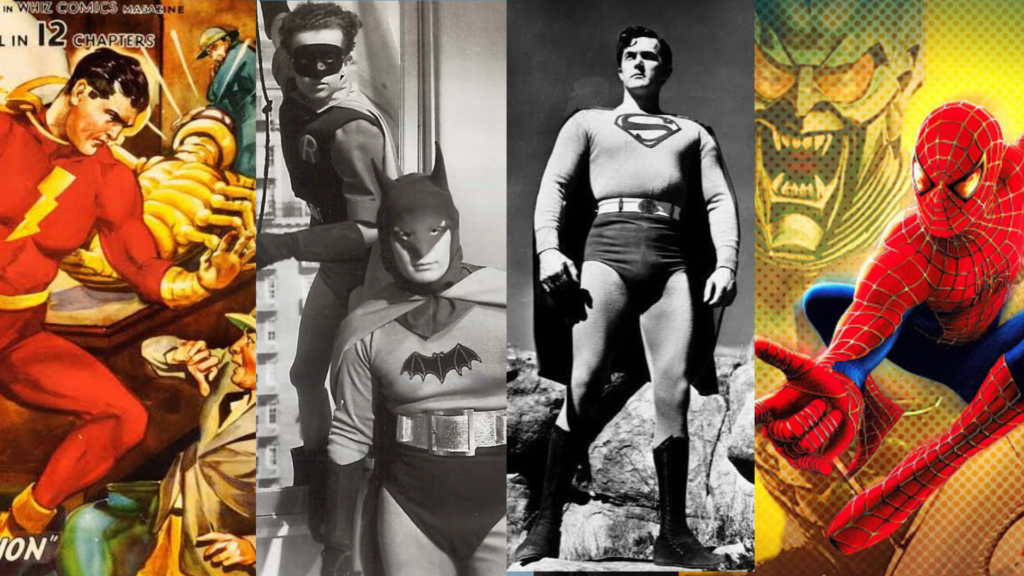
The first thing that might come to mind when one thinks of comic books being adapted into films is superheroes. We think of characters like Superman, Batman, Spider-Man, or the many Marvel characters who have come together on screen over the years. But comic book adaptations existed long before these films became the big-budget productions they are known for today.
The journey in fact began with simple comic strips in newspapers, at a time when the idea of turning illustrated stories into films was still relatively new.

One of the earliest examples of this is The Katzenjammer Kids, a comic strip created by Rudolph Dirks in 1897. It followed two mischievous brothers and their everyday antics, and was adapted into a silent live-action short film in 1898. That is just a year after the comic first appeared. As the medium evolved, the broader move to cinema continued through other popular newspaper comic strips, which inspired mid-century live-action hits like Skippy in 1931, Flash Gordon in 1936, and Dick Tracy in 1937. Today, when films based on comic books are associated with elaborate action sequences, larger-than-life characters and stories that span several films, it is quite different to go back to something like The Katzenjammer Kids.
There were no cinematic universes to build around these characters. There was simply a comic strip that people enjoyed reading, and a film adaptation that brought it to the screen.
The move to live-action adaptations came with comic book characters such as Captain Marvel, Batman and Superman. The Adventures of Captain Marvel (1941), based on the Fawcett Comics character, was among the earliest live-action comic book serials. Batman followed in 1943, and Superman in 1948. These were serials rather than the standalone feature films audiences are familiar with today, with stories unfolding across installments. The characters that readers had known from comic books were now being played by actors on screen.
And while the films may look very different from what the genre has become, the idea behind them was already familiar: audiences wanted to see these characters beyond the pages they had first encountered them on.

With the release of Superman (1978), directed by Richard Donner, came a significant moment for comic book adaptations. The film brought Superman to the big screen on a scale that audiences had not quite seen before in the genre with Christopher Reeve taking on the cape of Superman. It also showed that a film based on a comic book character could work as a major theatrical production without losing the character that readers already knew. Tim Burton’s Batman (1989) took things further, becoming a major cultural event and expanding the commercial side of comic book films through merchandising. These characters were no longer just appearing in films. They were becoming brands that audiences could recognise and follow.
By the time X-Men (2000) and Spider-Man (2002) arrived, advances in visual effects had made it easier to bring comic book worlds and abilities to the screen. The success of these films also helped superhero adaptations reach a much wider audience. And it is worth remembering that comic books had never been limited to superheroes in the first place. Yet as these films became more successful, superheroes increasingly came to define what people thought of when they heard the words comic book adaptation.
The medium had always offered different kinds of stories, but the films attracting the most attention were beginning to make the genre seem much narrower than it actually was.
That changed the scale of things further when Marvel launched the Marvel Cinematic Universe with Iron Man in 2008. Instead of treating every film as a separate story, Marvel began connecting its characters and films, gradually building towards crossovers that brought them together. It is difficult to talk about comic book adaptations today without talking about the MCU, considering how much it has influenced the way studios approach franchises. But its success has also changed audience expectations. A comic book film is no longer always expected to tell a story that begins and ends within a single film; sometimes, it is expected to be part of something much bigger.
But comic book adaptations have never been limited to superhero films, even if that is what the genre is most commonly associated with today.

Ghost World (2001), adapted from Daniel Clowes’ comic, follows two teenage girls trying to figure out what to do with their lives after school. It is a very different kind of story from the ones we usually associate with comic book adaptations, with its attention to ordinary lives, relationships and the uncertainty that comes with growing up. Then there is French animated film Persepolis (2007), adapted from Marjane Satrapi’s autobiographical graphic novel, which tells the story of her childhood and adolescence during and after the Iranian Revolution. Both films are proof of how much the medium has to offer beyond superheroes, and how differently comic book stories can be translated to cinema.
There has always been a debate about how closely these films should follow the original comics. Some fans want the films to stay true to the stories they know, while filmmakers may change certain things to make them work better on screen.
Stan Lee, who co-created many of Marvel’s most well-known characters, supported these adaptations and even made cameo appearances in several of them. But adapting a comic book is not quite the same as reproducing it on screen. A comic relies on drawings, panels and the reader’s imagination to move a story forward, while a film has its own way of telling it. Some changes may work, others may not, and that difference is often what leads to disagreements among fans.
The scale of comic book adaptations today also raises questions about the kind of films the industry chooses to invest in. Superhero films hold the power to bring in enormous audiences and box-office returns, which makes them appealing to major studios. But when so much money and attention go towards these franchises, it becomes worth asking what happens to films that do not fit the same model.
Comic books have always contained stories about people, relationships, politics and growing up, among many other things. Their adaptations need not all become billion-dollar spectacles to be worth making. The success of superhero films has shown just how much audiences can connect with characters who first appeared on a page. The question is whether cinema will continue to make room for the many other stories those pages have to offer.
The journey from comic strips to films that bring together dozens of characters and entire fictional worlds is a long one. A character that once existed in a few panels can now appear across many films, with audiences following their story for years. The way these stories are told has changed, too. What began with adapting a comic book character has, in many cases, grown into a much larger cinematic world that audiences keep returning to.
But the popularity of these films does not mean that every adaptation has to follow the same path. Ghost World and Persepolis are reminders that comic books have always had room for stories that do not depend on superheroes, elaborate action sequences or enormous budgets. There are stories in this medium that are personal, political, funny, uncomfortable, and ordinary. They may not all have the same commercial reach, but that does not make them any less worth bringing to the screen.
Comic books have been finding their way into cinema for well over a century, and it is interesting to see how much that relationship has changed. What once meant bringing a character from a page to a moving image can now mean building an entire franchise around them. Yet, the appeal of these adaptations still begins with the characters and stories that made people stop and read in the first place.
The technology and the scale may keep changing, but there is still a lot more to explore in the pages that filmmakers continue to return to.