
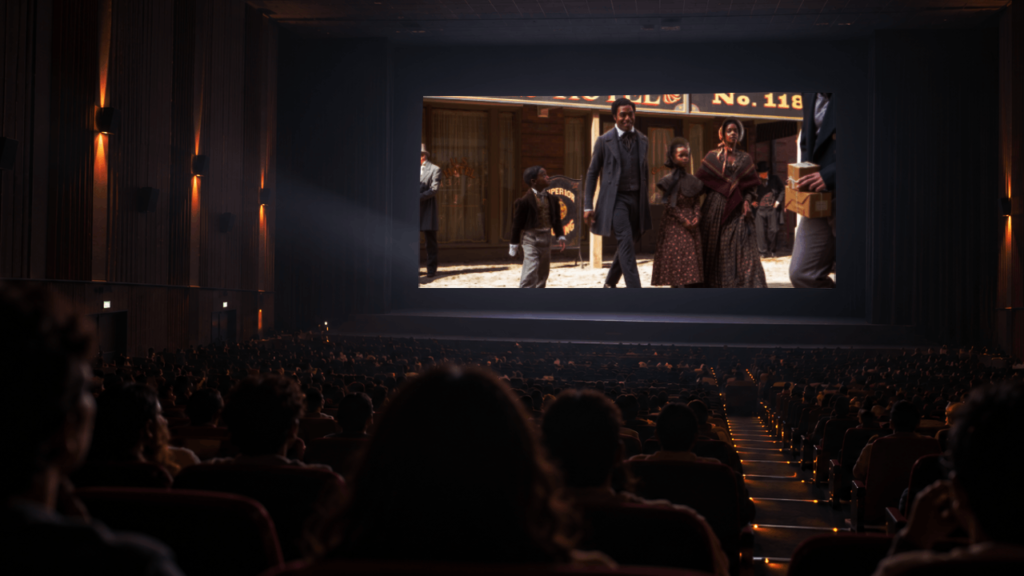
A nation is not just built through its borders, government, institutions, or the laws that hold it together. There is another kind of nation building that happens quietly, and that’s through the stories people tell about where they come from, what they have lived through, and what they imagine their country to be.
Cinema becomes a part of this process because it gives these ideas a form that people can see, hear and, more importantly, feel.
A film can show people their own country through a different pair of eyes. It can take a story from one part of the country and make it familiar to someone living thousands of kilometres away. It can preserve a memory that might otherwise disappear, introduce one community to another, and sometimes even create an image of the country that people begin to associate with themselves.
Cinema therefore does not merely exist within a nation. It can also participate in shaping the idea of one.
Every nation has memories that it carries with it. Some of them are found in history books, some are passed down through families, and some remain in the photographs, songs, and stories left behind by earlier generations. Cinema adds another layer to these memories. It records not only the major events of a time, but also the ordinary life around them, which can become part of a country’s visual memory.
This becomes especially important when a country has gone through war, political upheaval, colonialism, or social transformation. Cinema can preserve these histories, but it can also make them personal. Films such as 12 Years a Slave (2013) and Schindler’s List (1993) do not allow history to remain only a collection of dates and events. They place people inside it. The larger history is seen through individual lives, and this makes it easier for an audience to understand that what is remembered as a national event was also somebody’s fear, loss, tragedy, home.
Cinema then becomes a way of remembering a nation. But remembering is only one part of nation building. A country also has to recognise itself in the present.
This is where cinema’s ability to represent culture becomes important. Different nations have different languages, religions, communities, traditions, and ways of living. Cinema can bring some of these separate experiences into the same space. A person can encounter a culture they have never lived around simply by watching a film. A film can take a language spoken in one region and carry it somewhere else. It can introduce an audience to a community’s food, music, clothing, traditions, or everyday life.
Indian cinema has done this across its many languages and regions. But this is not limited to India. South Korean cinema has carried Korean culture to audiences around the world. Iranian cinema has allowed people outside Iran to experience ordinary Iranian lives through stories that are often simple but deeply rooted in their surroundings. Japanese cinema, African cinema, and Latin American cinema have done much the same.
There is also something else cinema does. It allows people to see themselves.
A person watching a film may recognise their language, their family, their neighbourhood, or even a small part of their own personality in a character. When a private experience appears on a screen, it stops feeling entirely private. This is how cinema can create shared identities. Not everyone in a nation has to live the same life. They do not even have to agree on everything. But they can still recognise something of themselves in the same story.
A song becomes associated with an entire generation. A dialogue is repeated for years. A character becomes a cultural reference point. People who have never met each other can remember the same scene and feel the same nostalgia when they hear its music. And suddenly, a film is no longer just a film. It has become a shared memory.
This is especially important for nations with large and diverse populations. Cinema can give people something common without asking them to become the same. It can allow difference to exist while still creating a feeling of belonging. But cinema’s role in nation building does not stop at reflecting what already exists.
It also sometimes influences what people imagine their country should become.
When countries are going through periods of major change, films can be used to present ideas of progress and development. Post-independence India offers a clear example of this. The Films Division of India produced films around science, technology, development, and modernisation. These films were part of a larger effort to imagine what India would become after independence.
Cinema was hence being used not simply to entertain people, but to communicate an idea of the nation and its future.
Something similar can be seen in other countries too. In China, cinema has often existed closely alongside the state’s political and cultural vision. Large productions can receive support not only because they have commercial potential but because they align with particular ideas of national identity, history, and politics.
And this is where cinema’s power becomes complicated. Because if cinema can help build a national identity, the question arises: whose idea of the nation are we watching?
A film can unite people around a common history. It can create pride, celebrate national achievements, and give people heroes to look up to. But it can also leave certain people outside that picture. A nation is not only its most powerful people, its biggest cities, or its proudest moments. It is also its minorities, its poor, its marginalized communities, and the people whose stories may not fit neatly into the official version of the country. But it is part of it, equally as much as the rest of it is.
This is why films that question a nation can be even more important to nation building than films that celebrate it. Parasite (2019), for instance, uses the lives of two families to look at the distance between the rich and the poor. Do the Right Thing (1989) examines racial tensions within an ordinary neighbourhood. These films contribute to the idea of a nation by asking uncomfortable questions about the society that makes up that nation.
A nation cannot become stronger by refusing to look at its own problems. Cinema can bring poverty, racism, discrimination, inequality, political oppression, and other social issues into the public imagination. It can take something that people may have only read about and make them feel it. A statistic about migration is one thing, watching a family leave its home is another. A statistic about war is one thing, watching a person lose somebody they love because of it is entirely another.
Cinema can turn an issue into an experience. And because films make us emotionally invested in characters, they can also cultivate empathy. That ability to create empathy can have a larger social effect. When people begin to understand experiences outside their own, the boundaries between different sections of society can become slightly less rigid. Cinema cannot solve social problems on its own, but it can make conversations around them possible. It can make people ask questions that they may not have asked without.
Cinema can also shape the way the rest of the world sees a nation.
A country is not branded only through advertisements, tourism campaigns, or political speeches. Films do it too, at times without even trying to. A city repeatedly shown on screen can become recognisable across the world. Its food, music, architecture and traditions can become familiar to audiences who have never actually been there. Sometimes people want to visit a place because they have already fallen in love with it through a film.
Cinema can therefore make a country attractive to the rest of the world simply by showing it. But even this comes with its own complications.
The image of a nation created through cinema may not always be a complete one. A country can be reduced to its most beautiful landscapes, its romanticised traditions, or the version of its culture that is easiest for outsiders to understand. Just as cinema can challenge stereotypes, it can create them as well. This is why the role of cinema in nation building cannot be understood as entirely positive or negative. It depends on what is being shown, who is showing it, why they’re showing it, and who is watching it.
Not every film changes society. Not every audience receives a film in the same way. A blockbuster may be made primarily for entertainment while an independent film may be trying to provoke a social or political conversation. But even entertainment can become part of cultural memory. A film does not have to announce that it is building a nation to become part of the way a nation sees itself.
And this might be what makes cinema’s relationship with nation building so intriguing.
A nation is not only a political or geographical idea. It is also an emotional one. People have to feel that they belong to something larger than themselves, which is also where patriotism stems from. They need memories that they can share, stories that they can recognise, and images through which they can imagine a common future. Cinema can give it all three.
It can preserve the past before it disappears. It can bring different communities into the same frame. It can question the things that divide people and create empathy for lives that remain outside people’s own experience. It can celebrate a country’s culture, but it can also question whether the country is living up to the values it claims to represent. And when its films travel beyond its borders, it can shape how the rest of the world sees that nation.
And maybe that is where cinema’s real contribution to nation building lies.
Not in telling people what their nation is, but in giving them enough stories to recognise it, question it, and imagine it differently. Because a nation, much like cinema, is never really finished. It keeps changing with the people who inhabit it, and the new stories that follow through them.