
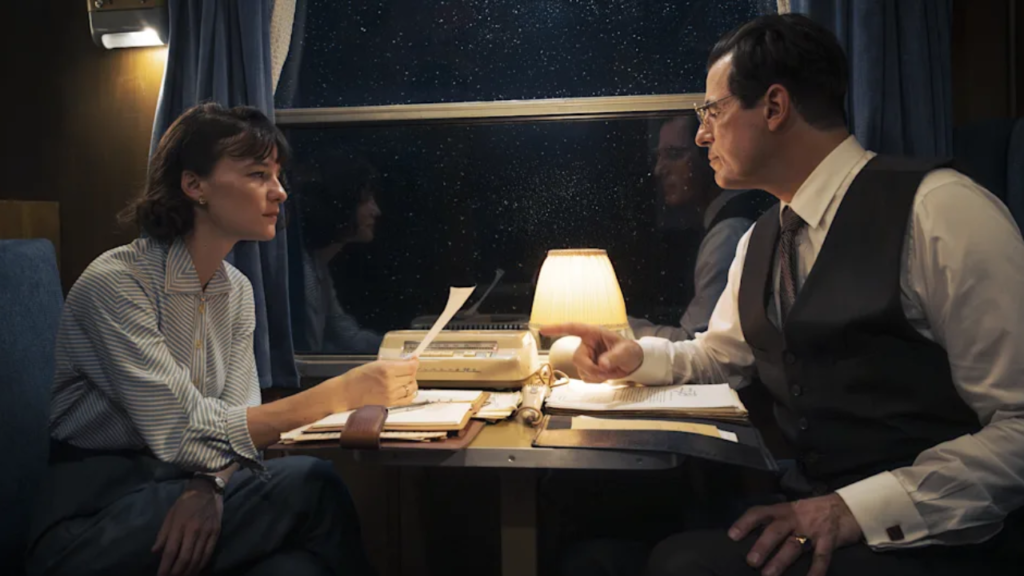
I Is Another (Ich ist ein Anderer in its original German) had its world premiere at the Locarno Film Festival’s Piazza Grande before arriving in wider release. Directed by Felix Randau and starring Claes Bang and Valerie Pachner, the film is based on the real and deeply contested story of Felix Kersten, the Baltic German massage therapist who became Heinrich Himmler’s personal physiotherapist during World War II and later claimed to have used that intimate access to save tens of thousands of Jewish lives. Critics have firmly placed the film in the positive column, with particular praise for Bang’s commanding performance and the film’s sharp contemporary resonance.
Set in the autumn of 1952, the story follows journalist Hedda Wohmann, played by Valerie Pachner, and her husband Winfried as they confront Felix Kersten during a train journey, determined to challenge the extraordinary claims that have shaped his post-war reputation. Kersten insists that he used his unique influence over Reichsführer-SS Heinrich Himmler, whose debilitating stomach cramps only he could relieve, to persuade the Nazi leader to halt the mass deportation of Dutch citizens and facilitate the release of concentration camp prisoners during the final days of the war. Hedda remains deeply sceptical. What begins as an interview soon develops into a tense psychological cat-and-mouse game, unfolding almost entirely within the claustrophobic confines of a train carriage while flashbacks revisit Kersten’s wartime relationship with Himmler.
The Hollywood Reporter describes the film as a compelling German suspense story that somehow becomes more than the sum of its parts, calling it “weirdly relevant” in today’s post-truth world. Variety similarly praises it as a handsomely crafted psychological thriller with unmistakable contemporary resonance, arguing that it raises difficult questions about historical fact and the increasingly malleable nature of truth itself. ICS Film’s Locarno review identifies the film’s central question as one of its greatest strengths: what compels a person to choose between good and evil? Rather than offering easy answers, the film refuses to settle the matter cleanly in either direction.
All three publications converge on one key observation. Although rooted firmly in history, I Is Another lands with uncomfortable force in 2026, at a moment when the meaning of truth, the reliability of memory and the danger of convenient narratives have rarely felt more urgent. Rather than functioning solely as a World War II drama, the film becomes a meditation on the ways history is interpreted, contested and reshaped over time.
The combustible on-screen chemistry between Claes Bang and Valerie Pachner has been widely identified as one of the film’s greatest strengths, but it is Bang who attracts the overwhelming share of critical praise. Variety describes him as impeccable, an actor capable of making audiences want to believe a man whose account is simultaneously morally ambiguous, self-serving and historically disputed. The Hollywood Reporter calls Bang a protean Danish polyglot whose effortless movement between languages and emotional registers gives Kersten the elusive, chameleonic quality the role demands.
That ambiguity was precisely why director Felix Randau wanted Bang from the very beginning. Speaking to The Hollywood Reporter, Randau explained that Bang’s near-perfect German made him the obvious choice, adding that “if Claes tells you a lie, you want to believe him.” The director believed that quality was essential to portraying a man whose credibility remains the film’s central mystery. Bang himself admitted he knew nothing about Kersten before Randau approached him, describing the true story as one that fascinates virtually everyone once they hear it.
Valerie Pachner receives equally strong notices for ensuring Hedda never becomes a passive observer in Kersten’s story. Instead of serving merely as the audience’s surrogate, she gives the journalist intellectual authority and emotional restraint, allowing every question she asks to carry genuine dramatic weight. Critics repeatedly praise her ability to stand opposite Bang without being overwhelmed, grounding the film whenever Kersten’s carefully constructed mythology threatens to dominate the narrative.
The supporting performances also leave a strong impression. Felix Kersten and Hedda Wohmann are each accompanied by their spouses, Irmgard and Winfried, played by Susanne Wuest and Timocin Ziegler. Through strained silences and carefully timed revelations, both characters add emotional texture to the film’s central debate. Variety highlights one particularly affecting scene in which Winfried recounts his experiences as a soldier—memories he appears never to have shared with Hedda before—forcing both her and the audience to reconsider fixed ideas about guilt, innocence and what ordinary people are capable of doing in extraordinary circumstances.
One of the film’s most admired formal choices is the way Randau visualises competing versions of the same events. Rather than presenting memory as objective truth, he stages identical incidents differently depending on whether they are being recalled by Felix Kersten or his wife. Variety also notes how mirrors, windows and reflections inside the confined train carriage reinforce the film’s recurring idea that every person contains multiple, often contradictory selves. These images contrast effectively with the suffocating wartime flashbacks, where the tension emerges less from overt spectacle than from Kersten’s unnervingly intimate proximity to one of history’s greatest criminals. Critics consistently describe the approach as restrained, intelligent and formally precise.
Randau himself has been remarkably candid about his interpretation of Kersten, resisting any attempt to present him as an uncomplicated hero. Speaking to Deadline, the director argued that Kersten undoubtedly did some genuinely good things, but often for deeply self-interested reasons. Rather than acting out of compassion or moral conviction, Randau believes Kersten was primarily trying to save his own life while later attempting to whitewash his wartime record. That moral ambiguity is woven into every aspect of the film and ultimately becomes its defining strength. Rather than asking audiences to decide whether Kersten was a hero or a fraud, I Is Another continually challenges them to confront the uncomfortable possibility that he may have been both.
The only recurring reservation among critics comes from ICS Film, which argues that the screenplay devotes surprisingly little time to the pivotal meeting between Himmler and Norbert Masur, facilitated by Kersten and widely regarded as instrumental in securing the release of concentration camp prisoners. The review suggests the sequence deserved considerably greater dramatic emphasis, making it the closest thing to a missed opportunity in an otherwise warmly received film. Significantly, this remains a minority criticism within an overwhelmingly positive critical reception.
I Is Another ultimately becomes more than a historical drama about a disputed footnote of World War II. Critics agree that it arrives at a moment when competing versions of truth, selective memory and historical revisionism dominate public discourse, giving Randau’s film an urgency that extends well beyond its period setting. Claes Bang anchors that ambiguity with one of the year’s finest performances, making Felix Kersten simultaneously persuasive, unsettling and impossible to fully trust. Working with remarkable economy and intelligence, Randau refuses to dictate moral certainty, instead inviting audiences to wrestle with history’s unresolved contradictions. In doing so, he delivers a film that is not only dramatically compelling but also strikingly relevant.
Watch I Is Another Trailer:

Film Details: I Is Another
Director: Felix Randau
Writer: Felix Randau
Cast: Claes Bang, Valerie Pachner, Martin Müller, Susanne Wuest, Timocin Ziegler
Genre: Historical Drama, Psychological Thriller
Language: German
Countries: Germany, Austria
Production Companies: Ostlicht Filmproduktion, Wega Film
World Premiere: Locarno Film Festival 2026
Read More Review Roundups on POF