
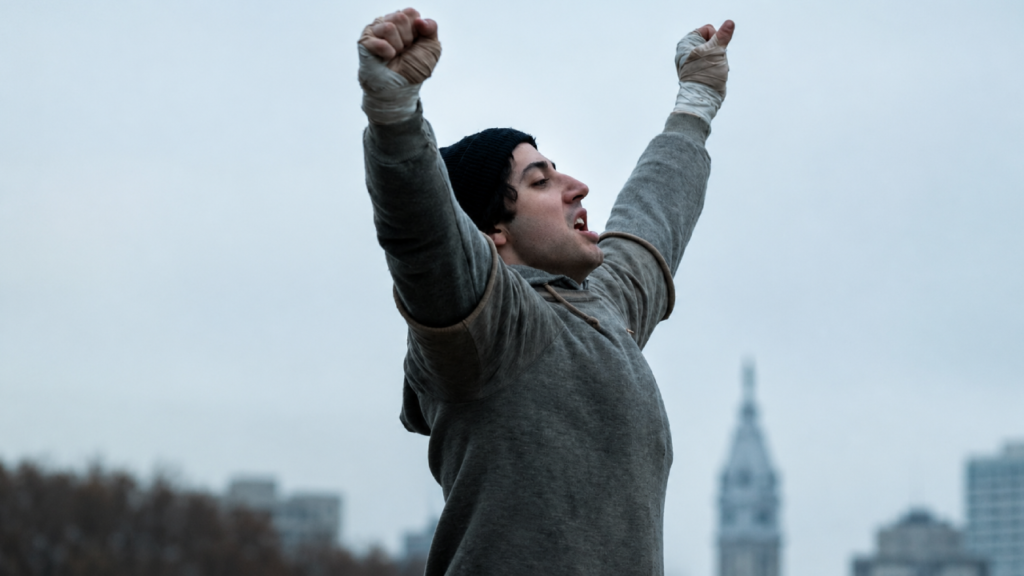
The first trailer for I Play Rocky is finally here, offering audiences a look at the true story behind one of Hollywood’s greatest underdog success stories. Directed by Peter Farrelly, the film stars Anthony Ippolito as a young Sylvester Stallone and follows the difficult journey that led to the making of Rocky in the 1970s. Rather than telling the story of boxer Rocky Balboa, the film focuses on the real struggle Stallone faced before the cameras ever started rolling.
Before Rocky became a global phenomenon, Stallone was a struggling actor trying to build a career in Hollywood. He wrote the screenplay after watching a boxing match between Muhammad Ali and Chuck Wepner, believing it could become his breakthrough. Studios liked the script and were willing to buy it, but there was one condition: they wanted a bigger star to play Rocky.
Stallone refused to sell the script unless he was allowed to play the lead role himself. Despite being offered far more money to walk away from the part, he held his ground. Eventually, producers Irwin Winkler and Robert Chartoff agreed to make the film with Stallone in the lead, a decision that changed his life forever.

The trailer follows Stallone during the toughest period of his career, showing him moving from one rejection to another while trying to convince people to believe in both his script and himself. It captures his determination to keep fighting even when almost everyone around him thinks he should give up.
One of the trailer’s biggest moments comes when Stallone explains why he cannot let somebody else play Rocky. For him, the story is deeply personal, and giving away the role would mean giving up on everything he believed in. The trailer also recreates several moments from the making of the original film, giving fans a glimpse of how Rocky slowly came together against the odds.
Anthony Ippolito leads the film as Stallone after previously playing a young Al Pacino in The Offer. AnnaSophia Robb stars as Stallone’s first wife, Sasha Czack, who supported him during the years before his breakthrough. The cast also includes Stephan James as Carl Weathers, who famously played Apollo Creed in Rocky, while Jay Duplass portrays director John G. Avildsen. Matt Dillon appears as Stallone’s father, Frank Stallone Sr., and Toby Kebbell and P.J. Byrne play producers Irwin Winkler and Robert Chartoff, the men who ultimately backed the project. The film also features Nicholas Podany, Will Harrison, Marcello Hernandez, Lilli Cooper, and Tim Blake Nelson in supporting roles.
I Play Rocky is directed by Peter Farrelly, best known for Green Book, which won the Academy Award for Best Picture. The screenplay is written by Peter Gamble, while the producers include Toby Emmerich, Peter Farrelly, and Anthony Farrell.
The film is backed by Amazon MGM Studios and is scheduled to arrive in theatres on October 30, 2026, just ahead of the 50th anniversary of the original Rocky, which was released in November 1976.
Made on a budget of just under $1 million, Rocky became one of Hollywood’s greatest success stories. The film earned more than $225 million worldwide, won three Academy Awards, including Best Picture, and turned Sylvester Stallone into an international star. It also launched one of cinema’s most successful franchises, followed by multiple sequels and, later, the Creed series.
Instead of revisiting those familiar films, I Play Rocky tells the story that came before all of them—the months when Stallone refused to give up on the role that would change his life forever.
With the first trailer now released, I Play Rocky is set to revisit one of Hollywood’s most inspiring real-life success stories. Rather than focusing on the famous boxer, the film tells the story of the man who refused to give up on the dream that made him a legend.
Read More:
- Spotlight: Making Injustice Heard in a World of Untouchable Power
- Harry Potter and the Question Every Reboot Must Answer
- Good Films Are Often Bad Experiences
- Top 10 Sequels That Elevated Cinema: When Hollywood Got Better the Second Time
- How much does responsibility seep into filmmaking? Or does it at all?