
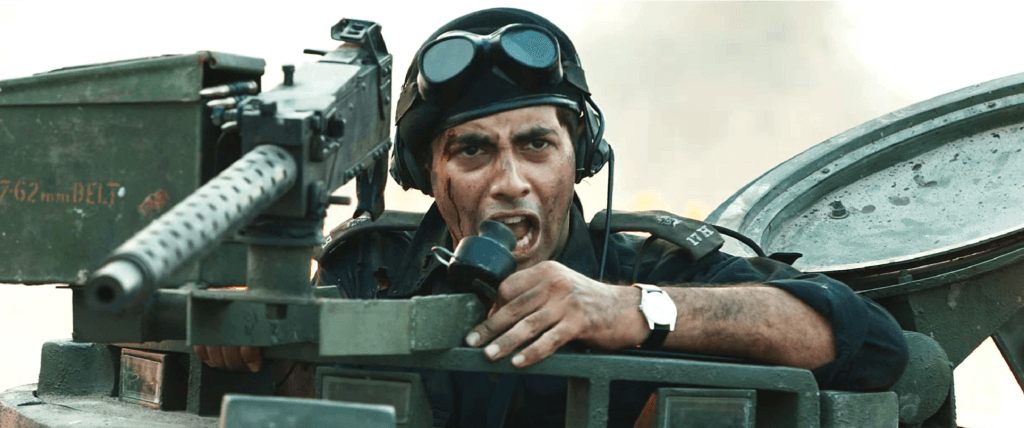
Ikkis arrives with a weight of expectation that very few Hindi films carry into the new year. Directed by Sriram Raghavan, a filmmaker celebrated for his razor-sharp thrillers and morally ambiguous noir, the film marks a decisive shift in tone and subject. Rooted in the real-life story of Second Lieutenant Arun Khetarpal, India’s youngest Param Vir Chakra awardee, Ikkis positions itself as a war drama driven not by spectacle or bravado, but by restraint, memory, and lived emotion. The title itself refers to Khetarpal’s age — 21 — at the time of his death during the 1971 Battle of Basantar, a fact that quietly frames the film’s emotional stakes from the outset. Released theatrically on 1 January 2026, at a time when large-scale patriotic cinema often leans toward loud rhetoric and grand visuals, Ikkis instead steps into cinemas carrying the promise of a more intimate, reflective experience.
Set against the backdrop of the 1971 Indo-Pak conflict, the film charts Arun Khetarpal’s journey from his early years and military training into active combat, gradually building toward the decisive tank battle at Basantar that would define his legacy. Rather than following a linear, battle-to-battle structure, the narrative moves between moments of personal reflection, interactions with fellow soldiers, and the slow accumulation of responsibility that comes with command. The film places equal emphasis on what surrounds the battlefield — family ties, moral resolve, fear, and quiet courage — as it does on the confrontation itself. Combat sequences are present but deliberately restrained, often unfolding through limited vantage points that prioritise the soldier’s experience over large-scale choreography. Reviewers across publications have noted that this storytelling approach establishes early on that Ikkis is less interested in recreating war as spectacle than in examining how it shapes young lives irreversibly.
Across major publications, the critical consensus around Ikkis has leaned largely positive, with an emphasis on its emotional sincerity and resistance to jingoistic excess. The Indian Express, NDTV, Scroll.in, Mint, and Film Information all note that the film avoids chest-thumping nationalism, opting instead for a subdued, reflective register. Several critics describe it as a war film that is quietly anti-war in mood rather than message, drawing attention to its refusal to sensationalise violence or frame conflict in simplistic moral binaries. The absence of overt villainisation and the film’s focus on duty, sacrifice, and consequence — rather than victory — have been repeatedly cited as distinguishing qualities. While opinions diverge on pacing, the broader sentiment across reviews acknowledges the film’s seriousness of intent and emotional discipline.
The most consistent critiques cluster around the film’s narrative structure and measured tempo. Reviewers from Film Information and Times of India have pointed out that Ikkis deliberately resists dramatic spikes, allowing scenes to breathe through silence, pauses, and understatement. This approach, while admired for its integrity, has also drawn criticism from some quarters for creating an episodic rhythm that occasionally disrupts momentum, particularly in the first half. More than one publication observes that the screenplay assumes a degree of historical familiarity, which may leave some viewers wanting additional context around military strategy and the broader political landscape. These reservations, however, are generally framed as trade-offs rather than flaws, arising from the film’s commitment to restraint.
Performances emerge as the film’s most widely praised element. Agastya Nanda’s portrayal of Arun Khetarpal has been consistently described as controlled and sincere, with critics highlighting his ability to convey resolve without leaning into overt heroism. His performance allows the character’s youth and sense of duty to coexist naturally, anchoring the film’s emotional core. Dharmendra’s role, which has been widely discussed in reviews, carries particular significance. Several publications, including NDTV and Bollywood Hungama, note the emotional weight his presence brings to the film, describing it as dignified and deeply affecting. Critics have remarked that his performance adds a generational gravitas to the narrative, lending Ikkis an added layer of poignancy without tipping into sentimentality. Jaideep Ahlawat and the supporting cast are also acknowledged for bringing texture and authenticity to the military environment, avoiding caricature and reinforcing the film’s grounded tone.
Technically, the response has been respectful but measured. The cinematography has been praised for its muted colour palette and observational framing, which complement the film’s reflective sensibility. Battle scenes favour clarity over chaos, allowing geography and movement to remain legible. At the same time, reviewers from Times of India and Mint have pointed out that the background score and songs, composed by Sachin–Jigar, do not always heighten emotional transitions as effectively as expected. Editing, particularly in the mid-section, has been cited as contributing to a slightly uneven rhythm that may test the patience of viewers accustomed to more propulsive war dramas.
A recurring theme in critical discourse is the perceived distance between Ikkis and mainstream audience expectations. Trade observers and reviewers alike note that viewers anticipating a conventional, high-octane war spectacle may find the film’s restraint challenging. Emotional payoffs are cumulative rather than immediate, and the film demands attentiveness instead of offering easy catharsis. This disconnect is not framed as a failure but as a conscious creative choice, with several publications suggesting that Ikkis aligns more closely with prestige historical drama than mass-market war cinema.
Several critics have also singled out Dharmendra’s presence as one of Ikkis’ most emotionally resonant elements, framing it less as a performance showcase and more as a moment of quiet cinematic significance. Publications including NDTV and Bollywood Hungama describe his role as dignified and deeply affecting, noting how his understated screen presence lends the film an added generational weight. Rather than leaning into nostalgia or grandeur, Dharmendra’s performance is marked by restraint, aligning seamlessly with the film’s overall tone. Critics observe that his scenes carry a sense of finality and reflection, reinforcing the film’s themes of memory, duty, and sacrifice without drawing attention to themselves. In a film centred on youth and loss, his presence has been widely read as a bridge between generations, adding emotional gravity that extends beyond the immediate narrative.
Within the broader industry context, Ikkis stands out as an unusual yet revealing entry in Sriram Raghavan’s filmography. Known for tightly plotted thrillers and dark humour, his pivot to a biographical war drama has been described by critics as both surprising and consistent with his aversion to excess. While the genre has shifted, reviewers note that his core strengths — control, precision, and narrative discipline — remain intact, positioning the film as a counterpoint to the current trend of maximalist war spectacles.
Ikkis stars Agastya Nanda, Dharmendra, Jaideep Ahlawat, Simar Bhatia, Vivaan Shah, Sikandar Kher, and Rahul Dev. The film is produced by Dinesh Vijan and directed by Sriram Raghavan, with cinematography by Anil Mehta and music by Sachin–Jigar. Its runtime is approximately 147 minutes.
In closing, the critical consensus around Ikkis recognises it as a sincere, thoughtfully made film that prioritises human experience over spectacle. While its subdued tone and deliberate pacing may not resonate with every viewer, critics largely agree that its emotional honesty, performances, and restraint give it lasting weight as it continues its theatrical run.
Read more POF Review Roundups