
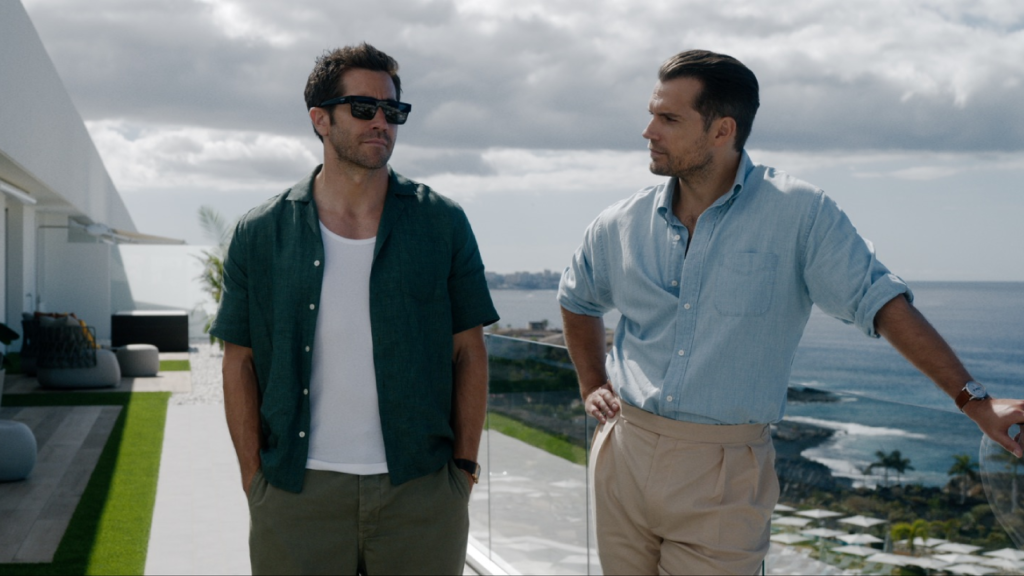
In the Grey Review Roundup: Guy Ritchie’s long-delayed action thriller has finally reached theaters, and critics are divided over whether the film is a stylish, entertaining B-movie or another familiar entry in the filmmaker’s recent run of slick but disposable capers. Starring Jake Gyllenhaal, Henry Cavill, Eiza González and Rosamund Pike, the film arrives with all the usual Ritchie ingredients — sharp suits, clipped banter, elite professionals, shifting loyalties, fast editing and a plot full of double-crosses. But the reviews suggest that those ingredients are working better for some critics than others.
The film follows Rachel Wild, played by Eiza González, a high-end debt collector and fixer who is trying to recover a billion-dollar debt from a dangerous figure. Jake Gyllenhaal and Henry Cavill play elite operatives drawn into the mission, while Rosamund Pike becomes part of the larger power game around the recovery operation. What begins as a stylish debt-recovery mission turns into a Guy Ritchie-style maze of strategy, deception, violence and shifting alliances. The problem, according to several critics, is not that the film has too much plot. It is that the plot often feels more complicated than meaningful.
The overall critical mood around In the Grey is clearly split. Some critics are enjoying the film as polished pulp entertainment — a fast, glossy action caper that delivers enough movement, chemistry and surface pleasure to satisfy viewers looking for a familiar Ritchie ride. Others argue that the film is overbuilt, underwritten and too dependent on the director’s old tricks. The same qualities that make it fun for some — the verbal plans, the swagger, the fractured plotting, the stylish action — are exactly what frustrate others.
One of the more positive responses comes from Benjamin Lee of The Guardian, who describes the film as a bizarrely buried action caper that is more entertaining than its quiet release might suggest. His review sees In the Grey as unexpectedly engaging and even positions it among Ritchie’s more purely enjoyable recent films. For Lee, the film works when it is treated as B-movie entertainment rather than a serious thriller. The action, locations and lead chemistry help carry it through the messier stretches.
That positive reading is important because it shows how the film can work on its own terms. In the Grey does not appear to be aiming for emotional depth or dramatic reinvention. It wants to be sleek, fast and playful. The Guardian’s response suggests that if viewers accept it as a glossy caper built on momentum, style and star presence, there is enough here to enjoy. Even when the story becomes nonsensical, the film’s energy keeps it moving.
RogerEbert.com also finds value in the film’s surface craft. The review points to the things Ritchie’s fans often expect from his work: nimble editing, attractive locations, sharp styling, playful insults, masculine banter and verbal plan summaries cut together with action. This is where In the Grey seems to deliver most reliably. Even critics who are not fully convinced by the story acknowledge that the film has rhythm, polish and sensory appeal.
That craft-focused praise matters because Ritchie’s cinema often depends on texture as much as plot. The suits, rooms, vehicles, locations, weapons, glances and verbal rhythms are part of the entertainment. In In the Grey, those elements appear to be arranged with confidence. The film may not convince every critic on a story level, but it still offers the visual and tonal package associated with Ritchie’s action capers.
ScreenRant also leans toward the positive side, reading the film as Guy Ritchie going back to basics and channeling what he does best. This is a useful way to understand the more forgiving reviews. For some critics, familiarity is not automatically a weakness. If the director is returning to a formula that still has energy, then In the Grey can be seen as comfort-zone filmmaking rather than creative laziness. It gives viewers a version of the movie they expect from Ritchie: stylish professionals, high-stakes money, dry humour and action built around elaborate plans.
Variety places the film within Ritchie’s familiar world of loyalty, masculine codes, grace under pressure, criminal professionalism and stylish action. That reading helps explain why In the Grey feels so recognizably like one of his films. The characters may be working in a slightly different mission setup, but the emotional and moral universe is familiar. Men and women with specialized skills move through dangerous spaces, speak in controlled rhythms, and treat violence as part of a professional code.
This familiarity is both the film’s selling point and its limitation. For viewers who enjoy Ritchie’s usual machinery, In the Grey may feel like a confident return to a known rhythm. But for critics looking for a fresh angle, the same machinery can feel repetitive. The film seems to sit in the middle of that divide: polished enough to entertain, but not distinct enough to fully surprise.
The more negative reviews are much harsher about that limitation. The Hollywood Reporter calls In the Grey a generic Guy Ritchie action thriller and criticizes it for being both ridiculously convoluted and simple-minded. That line captures the central complaint from several critics. The film is not being attacked simply for having a complex plot. It is being criticized because the complexity does not appear to create deeper suspense, sharper characters or stronger emotional stakes.
This is where the film’s structure becomes a problem. A caper can be complicated if every twist adds pressure or pleasure. But when the audience is asked to follow elaborate mechanics without enough character investment, the experience can become tiring. According to The Hollywood Reporter’s response, In the Grey piles on plot movement without giving viewers enough reason to care about the people moving through it.
Vulture gives one of the sharpest negative readings, arguing that Ritchie seems more interested in confusing viewers than entertaining them. The review criticizes the film’s overloaded structure, timelines, lists and plot mechanics, while also noting that the characters remain underdeveloped despite the presence of Jake Gyllenhaal and Henry Cavill. For Vulture, visual panache is not enough when the film lacks emotional connection.
That criticism cuts directly into the film’s biggest risk. In the Grey has recognizable faces, polished style and a high-stakes setup, but critics like Vulture suggest that the movie does not turn those elements into memorable characters or meaningful tension. The audience may understand that the mission matters in financial or strategic terms, but the emotional stakes remain thin.
The Playlist takes a more middle-ground position. Its review describes the film as exposition-heavy, noting that Gyllenhaal and Cavill bring charm but that the movie gets buried under its own machinery. This is perhaps the fairest way to describe the divided response. The film is not without spark. The cast has presence, the action has movement, and the world has polish. But the constant explanation and plot construction appear to weigh it down.
This also suggests that In the Grey may be more enjoyable in moments than as a whole. A scene of banter may work. A burst of action may land. A location may look sharp. But when all of it is tied together by dense plotting and repeated exposition, the film may lose the lightness that makes Ritchie’s best capers enjoyable.
Slant Magazine makes a similar point, calling the film a breezy island-set actioner that eventually chases its own tail. The review suggests that In the Grey begins with the promise of a light, stylish romp but becomes overly dense as the plot piles up. This is one of the most common criticisms across the reviews: the film starts with surface pleasure, but the more it explains itself, the less fun it becomes.
That is a familiar problem for action capers. These films often work best when they feel effortless, even if the mechanics are carefully designed. Once the audience starts feeling the machinery too heavily, the illusion breaks. Several critics seem to feel that In the Grey reaches that point. It wants to be slick, but it also wants to be clever, and the cleverness does not always feel worth the effort.
Still, the common praise across reviews is not insignificant. Critics who enjoy the film point to its slick visual style, attractive locations, fast editing, familiar caper rhythm and ensemble energy. Eiza González, Jake Gyllenhaal, Henry Cavill and Rosamund Pike give the film a strong screen presence, and Ritchie’s sense of surface movement remains intact. The film appears to be at its best when it stops trying to prove the cleverness of its plot and simply behaves like a stylish B-movie.
The common criticism is equally clear. The plot is convoluted. The characters are thin. The cast may be underused. The structure can feel confusing. The exposition is heavy. The emotional stakes are limited. And for some critics, the film feels like Ritchie operating on autopilot. It looks like a Guy Ritchie film, sounds like a Guy Ritchie film and moves like a Guy Ritchie film, but that familiarity does not always translate into freshness.
This is why In the Grey seems to divide critics so sharply. It sits exactly where its title suggests — between stylish entertainment and creative autopilot. For viewers who enjoy Ritchie’s polished caper mechanics, clipped banter, attractive locations and armed professionals moving through elaborate plans, the film may deliver enough. But for critics looking for sharper plotting, stronger character work or a fresher twist on the formula, it falls short.
From a Planet of Films perspective, the most interesting thing about In the Grey is not that it is being called either good or bad. It is that the reviews reveal the limits of style when style becomes too familiar. Ritchie’s filmmaking language is instantly recognizable, but recognition alone cannot create surprise. A director’s signature can be a strength when it feels alive. It can become a weakness when it starts to feel automatic.
The final consensus is that In the Grey is neither a disaster nor a reinvention. It is being received as a slick, familiar Guy Ritchie action caper — entertaining for some, disposable for others. Its best reviews praise its energy, cast chemistry, visual polish and pulp confidence. Its harshest reviews argue that the film is too generic, convoluted and emotionally empty to stand out. In the end, In the Grey may work best for viewers who want the comfort of Ritchie’s usual rhythm, but it seems unlikely to convince those waiting for him to step outside it.
Film: In the Grey
Director: Guy Ritchie
Writer: Guy Ritchie
Cast: Jake Gyllenhaal, Henry Cavill, Eiza González, Rosamund Pike, Carlos Bardem, Fisher Stevens, Kristofer Hivju
Genre: Action thriller / Heist caper
Runtime: 1 hour 38 minutes
Rating: R
Release Date: May 15, 2026
Production Companies: Black Bear, Toff Guy Films, C2 Motion Picture Group
Premise: A high-end debt recovery mission turns into a dangerous Guy Ritchie-style game of deception, violence, strategy and shifting loyalties.

Read More Review Roundups on POF