
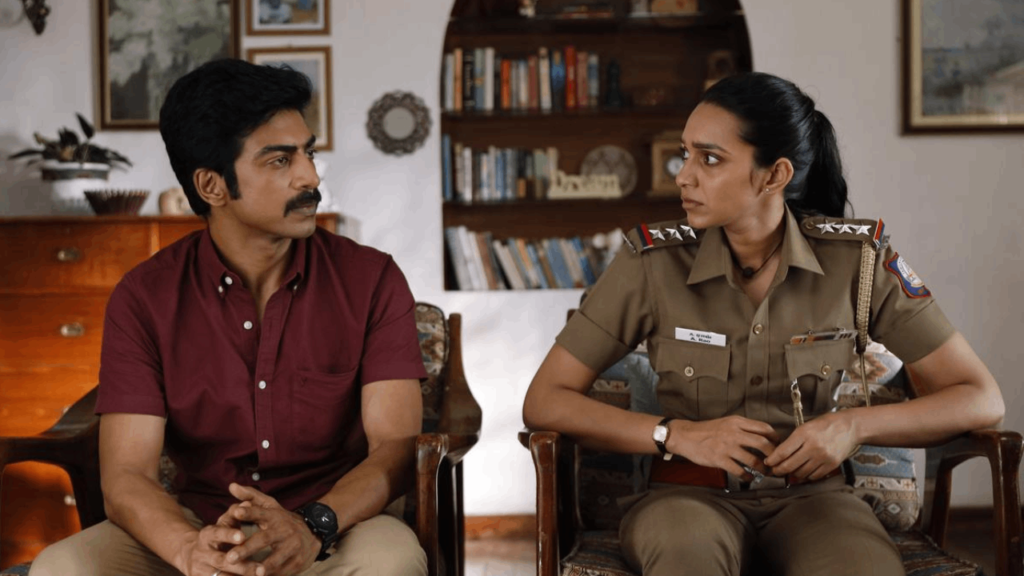
Madhumita’s Tamil crime thriller John Doe, starring Arjun Das and Sanchana Natarajan, has received a mixed response from critics. While its character-driven storytelling, emotional depth and exploration of troubled family relationships have found appreciation, the investigation and final reveal have drawn criticism. Reviewers have particularly recognised the performances and the film’s sensitive treatment of childhood trauma, even as some feel that its conclusion does not fully deliver on the promise of its setup. The film was released in theatres on November 13, 2026.
The story follows Chandru (Arjun Das), a young Kerala Police sub-inspector investigating the death of an unidentified child in Kadampuzha. The case runs parallel to the disappearance of Hriday, a young boy whose mother, Darshana (Srishti Y), has recently moved with her children to Kurinjimedu in Tamil Nadu. Inspector A Rao (Sanchana Natarajan) takes up the missing-child investigation, and the two cases gradually intersect. Alongside the investigation, Chandru struggles with the lasting effects of his late father’s harsh treatment and his own insecurities as a police officer.
Chandru’s characterisation is one of the film’s most appreciated aspects. Rather than presenting him as a conventional, aggressive police officer, Madhumita gives the character a sensitive and vulnerable side. The Hollywood Reporter India’s Vishal Menon highlights this contrast, particularly the way Chandru handles interrogations with patience rather than force. He also appreciates how Arjun Das brings out the character’s caring nature and emotional vulnerability.
The Times of India’s Roopa Radhakrishnan similarly identifies Chandru’s troubled relationship with his father as one of the film’s strengths. His childhood experiences are closely connected to the investigation, giving the character’s personal journey an important place in the narrative. The New Indian Express’s Akshay Kumar also finds Chandru endearing, particularly in his determination to prove himself after years of being made to feel inadequate by his father.
Sanchana Natarajan’s portrayal of Inspector A Rao adds another dimension to the story. The Hindu appreciates the contrasting approaches of the two officers, with Chandru often guided by emotions and instincts while Rao is more forceful and practical. Their partnership becomes an engaging part of the film, with the difference in their investigative methods adding another layer to the proceedings.
However, Rao’s characterisation has also attracted some criticism. The New Indian Express draws attention to unanswered questions surrounding her personality, while The Times of India considers her a familiar police character, despite acknowledging Sanchana Natarajan’s performance. The contrasting responses suggest that while the character contributes to the investigation, her development does not satisfy every reviewer.
Beyond the crime investigation, John Doe explores the need for belonging, validation and acceptance. The New Indian Express appreciates how these ideas influence the motivations of the film’s characters without feeling forced. The emotional concerns are woven into the investigation rather than being treated as separate narrative elements. The publication also praises the atmosphere created by Preetha Jeyaraman’s cinematography, particularly the misty and unsettling setting of Kurinjipadi near the Kerala-Tamil Nadu border.
The film’s quieter emotional moments have also received positive attention. Menon, writing for The Hollywood Reporter India, highlights a mortuary sequence involving parents who are asked to identify a body. He appreciates the way the film gives space to their grief instead of treating the moment merely as a plot device. The Hindu similarly praises the sensitive portrayal of parents coping with the loss of a child and children dealing with trauma. It also draws attention to Chandru’s relationship with his father, which makes the investigation part of his own journey towards understanding himself.
The family dynamics and supporting characters contribute to this emotional foundation. The Times of India appreciates the film’s exploration of interpersonal relationships, although it finds some of the early exchanges between Darshana and her neighbours rather contrived. The Hollywood Reporter India also points out that certain supporting performances and the bilingual dialogue affect the natural flow of some scenes. These observations indicate that while the film’s emotional intentions have found appreciation, the execution is not equally effective throughout.
The film’s biggest challenge, according to several reviewers, lies in its investigative narrative and final stretch. The New Indian Express feels that the screenplay becomes uneven as it approaches the climax. While the motivations behind the crime are considered convincing, the criminal’s explanation of the methods involved makes the final act less plausible. This creates a gap between the emotional groundwork established earlier and the demands of the eventual reveal.
The Times of India also points to logical gaps in the killer’s reveal, arguing that a tighter screenplay and a more convincing climax could have made the film considerably more satisfying. The Hollywood Reporter India is critical of the way important information is delivered, particularly through convenient explanations and an extended information dump. Menon feels that the film gradually loses the strength of its earlier dramatic writing as it moves towards a more conventional thriller.
The Hindu, while more appreciative of the overall experience, also notes that the killer’s identity is predictable, with the pre-interval twist being easier to anticipate. Nevertheless, the publication feels that the film remains engaging because of its sensitive writing and smaller character moments. It also points to certain cinematic liberties in the second half that affect the narrative.
Taken together, the reviews suggest that John Doe is more successful as a character-driven emotional drama than as a tightly constructed investigative thriller. Its strongest moments emerge from Chandru’s personal struggles, the contrasting personalities of the two investigating officers and the film’s treatment of family relationships, grief and childhood trauma. Arjun Das’s performance has been a particular point of appreciation, with critics responding positively to the vulnerability and sensitivity he brings to a police officer who does not fit the conventional mould.
However, the investigation and its eventual resolution have prevented the film from fully realising its potential. The predictable mystery, logical gaps and extended explanations in the final stretch weaken a narrative that otherwise establishes an engaging emotional foundation. While Madhumita’s writing and the performances give the film several memorable moments, a more carefully constructed investigation and a stronger climax could have made the overall experience considerably more satisfying.
Watch Trailer:

Film Details: John Doe
- Director: Madhumita
- Writer: Madhumita
- Cast: Arjun Das, Sanchana Natarajan, Srishti Y, Nirav S, Badava Gopi, Anupama Kumar, Archana Chandhoke and Zaara Vineet Chandhoke
- Producers: Prasad Devineni and Shobu Yarlagadda
- Production House: Arka Mediaworks
- Genre: Crime Thriller
- Language: Tamil
- Runtime: 2 hours 29 minutes
- Certification: UA
- Release Date: November 13, 2026