
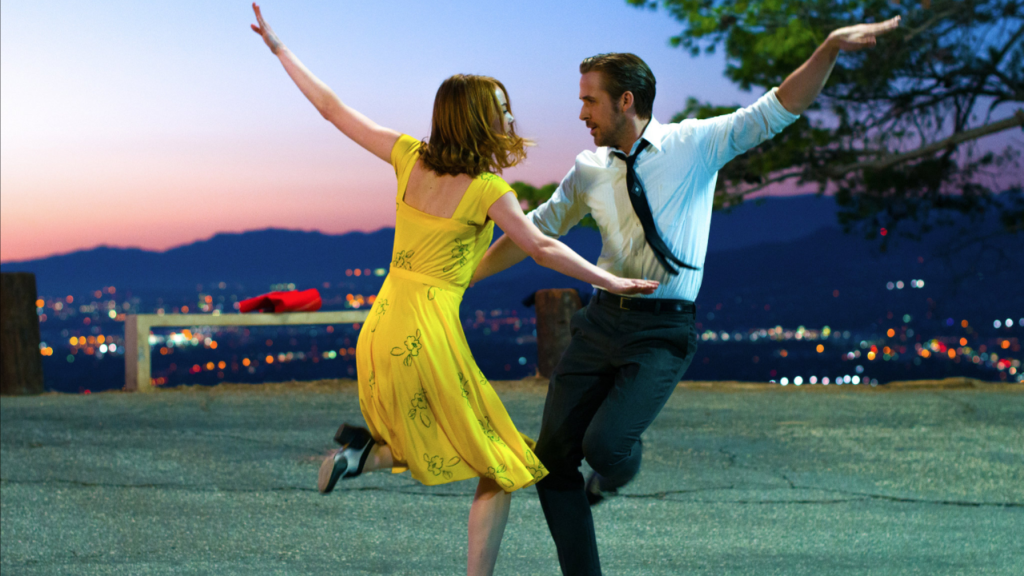
To judge a great film, an unbeatable test of time is to watch it for analysis, maybe about a particular take in the film, or about the entire film, and then have the film make you lose yourself and forget that you were ever analysing it. I think that is where the film wins.
And that’s what La La Land, written and directed by Damien Chazelle, accomplishes.
Every time you hear someone talk about what La La Land is about, the first thing is often, “Two young artists in LA who fall in love and whose dreams intersect, bring them together and tear them apart.” And the story is told through big musical numbers. But the film is about so much more of course.
A feeling that’s intangible, that might feel indescribable even, is shown as a musical, which makes you feel the grandeur of love itself. While the consuming feeling of love enthrals you, the grand fantasy world as a means of telling that love story is what makes it so poignant.
The film is about love, but it is equally about dreams. It is about what happens when two people are deeply in love and yet have things they want to achieve individually. And somehow, the film manages to make both things feel equally important. It never makes their love feel less important because of their dreams, nor does it make their dreams feel less important because of their love.
:max_bytes(150000):strip_icc()/la-la-land2-2000-cdc386889c1a42409110b5c45604429d.jpg "La La Land: A Love That Was Written in the Stars and Yet... 1")
The opening song almost tells you what the entire film is going to be about. Another Day of Sun introduces a city full of people chasing something. Everyone is going somewhere. Everyone has a dream, or at least the hope of one. The traffic is stuck, but the people are not. They are moving, dancing, singing, dreaming.
At the beginning, Mia is looking at herself in the mirror, forlorn and lonely, not quite fitting into the life she is living. There is a weight to it all. The wearing down of constantly trying, constantly auditioning, constantly waiting for something to happen. She wants to be at the centre, to reach there, hence the spotlight. Her song Someone in the Crowd captures this feeling beautifully. She is looking for a place where she can become who she is supposed to be, while also wondering if there is someone out there who will see her and recognise her. It feels like she is talking to her future self. While it can also be perceived as a romantic moment, calling out to an unknown, soon-to-be-met lover or stranger, there is something larger underneath it.
And then, walking home, she finds the sound of music playing. Immediately, the film shifts to Seb’s story.
It is almost as if music is the thread that brings them towards each other before they even know each other. They are as much attracted by love, that invisible string, as they are by music. Rather, their invisible string is music.
The film does not make their first interactions feel like some grand romantic meeting. There is a nonchalance to the way they talk to each other. There is irritation, teasing and denial. There is also an immediate sense that something is there, even though neither of them wants to admit it.
The night scene after the party where Seb in more ways than one rescues Mia says musically something about stumbling upon a view that seems tailor-made for two, only for those two people to be them. You know it in your bones that there’s a ‘might,’ and yet you deny it and run away from it. That is what makes their chemistry work. It isn’t loud. It doesn’t need to announce itself. It reflects and screams onto the screen in the most subtle way.
And what attracts them to each other first is maybe not even romance. It is their love for their own respective arts. They talk about their work. They listen to each other. They motivate each other. They understand what it means to care about something so deeply that it becomes a part of who you are. Instead of their conversations feeling mechanical, they feel like two people genuinely interested in understanding the other person.
Then comes City of Stars. The song carries the uncertainty of what is happening between them. “Is this the start of something wonderful and new, or one more dream that I cannot make true.” The beauty is that the film doesn’t give you the answer immediately.

Their official first date follows at the theatre, and music and love continue to pull Mia and Seb towards each other. The way they hold hands, the entire vibe of the moment. Seb noticing Mia’s hand on her lap, and him very slowly bringing his own closer, and intertwining into each other’s like a lost puzzle piece. It is simple. Almost ridiculously simple. But that is the thing about La La Land. It repeatedly takes the simplest things and gives them the strongest impact. A look. A hand being held. A song. A walk home. Two people sitting together. Nothing needs to be exaggerated because the film has already created a world where these tiny moments feel enormous.
The first kiss is one of those moments where the film’s visual language says everything before the characters do. The composition of the frame, the way the moment is built up, the music, the surroundings, everything comes together. It is not simply about two people finally kissing. It feels like the film itself has been waiting for this moment.
And then comes the montage during summer. Their relationship begins to exist in the little, everyday things. There is no longer the need for every meeting to feel like a date. They are simply together. They sing City of Stars together at home, and suddenly, the song that earlier carried all the uncertainty of what they were becoming now becomes something comfortable.
The film shows love not just through the grand moments, but through the comfort of the everyday. The two of them existing in the same space around each other. And while their love is growing, so are their dreams.
This is where the film begins to complicate what initially felt like a simple love story.
Seb’s job begins taking him away. The band becomes more successful, but the music is not the music he wanted to make. Mia’s play becomes a source of pressure. Their dreams, which once seemed like the thing that brought them together, slowly begin becoming the things that pull them apart.
There is something deeply painful about the fact that their relationship does not end because they stop loving each other. It ends because life begins moving in different directions. That is what makes the ending hurt. If they had stopped loving each other, it would have been easier to accept. But they don’t, and hence, it doesn’t.
The film never tells us that their love was a mistake. It never tells us that they were wrong for each other. In fact, everything we have seen tells us almost the opposite. They were right for each other. They just could not remain together. And that is where La La Land begins to move from being a love story into something much more complicated.
Because what happens when the person you love is also the person who helped you become who you wanted to be? What happens when you get the dream but lose the person you imagined sharing it with? What happens when the two things you wanted most in life cannot exist together?
The film does not really answer these questions. Instead, it shows us.
Years later, Mia has become successful. Seb has built the jazz club he dreamed of. They have both reached somewhere. They have both become the people they wanted to become. But they have done it separately. The moment Seb sees Mia, the film does not need to explain anything. The look says enough.
And then the alternate reality begins.
It is the film asking the question that has probably been sitting inside us the entire time: What if? What if Mia had stayed? What if Seb had chosen differently? What if they had made different decisions? What if they had somehow found a way to have both, the dreams and each other?
The alternate reality is everything their life together could have been. And yet, even here, there is something heartbreaking about it. Because we know it is not real.
The film gives us the fantasy we wanted, only to remind us that it is a fantasy.
And this is where the contrast of La La Land becomes so powerful. The entire world of the film is already far removed from real life. People converse through songs. They dance through the streets. They fly into the air. The colours are brighter than life. The city becomes a dreamscape. Everything tells us that this is a fantasy.
But Mia and Seb not ending up together brings you home. It brings you back to reality. Because in real life, you seldom end up with the one you love. With the one you dreamed a life with. With the one who dreamed for you. Sometimes, you meet the right person at the wrong time. Sometimes, the person you love is the person who helps you reach where you were meant to go, even if they are not the person who stays there with you.
And arguably that is the most beautiful contradiction of La La Land.
The film spends so much of its time convincing us that love is this grand, almost magical thing. It gives us songs, colour, choreography, impossible camera movements and a city that feels like it exists somewhere between a dream and reality. It makes love look larger than life.
But we also understand what was gained.
They both got what they wanted. Seb built the jazz club he had dreamed of. Mia became the actress she had always wanted to be. The dreams they once spoke about, argued about and struggled for are no longer dreams. They are their lives. And there is something beautiful in knowing that the person you loved helped you get there, even if they did not remain beside you. That is why the ending does not feel like a traditional heartbreak. There is sadness, of course. A lot of it. But there is also gratitude.
When Mia and Seb look at each other at the end, there is no bitterness. There is no anger. There is simply an understanding. A recognition of what they were to each other and what they meant to each other. They were once each other’s dreams.
La La Land makes you feel the love that was written in the stars. Even if, in the end, the stars didn’t write them a life together.