
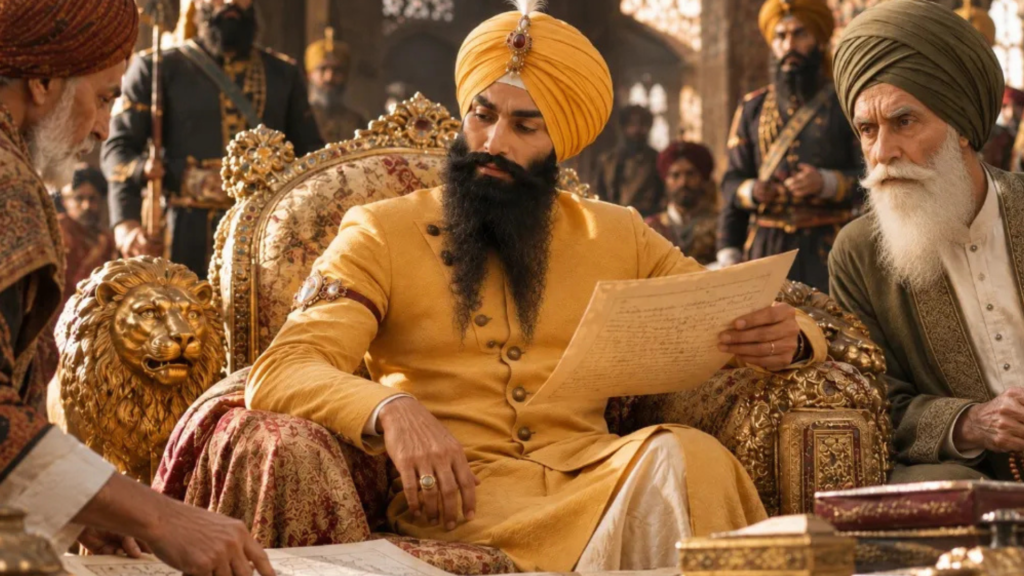
At first glance, Maharaja in Denims might sound like a film using artificial intelligence to recreate a historical ruler. However, its story extends well beyond bringing a king back to the screen. Based on Khushwant Singh’s 2014 novel, the feature follows Hari Sandhu, a young man living in 2008 who experiences connections to three lives across Sikh history: Maharaja Ranjit Singh in the nineteenth century, a victim of Partition violence in 1947 and a victim of the anti-Sikh violence of 1984. Produced by Intelliflicks Studios, the generative AI feature is directed by Balpreet Kaur, with Twenty-Twenty One Studios serving as co-producer. The team is targeting an April 2027 release, around Baisakhi.
These historical periods are not simply settings placed alongside one another. Through Hari’s experiences, the film connects the Sikh Empire with two later chapters marked by upheaval and loss. This gives the story a broader canvas than a conventional biographical film about Maharaja Ranjit Singh, while exploring how events separated by decades can shape the life of someone in the present.
This approach has also influenced the adaptation. Balpreet Kaur selected pivotal episodes from Maharaja Ranjit Singh’s life and incorporated material beyond the novel to give this historical strand greater space on screen. The filmmakers say they have drawn on historical sources, with Khushwant Singh consulting historians to assess the screenplay’s accuracy. They have also made adjustments where the technology struggled to reproduce period clothing. The challenge, therefore, is not simply to generate the past, but to determine how faithfully it can be represented.
The film’s journey to production was far from straightforward. Guneet Monga Kapoor optioned the novel in July 2020, but that version never made it to the screen. The pandemic disrupted cinema-going, while the story’s multiple historical periods called for a substantial production effort. In 2023, technology entrepreneur Gurdeep Singh Pall proposed an AI adaptation after discussing the stalled project with Khushwant Singh in Chandigarh. The two subsequently co-founded Intelliflicks Studios and unveiled the film with a short clip in 2024.
Choosing AI did not eliminate the challenges of building a believable historical world. Production began in 2024 using Midjourney and Runway, before the team moved through Google Veo, Nano Banana, Kling AI and Seedance 2.0. The filmmakers eventually completed their work using tools available on Higgsfield. ChatGPT and Google Imagen also helped develop early character references. Each technological shift brought new possibilities, but it also meant revisiting work that had already been completed.
For a film moving between different eras, maintaining visual continuity became a major challenge. Faces, costumes and rooms must remain recognisable from one shot to the next. Even a small object needs to stay in the same position when the camera angle changes. Khushwant Singh told Variety that the team rebuilt the film’s still images three times as the technology improved, reworking close to an hour of material. He cited the example of a lampshade that had to remain in the same position throughout a scene. Without such consistency, audiences could be pulled out of the story.
The experience also complicates the assumption that using AI automatically makes a film cheaper to produce. Khushwant Singh put the production cost at more than $500,000, excluding marketing. This figure reflects the repeated work required as the tools evolved, rather than serving as a general measure of what an AI-generated feature should cost. When a newer system offered another way to create moving shots from character sheets, the team chose to animate its existing still images instead of starting again.
Despite the technology involved, the production remains guided by human creative decisions. Real actors helped shape early performances through Runway Act-One, while screenwriting, direction, storyboarding and final creative decisions remained with the filmmaking team. Balpreet Kaur retains final creative control, while the music, dubbing and narration were also recorded by human performers.
The filmmakers are targeting an April 2027 release around Baisakhi, although a confirmed release date has not yet been announced. A theatrical release followed by other forms of distribution is being considered.
What makes Maharaja in Denims worth following is the meeting of its subject and its filmmaking approach. The film must make three distinct historical periods feel like parts of a single story, each with its own visual world. Its ultimate test will not be the number of AI tools used in its production, but whether audiences can travel through these chapters of Sikh history and feel the connections that bring them together across generations.