
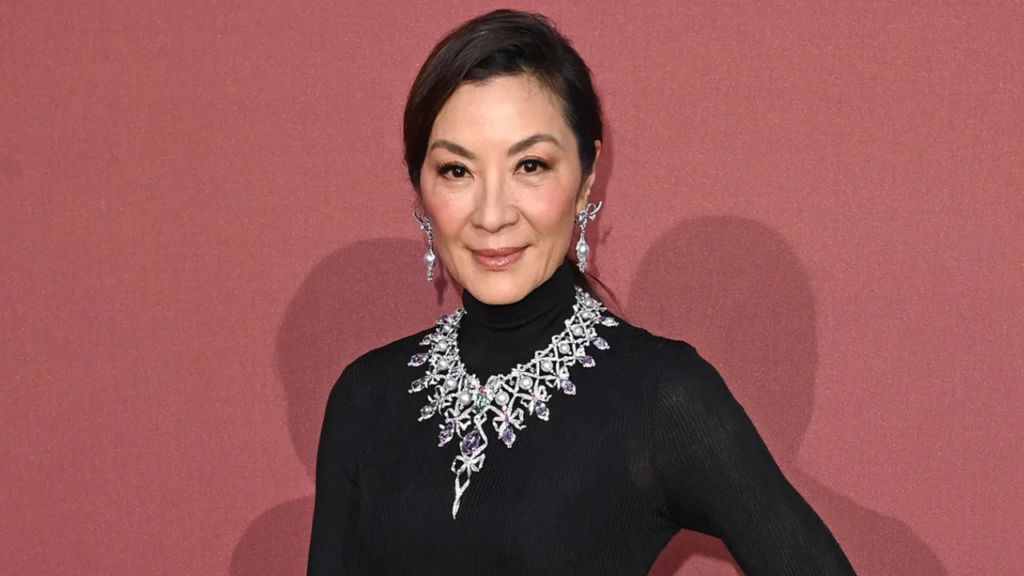
When the 31st Busan International Film Festival opens on October 6, one of Asian cinema’s most celebrated performers will receive one of its highest career honors. Michelle Yeoh has been named Asian Filmmaker of the Year, an award that recognizes artists whose work has made a lasting contribution to Asian and global cinema. For Yeoh, whose career spans four decades and multiple film industries, the recognition feels less like a surprise than a fitting acknowledgment of a legacy that has continually expanded the possibilities for Asian performers on the world stage.
Presented annually since 2003, the Asian Filmmaker of the Year award honors individuals whose achievements have significantly influenced the growth and international recognition of Asian cinema. Previous recipients have included some of the region’s most influential filmmakers and actors, making it one of the Busan International Film Festival’s most prestigious distinctions. Yeoh’s selection reflects not only her remarkable body of work but also the cultural impact she has had across multiple generations of filmmakers and audiences.
Born in Ipoh, Malaysia, in 1962, Yeoh originally trained as a dancer before an injury redirected her ambitions toward acting. Entering Hong Kong cinema during the mid-1980s under the name Michelle Khan, she quickly distinguished herself by performing many of her own stunts at a time when action films remained overwhelmingly dominated by male stars. Her breakthrough performance in Yes, Madam! (1985) introduced audiences to a new kind of action heroine, while films such as Police Story 3: Supercop alongside Jackie Chan and Wing Chun established her as one of Hong Kong cinema’s defining action stars.
As her career evolved, Yeoh expanded her creative ambitions beyond acting. Through her production company, Mythical Films, she helped develop projects including The Touch and Silver Hawk, later serving as a producer on Everything Everywhere All at Once and Star Trek: Section 31. This year, she also joined the Muay Thai drama Nak Muay as an executive producer, continuing her long-standing commitment to supporting stories rooted in Asian talent and filmmaking.
Her filmography charts the evolution of both Asian and international cinema over the past four decades. After establishing herself in Hong Kong, Yeoh successfully crossed into Hollywood with the James Bond film Tomorrow Never Dies (1997), before earning worldwide acclaim in Ang Lee’s Crouching Tiger, Hidden Dragon. She later balanced blockbuster franchises and character-driven dramas through performances in Memoirs of a Geisha, Crazy Rich Asians, Shang-Chi and the Legend of the Ten Rings and Wicked, demonstrating a versatility that few performers have matched.
More importantly, Yeoh became a bridge between two film industries that rarely intersected on equal terms. At a time when Asian actors were seldom cast in leading Hollywood roles, she carried the energy and discipline of Hong Kong action cinema into mainstream American filmmaking while continuing to work in Asian productions. Her career showed studios that international audiences would embrace Asian-led stories and gave a new generation of performers a visible example of what was possible on the global stage.
That influence reached a historic milestone in 2023 when Yeoh won the Academy Award for Best Actress for Everything Everywhere All at Once, becoming the first Asian performer to receive the honor. Beyond its significance as a personal achievement, the victory represented a landmark moment for Asian representation in Hollywood, demonstrating that an Asian actress could lead a globally acclaimed film and receive the industry’s highest acting recognition.
Awards alone, however, do not define Michelle Yeoh’s legacy. Her greatest contribution has been expanding opportunities for Asian actors, elevating Asian-led productions and proving that action stars can combine extraordinary physical ability with emotional depth. She has built a career that moves effortlessly between continents, languages and genres without losing sight of the stories she wants to tell or the communities she continues to represent.
As Busan prepares to honor Michelle Yeoh this October, the award recognizes far more than four decades of remarkable performances. It celebrates an artist who helped reshape global perceptions of Asian cinema, opened doors for generations of actors and demonstrated that Asian stories belong not at the margins of world cinema, but at its very center.
Read More:
- Spotlight: Making Injustice Heard in a World of Untouchable Power
- Harry Potter and the Question Every Reboot Must Answer
- Good Films Are Often Bad Experiences
- Top 10 Sequels That Elevated Cinema: When Hollywood Got Better the Second Time
- How much does responsibility seep into filmmaking? Or does it at all?