
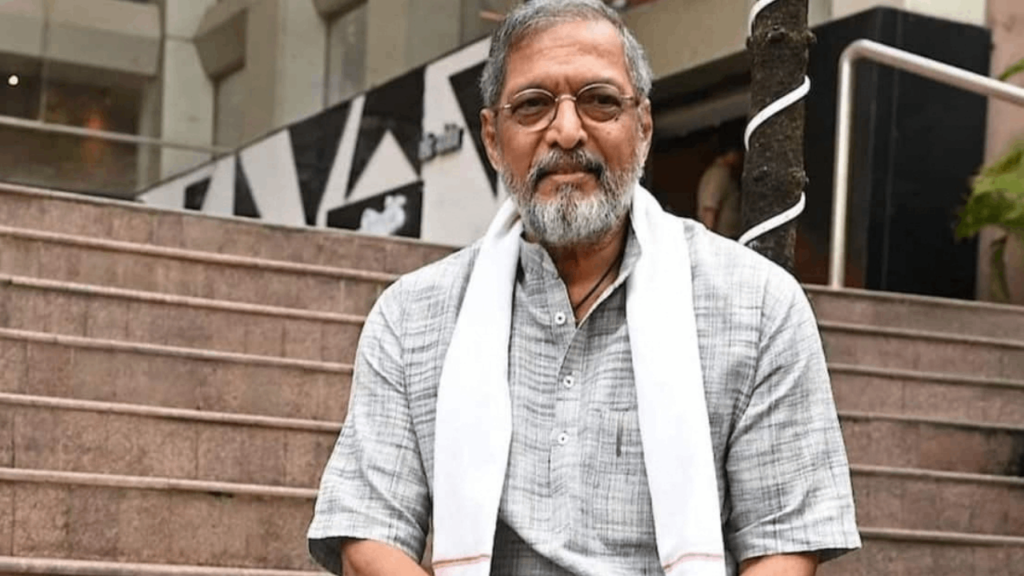
For generations of Indian audiences, Nana Patekar was more than an actor they watched on screen. He was an actor they felt they knew. He had a way of making audiences listen, whether through a line, a pause, a look or simply the way he held himself in a scene. His performances stayed with people because they felt lived-in, never distant from the emotions of the characters he played. For generations of Indian film audiences, his voice and presence became familiar in a way few actors manage to achieve.
On Thursday, October 8, 2026, that familiar presence was lost. Nana Patekar died at 75 after suffering a cardiac arrest at his residence in Goa. His son, Malhar Patekar, confirmed the news, while Dr. Shekhar Salkar of Manipal Hospital said attempts to revive the actor with CPR for around 45 minutes were unsuccessful.
Born Vishwanath Patekar, he came to cinema through theatre and made his screen debut with Gaman in 1978. There was little about the journey that followed that resembled the usual path of a Hindi film star. He did not need the traditional image of a hero. His strength was character. Give him a complicated man, a few sharp lines and enough space inside a scene, and he could make that character difficult to forget.
That quality became impossible to ignore with Parinda. As Anna, Nana Patekar did not play a gangster through loud gestures alone. There was calculation beneath the anger and a disturbing stillness beneath the violence. His performance won the National Film Award for Best Supporting Actor and announced an actor who could make menace feel painfully human.
Then came Pratap Narayan Tilak in Krantiveer, one of the performances that became inseparable from his name. The character’s anger was loud, but the performance was more than anger. Nana Patekar gave Tilak frustration, hurt, humour and a sense of a man trying to find his place in a world he no longer trusted. The performance earned him the National Film Award for Best Actor and a Filmfare Award for Best Actor.
But his career was never simply about playing angry men. In Agni Sakshi, he explored darker psychological territory and won another National Film Award for Best Supporting Actor. In Khamoshi: The Musical, as Joseph Braganza, he found emotion in restraint. The performance did not need the volume associated with some of his earlier characters. It showed another side of an actor whose greatest strength was perhaps knowing exactly when not to push a scene.
That understanding of performance followed him into Ab Tak Chhappan, where Sadhu Agashe was almost the opposite of the explosive characters audiences had come to expect. The policeman’s authority came through control. His silences mattered. His exhaustion mattered. Even his smallest reactions seemed to carry a history.
And then Nana Patekar did something that could easily have become a career-defining joke. He became Uday Shetty in Welcome.
The transformation was extraordinary because he did not abandon the qualities that had made him a dramatic actor. He brought the same pauses, stare, seriousness and sudden eruptions of anger into comedy. The result was a character that belonged to an entirely different cinematic world but still felt unmistakably like Nana Patekar. For younger audiences, Uday Shetty became their introduction to him. For older audiences, it was another reminder of how much he could do.
His connection with Marathi cinema revealed yet another dimension. In Natsamrat, Nana Patekar played Ganpatrao Belwalkar, a celebrated stage actor confronting loneliness, family and the fading of a life built around performance. It was a role that seemed to bring his theatre roots back to the centre of his cinema. His work in the film earned him the Filmfare Award for Best Actor in Marathi.
Theatre remained an important part of that foundation. So did his work behind the camera. With Prahaar: The Final Attack, Nana Patekar stepped into directing while also acting in the film. His career also extended into social work, including his involvement in initiatives connected with farmers and rural communities.
Over the decades, recognition followed him. Nana Patekar won three National Film Awards, received multiple Filmfare honours and was awarded the Padma Shri in 2013 for his contribution to the arts. But awards alone cannot explain his place in Indian cinema.
For one generation, he remains Anna. For another, Pratap Narayan Tilak. Some remember Sadhu Agashe, some Ganpatrao Belwalkar, and an entirely different generation remembers Uday Shetty. The characters changed. The worlds changed. His ability to make audiences stop and watch did not.
Perhaps that is the simplest way to remember Nana Patekar. Not through a number of films or awards, but through the moment when he entered a frame and something shifted. A voice became a warning. A pause became a feeling. A stare became a conversation. And sometimes, a serious actor made an entire theatre laugh.
The scene eventually ended. The film moved on. Nana Patekar remained.