
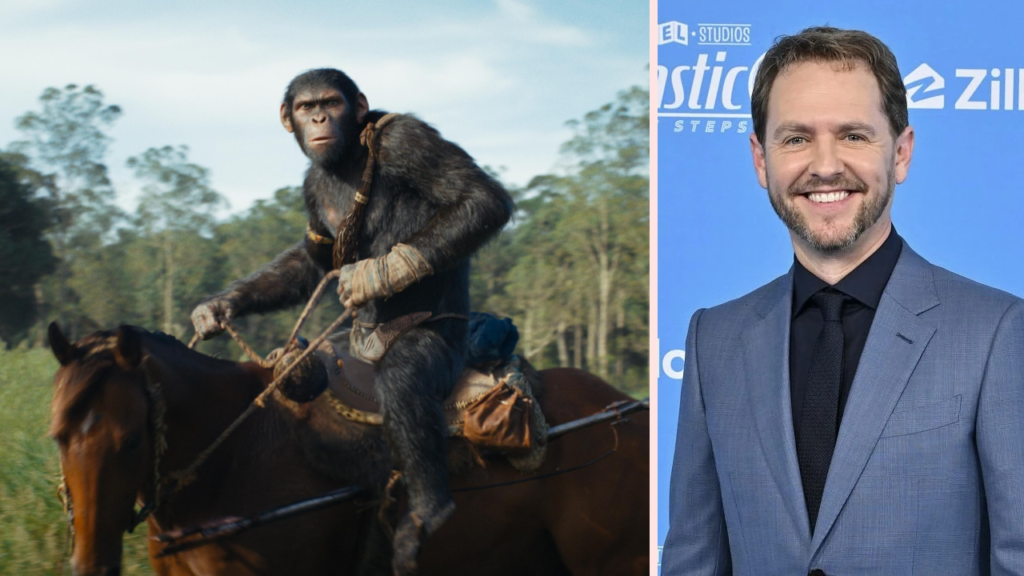
20th Century Studios is officially returning to the world of Planet of the Apes with a brand-new Planet of the Apes movie now in development, and the studio appears to be betting on one of Hollywood’s most in-demand blockbuster directors to lead the next phase of the long-running sci-fi franchise. Matt Shakman, who recently directed The Fantastic Four: First Steps for Marvel Studios, has been tapped to helm the new feature for 20th Century Studios.
The project will reunite Shakman with screenwriter Josh Friedman, who previously co-wrote Kingdom of the Planet of the Apes and also worked on large-scale 20th Century productions such as Avatar: The Way of Water and Avatar: Fire and Ash. Producers Rick Jaffa and Amanda Silver, both key creative forces behind the modern Apes reboot saga, are also returning for the new film.
Deadline first reported Shakman’s hiring, with the news later confirmed by multiple industry publications including The Hollywood Reporter and Variety. While official plot details remain under wraps, one of the biggest surprises surrounding the announcement is that the project is reportedly not being positioned as a direct sequel to Kingdom of the Planet of the Apes, despite the 2024 film setting up several possible story continuations.
That detail has immediately sparked speculation about the future direction of the franchise. Instead of continuing a strictly linear storyline, 20th Century may be exploring a more flexible approach to the Planet of the Apes universe — potentially expanding the mythology through standalone narratives, different timelines or entirely new ape and human conflicts. It marks an interesting shift for a franchise that has historically balanced blockbuster spectacle with political allegory and emotionally driven storytelling.
The modern Apes era began with Rise of the Planet of the Apes in 2011 and evolved into one of Hollywood’s most critically respected blockbuster franchises through Dawn of the Planet of the Apes, War for the Planet of the Apes and most recently Kingdom. Across four films, the rebooted franchise has grossed more than $2 billion worldwide while maintaining unusually strong critical reception for a major studio sci-fi series.
Although Kingdom of the Planet of the Apes did not reach billion-dollar blockbuster status, the film still emerged as a solid global performer with nearly $400 million worldwide and strong audience reception. The film’s visual effects work also continued the franchise’s reputation for technical excellence, earning praise for its motion-capture performances and large-scale worldbuilding.
Shakman’s involvement also says a great deal about how Disney and 20th Century currently view the property. Over the last few years, Shakman has quietly built a reputation as one of the industry’s strongest genre storytellers through projects like WandaVision and Monarch: Legacy of Monsters. His work often combines emotional storytelling with large-scale mythology and character-driven spectacle, making him a natural fit for the morally layered world of Planet of the Apes.
What separates Planet of the Apes from many other blockbuster franchises is that its appeal has rarely been based on action alone. The modern films have consistently explored themes such as power, fear, survival, social collapse and coexistence between species. Even at its most visually ambitious, the franchise has remained rooted in emotional conflict and political undertones. That balance between spectacle and thematic depth is likely part of the reason 20th Century is continuing to invest heavily in the property.
The announcement also reinforces Disney’s growing commitment to maintaining 20th Century’s legacy sci-fi brands as active long-term franchises. Alongside Avatar, Alien and Predator, Planet of the Apes remains one of the studio’s most recognizable global science-fiction properties. But unlike many nostalgia-driven reboots, the Apes franchise has managed to evolve creatively with each new chapter instead of simply repeating older formulas.
That may ultimately be the most interesting aspect of this new film. Rather than rushing toward a conventional sequel, 20th Century appears interested in keeping the franchise creatively open-ended. In an era where many blockbuster universes are struggling with repetition and franchise fatigue, Planet of the Apes continues to position itself as one of the few studio sci-fi properties still capable of reinvention.
Matt Shakman’s hiring suggests the studio is not simply making another sequel. It is attempting to preserve the franchise’s identity as prestige science fiction — blockbuster filmmaking that still prioritizes character, ideas and thematic ambition alongside spectacle.
Read More: