
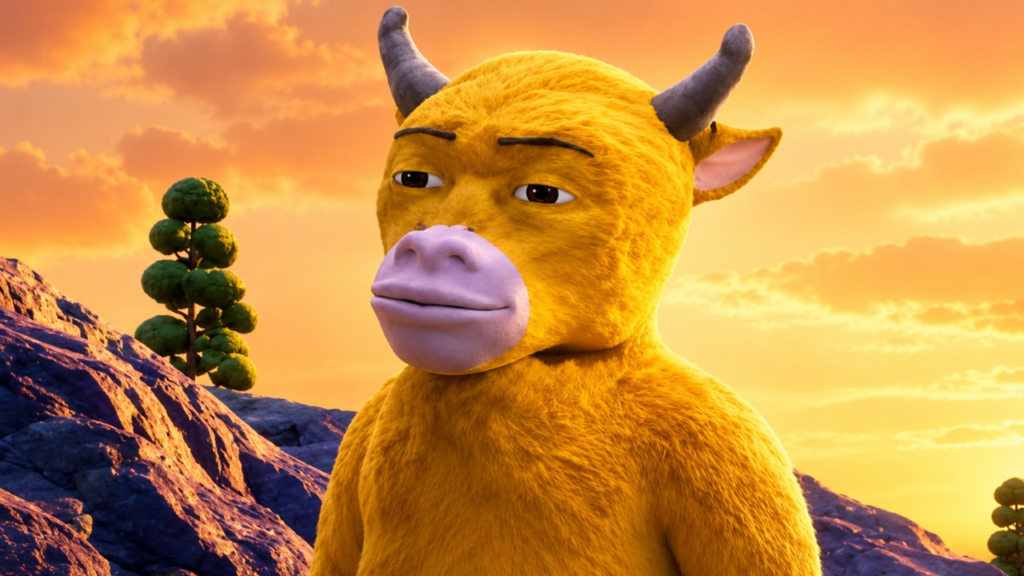
A film that barely registered at the Chinese box office is suddenly one of the country’s most unusual cinema stories. Released on August 5, 2026, the animated feature Niu Lai, also known as The Bull Comes, began with almost no conventional promotion and a disastrous first 10 days, earning around ¥7,700 ($1,145) from fewer than 300 tickets, according to local media reports.
The story behind that rise begins with the people who made it. Niu Lai is an 86-minute animated feature made over five years by director Xin Yumeng and his mother, Sun Lifang. They worked with extremely limited resources, handling the production themselves. The film has drawn attention because of its handmade approach and rough visual style, which audiences have contrasted with the polished, AI-assisted and CGI-heavy productions dominating the market.
Niu Lai reached cinemas without the usual machinery behind a major release. Reports say there was little conventional promotion, with no major trailer campaign or extensive publicity effort. Its early lack of visibility was therefore not surprising. But those same qualities later gave people a reason to talk about it.
At its centre, Niu Lai follows a newborn calf on a journey involving friendship, courage and loss as the herd faces danger while searching for greener pastures. The film’s basic animation, slow dialogue and unusual storytelling soon became the subject of widespread online discussion.
The mockery did not simply disappear after the first wave of jokes; it made the film more visible. Memes and social media posts created a simple question for many people: Is it really as unusual as everyone says? Audiences began buying tickets to find out for themselves. Online attention started becoming real theatrical attendance, giving cinemas a reason to add more screenings.
The response was also more complicated than a simple “so bad it is good” story. Some viewers continued to ridicule the film, while others responded to its sincerity, independence and the effort behind a feature made by such a small team. For some, watching Niu Lai became less about judging polished animation and more about taking part in a shared cultural moment.
That rise has unfolded during a competitive Chinese summer box office, with much larger releases including Spider-Man: Brand New Day. Against productions backed by major studios, large budgets and established promotional campaigns, Niu Lai’s sudden visibility stands out. By August 18, reports had placed its total at ¥17.1 million ($2.5 million), while Reuters reported on August 20 that the film had passed $4 million as its momentum continued.
The film’s turnaround has been remarkably fast. After earning only around ¥10,000 ($1,480) during its first 10 days, it reportedly grossed ¥8.2 million ($1.2 million) in a single day on August 17, according to Maoyan figures cited by AP.
Curiosity, memes, discussion and the desire to experience the same strange cultural event as everyone else helped drive people into cinemas. Its success demonstrates how attention can come from places no distributor, advertiser or conventional release strategy can fully control.
It began as an almost unnoticed release, stumbled through an extraordinarily poor opening and was pushed into public view by criticism rather than conventional promotion. What followed was an unexpected theatrical comeback built on attention that no standard marketing plan could have easily predicted. Niu Lai may not offer a formula for making a hit, but its journey shows that when online conversation and cinema-going curiosity meet at the right moment, audiences can still take a film in directions nobody expected.
Read More: