
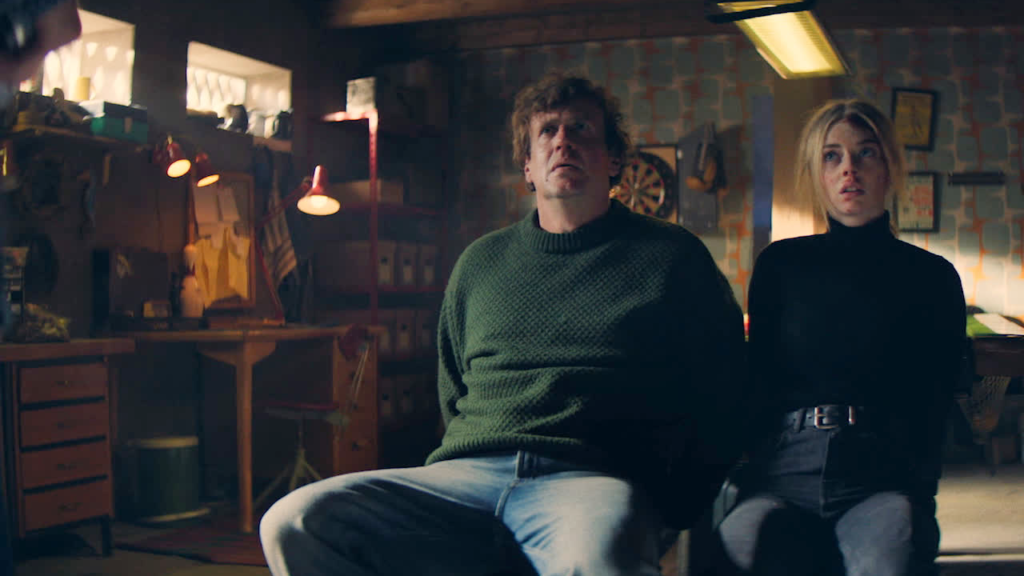
There’s a certain kind of dark comedy that thrives on discomfort — where relationships curdle, morality dissolves, and violence becomes the punchline. Over Your Dead Body builds itself entirely around that idea, turning a failing marriage into a literal game of survival, with both partners secretly plotting each other’s death. It’s a premise that instantly caught critics’ attention — bold, twisted, and full of potential. But as Over Your Dead Body reviews rolled in, the response revealed a film that intrigues more than it satisfies.
Critics largely agree that the central idea works. The film’s take on marriage as a battleground — both emotional and physical — gives it a sharp, satirical edge. The Los Angeles Times describes it as “a twisty yet underwhelming dark comedy that views marriage as both a hyperviolent blood sport and a battle to the death,” a line that neatly captures both its ambition and its limitation. The The New York Times echoes this perspective by framing the story as an “unholy matrimony,” suggesting that the film is less about romance and more about dismantling it entirely. The hook is undeniable — but sustaining it proves to be the challenge.
Where the film finds more consistent praise is in its performances. Samara Weaving, in particular, emerges as the standout, bringing a chaotic, physical intensity that aligns perfectly with the film’s tone. Jason Segel plays against that energy with a more restrained presence that gradually opens up as the narrative unfolds. The Los Angeles Times observes that the two leads become “much more winning once their characters start warming to one another,” suggesting that the film’s strongest moments come not from its violence, but from the shifting dynamic between its central pair. Even critics who found the film frustrating tend to agree that the performances give it a pulse.
There are also flashes where the film delivers exactly what it promises. Some critics embraced its willingness to lean into absurdity and gore without hesitation. Nerdist calls it “murderous good fun,” while Awards Radar describes it as “a funny and surprisingly gory black comedy,” both acknowledging that the film commits fully to its darkest instincts. Rolling Stone similarly suggests that viewers open to its chaotic storytelling and violent humor may find it entertaining, especially in its more unhinged stretches. For moments at a time, the film works — and when it does, critics admit it can be sharply enjoyable.
But those moments don’t last. A consistent thread across reviews is that the film quickly runs out of ways to escalate its own ideas. The violence, initially shocking, begins to feel repetitive rather than inventive. The Los Angeles Times delivers one of the most pointed critiques, noting that “once you’ve seen one pulverized face, you’ve seen them all,” underlining how the film’s reliance on gore eventually dulls its impact. What starts as bold quickly becomes predictable, and the humor loses its edge along the way.
That loss of momentum ties directly into the film’s tonal imbalance — perhaps its most frequently cited flaw. Dark comedy depends on precision, and here the balance never quite settles. Vulture captures the experience succinctly as “fun until it isn’t,” pointing to a mid-film drop in energy where the jokes stop landing as effectively. Spectrum Culture notes that while the screenplay aims for “the blackest variety” of humor, it rarely moves beyond surface-level shock. Meanwhile, InBetweenDrafts describes the film as “sloppy, but funny,” a phrase that encapsulates the inconsistency that defines much of its reception. The film isn’t devoid of humor — it just struggles to sustain it.
The writing itself becomes another sticking point. While the premise suggests something sharper, critics argue that the characters never develop enough depth to support the narrative. Mashable goes as far as calling it “a comically bad romance,” pointing to the lack of emotional grounding between the leads. IndieWire labels the film a “misfire,” suggesting that its mean-spirited tone ultimately works against its comedic ambitions. Without stronger character work, the film’s escalating chaos begins to feel hollow rather than engaging.
Director Jorma Taccone approaches the material with visible energy, but critics remain divided on whether that energy translates into control. The Los Angeles Times refers to the filmmaking as “gleeful excessiveness,” a description that captures both its appeal and its limitation. The film pushes itself further with each sequence, but rarely in a way that deepens its impact. Instead, it becomes louder rather than sharper, bigger rather than better.
What ultimately defines Over Your Dead Body is that sense of almost. There’s a compelling idea at its core, performances that hold attention, and moments where the film genuinely clicks. But those elements never fully align. Critics see a film that understands its potential, gestures toward it repeatedly, and then drifts away from it just as often.
The consensus, across publications, lands in a similar place. It’s a bold concept anchored by committed performances, but one that struggles under the weight of uneven writing, repetitive execution, and an unstable tone. A dark comedy that comes close to finding its edge — but never quite cuts deep enough.
Film Info:
Over Your Dead Body | Director: Jorma Taccone | Cast: Jason Segel, Samara Weaving | Genre: Dark Comedy, Action | Based on: The Trip (2021) | Release: 24 April, 2026 | Critical Reception: Mixed to Negative

Read More Review Roundups on POF