
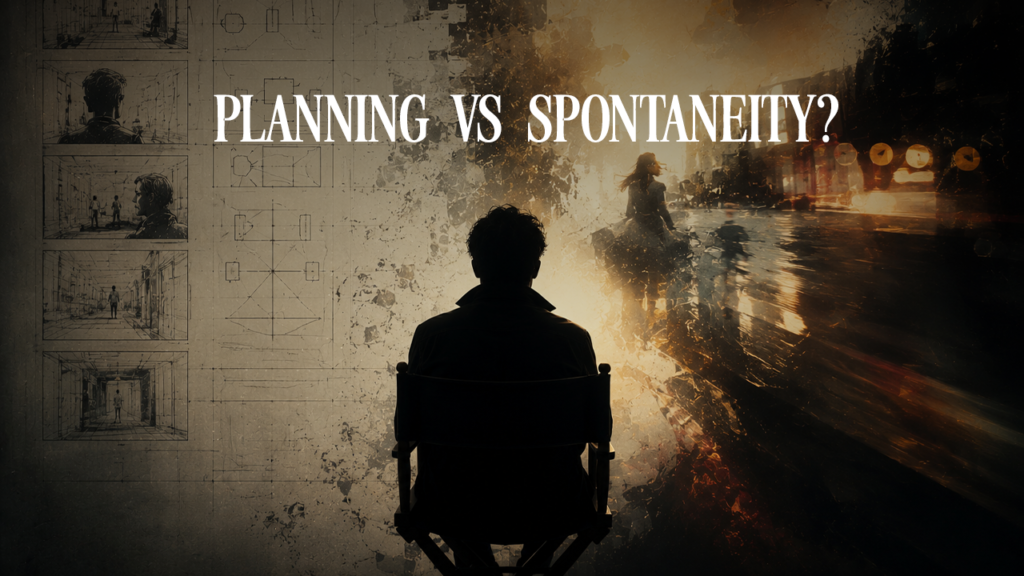
Is spontaneity your friend or foe?
We often romanticize the idea of not having a plan. The best trips are the ones you didn’t plan. The best outings are the ones where the itinerary doesn’t exist yet. Because then you explore. And what you discover often lies beyond imagination. What hasn’t been imagined yet, that’s where the magic happens.
And in more ways than not, filmmaking process shares that same spirit. But here’s where it gets complicated, or you could say… different.
Step by step filmmaking process, while deeply creative, is also deeply technical. Pre-production isn’t just helpful, it’s foundational. Everything that goes on set ideally needs to be decided beforehand like shot divisions, blocking, look and feel of each scene, lighting setups, production logistics. The sheer scale of coordination demands structure. Without it, things don’t just get chaotic, they become expensive.
Because on a film set, time is money. Every minute is accounted for, and every delay has a cost. When you’re working within a limited budget, and most productions are, you don’t have the luxury to “figure things out” endlessly on set. You’re racing against the clock. That’s why preproduction planning becomes less of a preference and more of a necessity.
In that sense, spontaneity can feel like a privilege.
The freedom to experiment, to change things on the day, to discover moments organically, it often comes when you have the time and financial cushion to allow for it. Without those, structure becomes your safety net. And yet, despite all of this, many filmmakers resist the idea of rigid planning. Because cinema, at its core, is still an art form. And art doesn’t always behave.
As Martin Scorsese puts it, “There’re some miraculous things that happen by accident.” That unpredictability, the things you couldn’t have planned, can sometimes elevate a scene beyond what was ever written on paper.
Todd Phillips advocates this fluidity, “Making movies is jazz, it’s not math. There’s not ‘a way’ to do it. You prep and you do it, but then you come on set and it might just change on a day.”
So, where does that leave us in the debate between Planning Vs Spontaneity?
Some directors walk onto set with a plan, but hold it loosely. Fernando Meirelles, the director of The Two Popes, said, “I have a plan when I go to the set but then whatever happens, I have an opportunity to make it different and change the script.” The plan becomes a starting point, not a constraint.
Others believe that structure itself enables freedom. Talking about Marriage Story, Noah Baumbach explained: “The dialogue is all scripted. The overlaps are scripted. Where people come in, in the middle of the line, we block it all very particularly. For me, I find that creating these parameters actually gives freedom, and I think the actor would refer to it as improvisation because it’s not new lines but it’s freedom.”
So even within control, there is room for spontaneity.
And sometimes, it’s the unexpected obstacles that unlock something better. Joe Wright said, “Always, the obstacle gives you solutions that you find are far more interesting and better.” Greta Gerwig reinforces this idea, “I knew that when things came up that were problems or difficulties or something went awry, that that was not a deviation from the path, that that was the path.” Guillermo del Toro builds on it further, “That’s a buddhist saying, ‘the obstacle is the path.’”
In other words, unpredictability isn’t the enemy, it’s part of the process.
But it would be misleading to say that planning doesn’t matter. In fact, many filmmakers argue the opposite. Greta Gerwig also said, “I feel deeply that movies are made in prep. By the time you’re on set, it’s too late. I feel quite vividly that every second you spend doing one thing is the second you don’t spend doing something else.”
This isn’t a contradiction, it’s balance.
Preparation gives you clarity. It gives your team direction. It allows you to use your time efficiently. But improvisation on set gives you life. It allows moments to breathe, evolve, and sometimes become something better than what was imagined.
So, is spontaneity in filmmaking your friend or foe?
It’s both. And it’s neither.
There is no single way to make a film. Every director works differently. Every actor responds differently. Every crew operates within different constraints. Some films thrive on meticulous planning; others find their voice in chaos. And sometimes, a film needs both.
What ultimately matters isn’t the method, but the result. The story you’re telling. The world you’re creating. The emotions you’re able to evoke. Whether that comes from a tightly structured plan or a moment of pure accident is entirely up to you.
Because in filmmaking workflow, just like in life, there isn’t a “right” way, only the way that works.
Read More: